Category: Machine Learning

  • Top 10 Beginner-Friendly Machine Learning Resources

    Discover beginner-friendly machine learning resources that provide clarity, practice, and progression. Start your journey with the best tools and knowledge.

    Top 10 Beginner-Friendly Machine Learning Resources

    Discover the best resources for starting your machine learning journey.

    This list is deliberately mixed: courses, a book, bite-size tutorials, project platforms, and a couple “stay current” feeds. I picked them because they do three things well for beginners: they explain ideas without haze, they make you write code (even when you don’t feel ready), and they fit into a sensible progression.

    I’m also not treating this as a popularity contest. The selection criteria are simple: (1) beginner access (you can start today), (2) clarity (few hidden prerequisites), (3) practical value (you touch data and measure something), (4) credibility (the material isn’t random), and (5) progression (it points to a next step instead of dumping you into the deep end).

    1) Coursera (structured fundamentals)

    If you need a handrail, start here. A good Coursera sequence gives you the “why” and the “when” for common models, and because it’s linear, you don’t waste a week bouncing between tabs.

    That said, the common beginner mistake is treating video progress like skill. So, as you go, pause after each concept (say, overfitting, regularization, train/test split) and write a two-sentence explanation in your own words. Then try to predict what would happen if you doubled features or cut your dataset in half. When your prediction is wrong, you just learned something real.

    2) Google Machine Learning Crash Course (fast, applied, no fluff)

    Google’s Machine Learning Crash Course is the one I point to when someone says, “I get the theory, but I still don’t know what to do.” It tends to move quickly, so you’ll feel productive early, which matters when motivation is shaky.

    Don’t rush the exercises. Instead, run them twice: first time following along, second time with one intentional change—swap a feature, change the learning rate, or alter the evaluation metric. Even tiny edits teach you cause-and-effect.

    3) Kaggle Learn (guided practice that actually sticks)

    Kaggle Learn is great because it forces reps. You’ll write code, load datasets, build simple models, and see results without having to set up a whole environment. Beginners need this kind of immediate feedback.

    The trap: people jump straight into competitions and get crushed by feature engineering they’ve never seen. Use Kaggle Learn first, then pick a beginner-friendly dataset and aim for “works end-to-end,” not “top 5%.” A functioning baseline is a win.

    4) Machine Learning for Dummies (plain-English mental model)

    This is the book I recommend when someone keeps getting lost in jargon. A readable book slows you down in a good way, because you can re-read a paragraph without rewinding a video 12 times.

    Use it like a translation layer: read a chapter, then map its terms to what you see in code. “Features” become columns. “Labels” become your target variable. “Training” becomes .fit(). That little mapping exercise reduces a ton of friction.

    5) Short Python + NumPy/Pandas refreshers (the hidden prerequisite)

    Most “ML is hard” moments are actually “my data wrangling is slow.” A short, focused refresher on Python basics, NumPy arrays, and Pandas operations pays off immediately.

    Keep it practical: practice selecting columns, handling missing values, converting types, and doing a quick groupby. Then, when an ML tutorial asks you to clean a dataset, you won’t freeze.

    6) scikit-learn tutorials (the everyday toolkit)

    If you’re learning ML for work, scikit-learn is the day-to-day reality for classic models. Tutorials here teach you the real workflow: split data, build a pipeline, train, validate, then iterate.

    Common mistake: training on data leakage without realizing it. If you compute something using the full dataset (like scaling or imputation) before splitting, you’ll get suspiciously good scores. So, learn pipelines early—they prevent “accidentally cheating.”

    7) A small project template (one notebook, one goal)

    Beginners don’t need a “capstone.” They need a tiny project with a clear finish line. One notebook. One dataset. One target. One metric.

    For example: predict house prices, detect spam, or classify sentiment. The goal is not the fanciest model. The goal is to practice the loop: define the problem, create a baseline, improve it once or twice, then explain what went wrong.

    8) Model evaluation explainers (metrics without pain)

    Evaluation is where beginners get misled. Accuracy is not magic, and in many real datasets it’s the wrong metric.

    Look for resources that teach confusion matrices, precision/recall, ROC-AUC, and basic cross-validation using concrete examples. Then, apply that learning immediately by re-evaluating your own toy project. If you can explain why a model fails, you’re doing ML—not just running code.

    9) A lightweight “ML reading habit” (articles, not rabbit holes)

    You do want to read, but you don’t want to chase every trend. Pick one or two reliable sources and set a cadence—like one article per week.

    The rule I use: if an article can’t show the data, the metric, and the failure mode, it’s entertainment. That’s fine sometimes, but it shouldn’t be your learning plan.

    10) A place to publish your learning notes (so you can think)

    A simple habit that works: keep an experiment log. What dataset did you use, what features did you try, what model, what metric, what changed, what broke.

    This does two things. First, it makes your work reviewable—so you can pick up where you left off. Second, it teaches you to reason about results instead of trusting vibes.

    What You Will Learn

    Machine learning uses data to help software make predictions or generate outputs, but beginners do best when they learn it as a workflow, not a bag of algorithms.

    The core concepts you actually need first

    Start with the vocabulary you’ll touch every day:

    • Features: the inputs (usually columns) that describe each example.
    • Labels: what you’re trying to predict.
    • Training: fitting model parameters to patterns in data.
    • Evaluation: measuring performance with a metric that matches the problem.
    • Supervised learning: you have labels.
    • Unsupervised learning: you don’t.
    • Deep learning: neural networks, useful—but not required on day one.

    People often try to “learn neural networks” before they can explain a train/test split. That’s like learning to drift a car before you can brake smoothly.

    A two-to-three-week plan that doesn’t collapse

    A two-to-three-week plan can create momentum if you keep it grounded:

    1. Days 1–4: concepts first. Learn the loop: define the problem → gather data → split → train → evaluate → iterate.
    2. Days 5–10: guided exercises next. Follow a tutorial where you run code and see metrics change.
    3. Days 11–17: one small project. Pick a dataset, build a baseline, improve it once, and document the mistakes.
    4. Days 18–21: explain errors. Write a short “postmortem”: where did it fail, and why?

    The best beginner win is being able to say, “My model improved when I did X, and it got worse when I did Y.” That’s the muscle you’re building.

    Machine Learning Resources

    Each resource type here has a distinct job, and that’s on purpose. You don’t need to finish every item—what you need is coverage across skills.

    How to combine them without burning out

    If you’re starting from scratch, here’s a combo that works:

    • One structured course (Coursera or Google) for sequencing.
    • One hands-on tutorial track (Kaggle Learn) for repetition.
    • One readable reference (Machine Learning for Dummies) when jargon gets sticky.
    • One tiny project to force decisions.

    Try not to “resource hop.” I’ve seen beginners do five intros at once because each one feels easy in the first 20 minutes. Then, week two hits, nothing feels coherent, and they quit. Pick one foundation and stay with it for at least a few sessions.

    Keep notes like an engineer, not a student

    Start a simple log while you learn. Nothing fancy:

    • Dataset name and what each row represents
    • What your target is (and why)
    • What metric you used
    • Baseline score
    • One improvement attempt
    • One failure you don’t understand yet

    That last line matters, because it gives you a clean question to research instead of vague panic.

    A Four-Step Learning Path

    The point of a learning path is to keep you moving while you’re still confused. Confusion is normal; getting stuck isn’t.

    Step 1: Build a mental model with Coursera or Google

    1. Learn what features and labels are.
    2. Understand train/validation/test splits.
    3. Run a basic linear regression and a basic classifier.

    If a lesson introduces math you don’t recognize, don’t stop for three days to “learn all the math.” Write down the term, keep going, and circle back when you have context.

    Step 2: Connect concepts with data through a book and Kaggle

    Use the book to clarify what you’re doing, and Kaggle to do it with your hands.

    A practical routine that works:

    • Read 10–15 pages.
    • Immediately do a Kaggle Learn lesson that touches the same idea.
    • Then rewrite the idea in your own words in 3–5 bullet points.

    The common mistake here is passive reading. If you’re not touching data, you’re not learning ML—you’re learning vocabulary.

    Step 3: Make and review a small project

    Pick a project small enough to finish in a weekend. Seriously.

    A “small project” looks like:

    • One dataset (clean-ish)
    • One target
    • Two models max (baseline + one upgrade)
    • A short readme explaining your approach

    When I coached a new analyst last year, they tried to build a stock predictor as their first project. It turned into a month of confusion. We switched to a simple churn dataset, they got a model running in two days, and suddenly all the earlier lessons clicked.

    Step 4: Follow articles and tutorials without chasing every trend

    Stay current, but stay picky.

    If you read something new, tie it back to your project:

    • Could this improve feature engineering?
    • Does it change evaluation?
    • Does it fix a failure mode you already saw?

    This is how you avoid the “I know a lot of terms but can’t build anything” trap.

    How These Resources Were Chosen

    I reviewed these resource types the same way I review onboarding material for a new teammate: can they start, can they understand it, and can they produce a result they can explain.

    The selection criteria (and why they matter)

    • Beginner access: you shouldn’t need five installs before lesson one.
    • Clarity: good resources define terms, show examples, and don’t hide prerequisites.
    • Practical value: you build or run something and see output.
    • Credibility: the content has a track record; it’s not random snippets.
    • Progression: it leads somewhere—next lessons, next projects, next skills.

    No single resource does everything well. Courses give you sequence, books reduce jargon, tutorials create repetition, and projects reveal the gaps you didn’t know you had. So, the “best” path is a combination.

    A quick anti-pattern I’m avoiding here

    I’m not recommending “start with deep learning” as the default. Yes, it’s exciting. But most beginners benefit from classic models first because you can debug them. You can see what features matter, you can interpret failures, and you can iterate quickly.

    Choose By Your Goal

    Different goals need different mixes, otherwise you’ll feel like you’re working hard and going nowhere.

    If you’re an applied beginner (you want to build)

    Combine Google Machine Learning Crash Course, Kaggle Learn, and a small notebook project.

    A simple schedule:

    • Week 1: crash course modules + Kaggle exercises that match them.
    • Week 2: pick a dataset, build a baseline model, write down three ideas to improve it.
    • Week 3 (optional): implement one improvement, then document the failure mode you still can’t fix.

    This approach works because it forces you to make decisions: what metric, what split, what baseline, what improvement.

    If you’re concept-first (you want it to make sense)

    Start with Machine Learning for Dummies and Coursera, then read selected articles.

    Here’s the trick: after each chapter/lecture, write one paragraph answering, “What would make this model fail?” If you can’t answer, look up that specific gap. That beats re-watching the same lecture on 1.5x.

    If you want a formal sequence (you like structure)

    Test a short course first, then consider the edX program.

    I’ve seen people commit to a long program, then discover they hate the day-to-day work (debugging data issues, cleaning columns, rerunning experiments). A short test run saves you time and money.

    Suggested Topics And Tags

    These topics and tags aren’t just SEO fluff—they’re the labels that help you find the right next resource when you get stuck.

    Topics that map to real beginner milestones

    • Machine learning concepts: train/test split, overfitting, bias/variance.
    • Beginner resources: courses, guided tutorials, low-prereq books.
    • Learning platforms: where you can practice with feedback loops.
    • Artificial intelligence vs machine learning: so you don’t confuse marketing with methods.
    • Data science basics: cleaning, wrangling, and plotting—because you will do a lot of it.

    Keyword labels that are worth using

    Useful keyword labels include best machine learning courses, learn machine learning online, and machine learning for beginners.

    One more I’d add in your own notes: “baseline model.” If you train yourself to always start with a baseline, you’ll progress faster than the person who immediately hunts for a fancy architecture.

    The Short Version

    If you only do three things, do these—and do them in this order.

    The three-piece starter stack

    1. Coursera or Google to establish fundamentals (terminology, workflow, basic models).
    2. Kaggle Learn to turn ideas into practice with guided exercises.
    3. One small project to build judgment and reveal gaps.

    Books and articles add context, but projects are where you learn what your model actually does. An experiment log is what turns that project into skill, because then you can repeat improvements intentionally.

    A realistic “first project” checklist

    • You can explain the dataset in two sentences.
    • You can state your metric and why it matches the goal.
    • You have a baseline score you can reproduce.
    • You tried one change and it either helped or hurt.
    • You can describe one failure mode without hand-waving.

    That’s enough to move forward.

    Frequently Asked Questions

    What is the difference between AI and ML?

    AI refers to the broader concept of machines being able to carry out tasks in a way considered intelligent, while ML is a subset of AI that focuses on the idea that systems can learn from data.

    Is ChatGPT machine learning?

    Yes, ChatGPT is an example of a machine learning model that utilizes deep learning techniques to generate human-like text.

    Is machine learning difficult?

    Machine learning can be complex, but many beginner-friendly resources are available to make the learning process easier.

    What is an example of machine learning?

    An example of machine learning includes recommendation systems used by streaming services like Netflix to suggest shows based on user preferences.

    If you want more practical write-ups that pair well with the course-and-project approach above, WPGrit is a solid stop—especially when you’re trying to translate “I watched the lesson” into “I can ship a notebook and explain it.”

  • Top 10 Beginner-Friendly Machine Learning Resources

    Discover beginner-friendly machine learning resources that provide clarity, practice, and progression. Start your journey with the best tools and knowledge.

    Top 10 Beginner-Friendly Machine Learning Resources

    Discover the best resources for starting your machine learning journey.

    This list is deliberately mixed: courses, a book, bite-size tutorials, project platforms, and a couple “stay current” feeds. I picked them because they do three things well for beginners: they explain ideas without haze, they make you write code (even when you don’t feel ready), and they fit into a sensible progression.

    I’m also not treating this as a popularity contest. The selection criteria are simple: (1) beginner access (you can start today), (2) clarity (few hidden prerequisites), (3) practical value (you touch data and measure something), (4) credibility (the material isn’t random), and (5) progression (it points to a next step instead of dumping you into the deep end).

    1) Coursera (structured fundamentals)

    If you need a handrail, start here. A good Coursera sequence gives you the “why” and the “when” for common models, and because it’s linear, you don’t waste a week bouncing between tabs.

    That said, the common beginner mistake is treating video progress like skill. So, as you go, pause after each concept (say, overfitting, regularization, train/test split) and write a two-sentence explanation in your own words. Then try to predict what would happen if you doubled features or cut your dataset in half. When your prediction is wrong, you just learned something real.

    2) Google Machine Learning Crash Course (fast, applied, no fluff)

    Google’s Machine Learning Crash Course is the one I point to when someone says, “I get the theory, but I still don’t know what to do.” It tends to move quickly, so you’ll feel productive early, which matters when motivation is shaky.

    Don’t rush the exercises. Instead, run them twice: first time following along, second time with one intentional change—swap a feature, change the learning rate, or alter the evaluation metric. Even tiny edits teach you cause-and-effect.

    3) Kaggle Learn (guided practice that actually sticks)

    Kaggle Learn is great because it forces reps. You’ll write code, load datasets, build simple models, and see results without having to set up a whole environment. Beginners need this kind of immediate feedback.

    The trap: people jump straight into competitions and get crushed by feature engineering they’ve never seen. Use Kaggle Learn first, then pick a beginner-friendly dataset and aim for “works end-to-end,” not “top 5%.” A functioning baseline is a win.

    4) Machine Learning for Dummies (plain-English mental model)

    This is the book I recommend when someone keeps getting lost in jargon. A readable book slows you down in a good way, because you can re-read a paragraph without rewinding a video 12 times.

    Use it like a translation layer: read a chapter, then map its terms to what you see in code. “Features” become columns. “Labels” become your target variable. “Training” becomes .fit(). That little mapping exercise reduces a ton of friction.

    5) Short Python + NumPy/Pandas refreshers (the hidden prerequisite)

    Most “ML is hard” moments are actually “my data wrangling is slow.” A short, focused refresher on Python basics, NumPy arrays, and Pandas operations pays off immediately.

    Keep it practical: practice selecting columns, handling missing values, converting types, and doing a quick groupby. Then, when an ML tutorial asks you to clean a dataset, you won’t freeze.

    6) scikit-learn tutorials (the everyday toolkit)

    If you’re learning ML for work, scikit-learn is the day-to-day reality for classic models. Tutorials here teach you the real workflow: split data, build a pipeline, train, validate, then iterate.

    Common mistake: training on data leakage without realizing it. If you compute something using the full dataset (like scaling or imputation) before splitting, you’ll get suspiciously good scores. So, learn pipelines early—they prevent “accidentally cheating.”

    7) A small project template (one notebook, one goal)

    Beginners don’t need a “capstone.” They need a tiny project with a clear finish line. One notebook. One dataset. One target. One metric.

    For example: predict house prices, detect spam, or classify sentiment. The goal is not the fanciest model. The goal is to practice the loop: define the problem, create a baseline, improve it once or twice, then explain what went wrong.

    8) Model evaluation explainers (metrics without pain)

    Evaluation is where beginners get misled. Accuracy is not magic, and in many real datasets it’s the wrong metric.

    Look for resources that teach confusion matrices, precision/recall, ROC-AUC, and basic cross-validation using concrete examples. Then, apply that learning immediately by re-evaluating your own toy project. If you can explain why a model fails, you’re doing ML—not just running code.

    9) A lightweight “ML reading habit” (articles, not rabbit holes)

    You do want to read, but you don’t want to chase every trend. Pick one or two reliable sources and set a cadence—like one article per week.

    The rule I use: if an article can’t show the data, the metric, and the failure mode, it’s entertainment. That’s fine sometimes, but it shouldn’t be your learning plan.

    10) A place to publish your learning notes (so you can think)

    A simple habit that works: keep an experiment log. What dataset did you use, what features did you try, what model, what metric, what changed, what broke.

    This does two things. First, it makes your work reviewable—so you can pick up where you left off. Second, it teaches you to reason about results instead of trusting vibes.

    What You Will Learn

    Machine learning uses data to help software make predictions or generate outputs, but beginners do best when they learn it as a workflow, not a bag of algorithms.

    The core concepts you actually need first

    Start with the vocabulary you’ll touch every day:

    • Features: the inputs (usually columns) that describe each example.
    • Labels: what you’re trying to predict.
    • Training: fitting model parameters to patterns in data.
    • Evaluation: measuring performance with a metric that matches the problem.
    • Supervised learning: you have labels.
    • Unsupervised learning: you don’t.
    • Deep learning: neural networks, useful—but not required on day one.

    People often try to “learn neural networks” before they can explain a train/test split. That’s like learning to drift a car before you can brake smoothly.

    A two-to-three-week plan that doesn’t collapse

    A two-to-three-week plan can create momentum if you keep it grounded:

    1. Days 1–4: concepts first. Learn the loop: define the problem → gather data → split → train → evaluate → iterate.
    2. Days 5–10: guided exercises next. Follow a tutorial where you run code and see metrics change.
    3. Days 11–17: one small project. Pick a dataset, build a baseline, improve it once, and document the mistakes.
    4. Days 18–21: explain errors. Write a short “postmortem”: where did it fail, and why?

    The best beginner win is being able to say, “My model improved when I did X, and it got worse when I did Y.” That’s the muscle you’re building.

    Machine Learning Resources

    Each resource type here has a distinct job, and that’s on purpose. You don’t need to finish every item—what you need is coverage across skills.

    How to combine them without burning out

    If you’re starting from scratch, here’s a combo that works:

    • One structured course (Coursera or Google) for sequencing.
    • One hands-on tutorial track (Kaggle Learn) for repetition.
    • One readable reference (Machine Learning for Dummies) when jargon gets sticky.
    • One tiny project to force decisions.

    Try not to “resource hop.” I’ve seen beginners do five intros at once because each one feels easy in the first 20 minutes. Then, week two hits, nothing feels coherent, and they quit. Pick one foundation and stay with it for at least a few sessions.

    Keep notes like an engineer, not a student

    Start a simple log while you learn. Nothing fancy:

    • Dataset name and what each row represents
    • What your target is (and why)
    • What metric you used
    • Baseline score
    • One improvement attempt
    • One failure you don’t understand yet

    That last line matters, because it gives you a clean question to research instead of vague panic.

    A Four-Step Learning Path

    The point of a learning path is to keep you moving while you’re still confused. Confusion is normal; getting stuck isn’t.

    Step 1: Build a mental model with Coursera or Google

    1. Learn what features and labels are.
    2. Understand train/validation/test splits.
    3. Run a basic linear regression and a basic classifier.

    If a lesson introduces math you don’t recognize, don’t stop for three days to “learn all the math.” Write down the term, keep going, and circle back when you have context.

    Step 2: Connect concepts with data through a book and Kaggle

    Use the book to clarify what you’re doing, and Kaggle to do it with your hands.

    A practical routine that works:

    • Read 10–15 pages.
    • Immediately do a Kaggle Learn lesson that touches the same idea.
    • Then rewrite the idea in your own words in 3–5 bullet points.

    The common mistake here is passive reading. If you’re not touching data, you’re not learning ML—you’re learning vocabulary.

    Step 3: Make and review a small project

    Pick a project small enough to finish in a weekend. Seriously.

    A “small project” looks like:

    • One dataset (clean-ish)
    • One target
    • Two models max (baseline + one upgrade)
    • A short readme explaining your approach

    When I coached a new analyst last year, they tried to build a stock predictor as their first project. It turned into a month of confusion. We switched to a simple churn dataset, they got a model running in two days, and suddenly all the earlier lessons clicked.

    Step 4: Follow articles and tutorials without chasing every trend

    Stay current, but stay picky.

    If you read something new, tie it back to your project:

    • Could this improve feature engineering?
    • Does it change evaluation?
    • Does it fix a failure mode you already saw?

    This is how you avoid the “I know a lot of terms but can’t build anything” trap.

    How These Resources Were Chosen

    I reviewed these resource types the same way I review onboarding material for a new teammate: can they start, can they understand it, and can they produce a result they can explain.

    The selection criteria (and why they matter)

    • Beginner access: you shouldn’t need five installs before lesson one.
    • Clarity: good resources define terms, show examples, and don’t hide prerequisites.
    • Practical value: you build or run something and see output.
    • Credibility: the content has a track record; it’s not random snippets.
    • Progression: it leads somewhere—next lessons, next projects, next skills.

    No single resource does everything well. Courses give you sequence, books reduce jargon, tutorials create repetition, and projects reveal the gaps you didn’t know you had. So, the “best” path is a combination.

    A quick anti-pattern I’m avoiding here

    I’m not recommending “start with deep learning” as the default. Yes, it’s exciting. But most beginners benefit from classic models first because you can debug them. You can see what features matter, you can interpret failures, and you can iterate quickly.

    Choose By Your Goal

    Different goals need different mixes, otherwise you’ll feel like you’re working hard and going nowhere.

    If you’re an applied beginner (you want to build)

    Combine Google Machine Learning Crash Course, Kaggle Learn, and a small notebook project.

    A simple schedule:

    • Week 1: crash course modules + Kaggle exercises that match them.
    • Week 2: pick a dataset, build a baseline model, write down three ideas to improve it.
    • Week 3 (optional): implement one improvement, then document the failure mode you still can’t fix.

    This approach works because it forces you to make decisions: what metric, what split, what baseline, what improvement.

    If you’re concept-first (you want it to make sense)

    Start with Machine Learning for Dummies and Coursera, then read selected articles.

    Here’s the trick: after each chapter/lecture, write one paragraph answering, “What would make this model fail?” If you can’t answer, look up that specific gap. That beats re-watching the same lecture on 1.5x.

    If you want a formal sequence (you like structure)

    Test a short course first, then consider the edX program.

    I’ve seen people commit to a long program, then discover they hate the day-to-day work (debugging data issues, cleaning columns, rerunning experiments). A short test run saves you time and money.

    Suggested Topics And Tags

    These topics and tags aren’t just SEO fluff—they’re the labels that help you find the right next resource when you get stuck.

    Topics that map to real beginner milestones

    • Machine learning concepts: train/test split, overfitting, bias/variance.
    • Beginner resources: courses, guided tutorials, low-prereq books.
    • Learning platforms: where you can practice with feedback loops.
    • Artificial intelligence vs machine learning: so you don’t confuse marketing with methods.
    • Data science basics: cleaning, wrangling, and plotting—because you will do a lot of it.

    Keyword labels that are worth using

    Useful keyword labels include best machine learning courses, learn machine learning online, and machine learning for beginners.

    One more I’d add in your own notes: “baseline model.” If you train yourself to always start with a baseline, you’ll progress faster than the person who immediately hunts for a fancy architecture.

    The Short Version

    If you only do three things, do these—and do them in this order.

    The three-piece starter stack

    1. Coursera or Google to establish fundamentals (terminology, workflow, basic models).
    2. Kaggle Learn to turn ideas into practice with guided exercises.
    3. One small project to build judgment and reveal gaps.

    Books and articles add context, but projects are where you learn what your model actually does. An experiment log is what turns that project into skill, because then you can repeat improvements intentionally.

    A realistic “first project” checklist

    • You can explain the dataset in two sentences.
    • You can state your metric and why it matches the goal.
    • You have a baseline score you can reproduce.
    • You tried one change and it either helped or hurt.
    • You can describe one failure mode without hand-waving.

    That’s enough to move forward.

    Frequently Asked Questions

    What is the difference between AI and ML?

    AI refers to the broader concept of machines being able to carry out tasks in a way considered intelligent, while ML is a subset of AI that focuses on the idea that systems can learn from data.

    Is ChatGPT machine learning?

    Yes, ChatGPT is an example of a machine learning model that utilizes deep learning techniques to generate human-like text.

    Is machine learning difficult?

    Machine learning can be complex, but many beginner-friendly resources are available to make the learning process easier.

    What is an example of machine learning?

    An example of machine learning includes recommendation systems used by streaming services like Netflix to suggest shows based on user preferences.

    If you want more practical write-ups that pair well with the course-and-project approach above, WPGrit is a solid stop—especially when you’re trying to translate “I watched the lesson” into “I can ship a notebook and explain it.”
  • What Makes Machine Learning Different in 2026?

    What Makes Machine Learning Different in 2026?

    Explore the evolution and future of machine learning in 2026, including trends and practical examples for beginners and professionals.

    The Evolution of Machine Learning by 2026

    Machine learning (ML), a subset of artificial intelligence (AI), has evolved less in “what it is” and more in how it gets built and deployed. The core idea is unchanged: systems learn from data to make decisions or predictions. But by 2026, the ecosystem around that idea—tooling, evaluation habits, and expectations—has matured fast.

    If you want a crisp grounding before the nuance, IBM’s overview is still a solid reference: What is Machine Learning?. Databricks also frames the modern workflow well because it reflects how many teams actually build this stuff today: What is Machine Learning? How It Works, Types and Use Cases | Databricks Blog.

    In practice, ML in 2026 looks more like an engineering discipline than a science fair. You version datasets, you track experiments, you watch drift, and you care about unit economics (latency, GPU time, inference spend). And because models now touch regulated or high-stakes workflows, teams treat evaluation like a first-class artifact, not an afterthought.

    What is Machine Learning in Simple Terms?

    Machine learning is a branch of AI where systems learn from data to make decisions or predictions. Algorithms ingest training data, adjust internal parameters to reduce error, and then generalize to new inputs.

    Here’s the “simple but honest” version I use when I explain ML to non-technical teammates:

    1. You collect examples (inputs + the outcome you care about).
    2. You clean and label them (usually the most painful part).
    3. You train a model to map input → output.
    4. You test it on data it hasn’t seen so you don’t fool yourself.
    5. You deploy it with monitoring, because reality changes.

    The 2026 twist is step 5. Drift is the norm now—customer behavior changes, attackers adapt, medical protocols update, markets shift. So, if you don’t plan for re-training and evaluation cycles, you’ll ship something that degrades quietly.

    What’s the Difference Between AI and ML?

    AI is the broad umbrella: systems that perform tasks we associate with “intelligence.” ML is one major approach under that umbrella: it learns patterns from data rather than following only hand-coded rules.

    That distinction matters because people still buy “AI” when they really need one of these:

    • Rules + automation (fast to ship, easy to audit, brittle at edges).
    • Classic ML (great for scoring, ranking, forecasting, classification).
    • Deep learning (best when you have tons of data and messy inputs like images, audio, text).

    Self-driving cars and chatbots are ML-heavy, sure, but they’re also systems: sensors, retrieval, safety filters, UI/UX, and a bunch of glue code. Confusing “AI = model” is how teams end up with a clever prototype that can’t survive production.

    Understanding Machine Learning

    Machine learning turns raw data into decisions. The part people underestimate is all the work wrapped around the model—especially data quality, evaluation, and feedback loops.

    If you’ve ever watched an ML project stall, it usually wasn’t because gradient descent failed. It was because the data didn’t match the business question, labels were inconsistent, or nobody agreed on what “good” means.

    Machine Learning Definition and Examples

    Machine learning allows computers to learn from data. Common techniques include supervised learning, unsupervised learning, and reinforcement learning, and each one fits different realities.

    A few examples that show what ML looks like in 2026:

    • Healthcare: Predictive models that forecast patient outcomes based on historical data, improving treatment strategies and patient care (Uvik Software). What’s changed is the workflow: hospitals don’t just ask “is the model accurate?” They ask “does it reduce readmissions without introducing bias, and can clinicians override it?”
    • Finance: Automated trading and risk systems that score patterns in real time. However, modern teams spend serious effort on monitoring because market regimes change and yesterday’s signal becomes today’s noise.
    • Retail: Recommendation systems that personalize shopping by predicting consumer preferences based on past behavior. Meanwhile, privacy constraints and consent tracking increasingly shape what data you can even use.

    A real scenario I’ve seen: a team built a strong churn predictor, then watched performance crater after a pricing change. Nothing “broke” technically. The data distribution shifted, and the model kept acting confident anyway. In 2026, the difference is that more teams expect this, so they build drift checks and retraining triggers from day one.

    If you want a broader survey of where the field is heading, this list is a decent jumping-off point: Machine Learning Statistics for 2026: The Ultimate List. I don’t treat lists like gospel, but they’re useful for pressure-testing assumptions about adoption and investment.

    Exploring the Different Types of Machine Learning

    The “types” of machine learning aren’t academic categories—they’re decision tools. Pick the wrong type and you’ll waste months.

    The big 2026 pattern: many teams combine approaches. They’ll use supervised learning for scoring, deep learning for perception or text, and then rules for guardrails. That hybrid is often more reliable than betting everything on a single giant model.

    What is Deep Learning?

    Deep learning is a subset of machine learning that uses neural networks with multiple layers to analyze data. It shines when inputs are high-dimensional and messy—images, audio, free-form text, video.

    IBM’s explainer is clear and practical: deep learning.

    What’s “different” in 2026 is how deep learning gets applied:

    • Better defaults, faster iteration. Frameworks and pretrained models cut time-to-first-result dramatically.
    • Higher expectations. Stakeholders assume the system can explain itself, behave safely, and fail gracefully.
    • Cost becomes a feature. Training and inference can get expensive, so architecture choices get judged like cloud spend.

    Step-by-step, here’s how I’d sanity-check a deep learning use case before committing:

    1. Confirm the input is truly unstructured. If a spreadsheet model works, use that.
    2. Inventory your labels. If you can’t define “correct,” deep learning won’t save you.
    3. Start with a pretrained baseline and measure it.
    4. Define unacceptable errors (false negatives in medicine, false positives in fraud, etc.).
    5. Set a budget for latency and cost per prediction, then design around it.

    Common mistake: teams chase a fancy architecture while ignoring labeling quality. I’ve watched a medical imaging POC spend weeks tuning the network, only to discover two radiologists labeled the same condition differently. Once they aligned definitions, accuracy jumped—no new model required.

    Comparing Machine Learning and Artificial Intelligence

    People still use “AI” and “ML” interchangeably, but the difference matters when you’re scoping work. AI can include symbolic reasoning, planning, rule-based systems, and human-in-the-loop workflows. ML is the learning-from-data piece.

    In 2026, the practical distinction shows up in ownership: ML systems need ongoing care. If nobody owns the feedback loop, performance decays, and the business loses trust.

    Is ChatGPT AI or Machine Learning?

    ChatGPT is AI, and it’s built using machine learning—specifically advanced ML techniques trained on large datasets to generate text responses (Coursera).

    The more useful question for builders is: what role does a ChatGPT-like model play inside a product? In many shipped systems, it’s one component among others:

    • Retrieval (pull correct docs)
    • Generation (draft response)
    • Guardrails (block unsafe output)
    • Review/feedback (human edits become training signals)

    Without those pieces, teams end up with a bot that sounds confident while making things up. That’s not a “model problem” as much as a system design problem.

    Is Machine Learning Difficult?

    It can be, but the difficulty is uneven. Getting a toy model working is easier than ever. Shipping a reliable ML feature is where people struggle.

    The hard parts usually look like this:

    • Data wrangling: missing values, shifting definitions, weird edge cases.
    • Evaluation: picking metrics that match the real-world cost of mistakes.
    • Deployment: latency, scaling, rollbacks, and monitoring.

    If you’re learning, I’d focus on one complete loop—data → model → evaluation → deployment—before you dive into exotic algorithms. You’ll learn faster, and you’ll also build intuition for what breaks.

    Conclusion

    Machine learning in 2026 isn’t magic—it’s infrastructure. The leap forward is that more teams treat ML like a product surface that needs monitoring, governance, and iteration, not a one-time research deliverable.

    Here’s a concrete example I’ve seen play out: a mid-sized e-commerce company added an ML model to flag “high-risk” orders for manual review. Week one looked amazing—chargebacks dropped. Then the ops team started drowning because the model’s threshold was tuned for accuracy, not workload. So, they added a simple step-by-step process: (1) set a daily review capacity target, (2) tune the threshold to hit that volume, (3) sample the auto-approved orders weekly to catch false negatives, and (4) retrain monthly or when drift alerts fire. Performance stayed strong, and the humans stopped hating the system.

    If you take one next step after reading this, make it this: pick a real problem you care about, define what “good” means with a metric and a constraint (cost, time, risk), then build the smallest ML loop you can actually maintain.

    FAQs

    • Q: What is machine learning in simple terms?
      A: Machine learning is a branch of AI where systems learn from data to make decisions or predictions.

    • Q: What’s the difference between AI and ML?
      A: AI is the broader concept of machines executing tasks intelligently, while ML specifically involves algorithms that learn from data.

    • Q: Is ChatGPT AI or machine learning?
      A: ChatGPT is a product of machine learning trained on a large dataset to generate conversational responses.

    • Q: Is machine learning difficult?
      A: Machine learning can be complex due to the need for a solid foundation in statistics and programming.

    What is Machine Learning?
    What is Machine Learning? How It Works, Types and Use Cases | Databricks Blog
    Machine Learning Statistics for 2026: The Ultimate List

  • What is Machine Learning in 2026?

    What is Machine Learning in 2026?

    Discover what machine learning is in 2026, including its types, applications, and core concepts.

    Featured image for What is Machine Learning in 2026? A Simple Explanation

    Exploring Types and Applications of Machine Learning

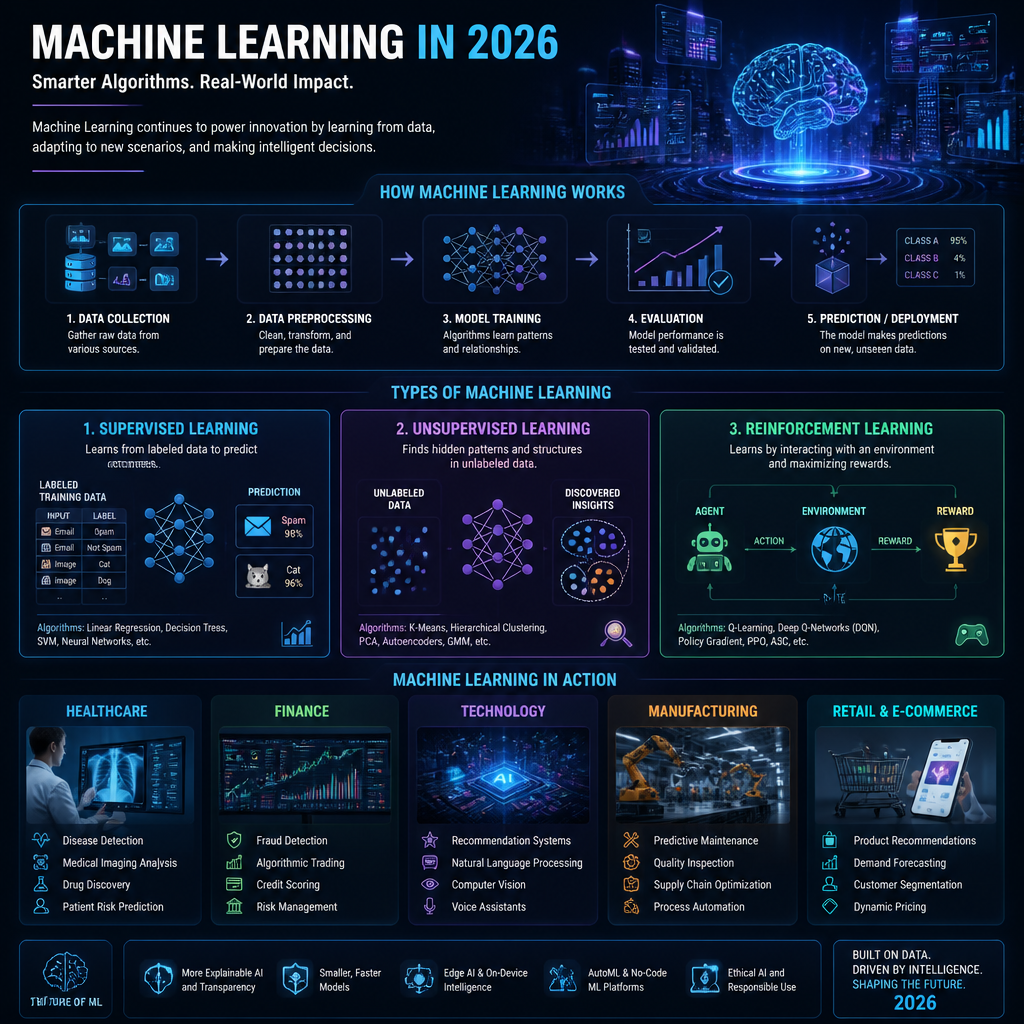
    Machine learning is a subset of artificial intelligence (AI) that learns patterns from data and then uses those patterns to predict, rank, classify, or generate outputs. So instead of writing a pile of if/else rules, you feed it examples, pick a learning approach, and measure how well it performs.

    Machine learning in 2026 explained with data, training, evaluation, and deployment steps

    Applications of Machine Learning

    Machine learning is not just a buzzword—it’s a set of tools that companies use to reduce manual decisions, spot patterns humans miss, and move faster with fewer mistakes. That said, the “best” application is usually the boring one that ties directly to cost, risk, or revenue.

    1. Healthcare: ML models help with early diagnosis, patient risk scoring, and operational planning. A common use is predictive models that flag patients who might deteriorate, so clinicians can intervene earlier. That doesn’t mean a model replaces a doctor—usually it’s a triage and prioritization tool that helps the team spend attention where it matters. According to a Helpware article, machine learning is used in predictive healthcare models to improve patient outcomes dramatically.

    2. Finance: Fraud detection is the classic example, but it’s only half the story. Banks also use ML for credit risk signals, anti-money-laundering alert ranking, and even customer support routing. The trick is tuning for the right tradeoff: if you catch 99% of fraud but block 5% of legit transactions, you’ll lose customers fast.

    3. E-commerce: Recommendations, search ranking, “customers also bought,” dynamic pricing, inventory forecasting—this is where ML prints money when it’s done right. But it can also backfire. I’ve seen recommendation models overfit to short-term clicks and accidentally push low-margin products, which looked good in dashboards and terrible in profit.

    4. Transportation: Autonomous driving grabs headlines, but plenty of ML value is quieter—route optimization, predictive maintenance, demand forecasting, and anomaly detection on sensor data. A fleet that avoids downtime by predicting failures a week early will beat a fleet chasing full autonomy demos.

    5. Marketing: ML can segment audiences, score leads, and optimize ad spend, but the real gain is usually measurement. If your attribution data is noisy, the model will confidently optimize the wrong thing. So you end up paying more for “better performance” that isn’t real.

    A real-world example (recommendations)

    Here’s a simple, realistic scenario I’ve seen: an online store wants to increase average order value.

    • Naive approach: “Recommend the most popular items.” Easy, but it mostly shows what people already know.
    • ML approach: Train a model on sessions (views, add-to-cart, purchases) to predict “next product likely to be purchased.”
    • Messy part: returns and cancellations. If you train on raw purchases only, you may recommend items that sell a lot but get returned constantly.

    When teams add return-rate as a negative signal, the recommendations usually get less flashy, but margins improve. That’s the kind of tradeoff that matters in production.

    What’s the Difference Between AI and ML?

    AI is the umbrella term: any system that does something we’d call “smart” (reasoning, planning, perception, language). Machine learning is one way to build AI, and it’s the dominant way now because it adapts to data.

    I explain it like this:

    • AI is the goal: “make the machine behave intelligently.”
    • ML is one method: “learn the behavior from data.”

    So, yes—most modern AI products you touch daily are powered by ML. But no—rule-based systems, search algorithms, and hand-built decision engines can still be “AI” even if they don’t learn.

    Understanding Machine Learning: A Simple Explanation

    If you remember one thing, make it this: machine learning is a workflow, not magic. You decide what you want to predict, gather the right data, train a model, test it honestly, then deploy it with guardrails.

    What is Machine Learning How Does it Work?

    Most ML projects follow a loop. The loop is the work.

    Step-by-step: the basic ML pipeline

    1. Define the task: Are you predicting a number (demand forecasting), choosing a category (spam vs not spam), or ranking options (which product to show first)? This sounds obvious, but teams mess it up by starting with “we need AI” instead of “we need fewer chargebacks” or “we need faster triage.”

    2. Collect and label data: In supervised learning, you need examples with correct answers (labels). In fraud, labels might be “confirmed fraud” vs “legit.” In support, labels might be “billing issue” vs “technical issue.” Labeling is slow and expensive, so people cut corners—and then wonder why the model fails.

    3. Split the dataset: Train set, validation set, and test set. If you don’t do this properly, you’ll fool yourself. I’ve watched teams celebrate a 98% accuracy score… until we realized the same customer IDs appeared in both train and test data.

    4. Choose a baseline first: Before neural networks, try something dumb and measurable. Logistic regression, a small decision tree, even “predict last week’s value.” Baselines keep you honest, and they’re often surprisingly competitive.

    5. Train the model: The algorithm adjusts internal parameters to reduce error. In deep learning, that’s weight updates via backpropagation. In trees, that’s splitting rules. Either way, you’re optimizing for a metric.

    6. Evaluate with the right metric: Accuracy is a trap for imbalanced problems. Fraud detection often needs precision/recall, AUC, or cost-based metrics. A model that flags every transaction as fraud can be “accurate” if fraud is rare—while still being useless.

    7. Deploy with monitoring: This is where ML becomes real software. You track latency, error rates, and also model drift (when the world changes and the model’s assumptions stop matching reality).

    8. Retrain and iterate: Data changes, users change, products change. In 2026, mature teams schedule retraining (weekly/monthly), run canary releases, and keep rollback plans.

    Common mistakes I see (and how to avoid them)

    • Training on data you won’t have later: If you use “chargeback confirmed” as a feature at prediction time, congrats—you built a time machine. Keep features limited to what exists at the moment you need a decision.
    • Leaking the label: Anything that directly encodes the target (or future info) will inflate performance.
    • Ignoring feedback loops: Your model changes user behavior, which changes the data, which changes the model. Recommendations are notorious for this.
    • Shipping without a fallback: If the model fails, what happens? A safe default beats a broken “smart” feature.

    Machine Learning Definition and Examples

    In simple terms, machine learning lets a computer learn from past examples to make a decision on new data. It’s pattern learning with measurement.

    Example 1: spam detection (the classic)

    Email services label messages as spam or not spam based on:

    • word patterns (but also metadata like sender reputation)
    • user actions (marking spam, deleting, replying)
    • message structure (links, domains, attachment types)

    A practical detail: spam models don’t just classify; they often score. Then the product team sets thresholds. Raise the threshold and you catch more spam but risk false positives (missing important emails). Lower it and inbox quality drops.

    Example 2: streaming recommendations (Netflix-style)

    Recommendation systems learn from:

    • what you watched
    • what you stopped watching after 3 minutes
    • what you searched for
    • what people similar to you watched next

    The “gotcha” is that you can optimize for the wrong target. If you optimize only for clicks, you can end up with a feed that feels addictive but not satisfying. Good teams include longer-term signals (completion rate, return visits, thumbs-up/down) so the model aligns with user happiness, not just short-term engagement.

    My Experience With This

    I’ve watched ML projects succeed for one reason: the team treated it like a product, not a science fair.

    One of the most useful patterns I’ve used (and re-used) is prediction + workflow. The model doesn’t “solve fraud” or “solve churn.” It produces a score, then the business wraps a workflow around it—review queues, thresholds, approvals, and auditing.

    A mini story: the dashboard that lied

    A while back, I helped a team rolling out an ML feature to rank support tickets by urgency. The model looked great in offline tests. Then we deployed it and support agents complained within a week.

    What happened?

    • The training labels came from historical “priority” fields.
    • Those fields were inconsistent—different managers used different definitions.
    • The model learned the inconsistencies perfectly.

    So, yes, the metrics were “good,” because we trained the model to match messy labels. After we fixed the labeling process (clear rubric + quick sampling audits), performance actually improved in the real world.

    What I do now by default

    • I insist on a baseline (even a simple rules engine) because it forces clarity.
    • I review the data schema early (null rates, outliers, timestamp sanity). It saves weeks.
    • I ship with monitoring: latency, drift, and a human override. If your model can’t be overridden, it will eventually cause an incident.

    If you’re new to this, that might sound cautious. It is. I’m biased toward boring and reliable, because production ML punishes ego.

    Frequently Asked Questions

    • Q: What is machine learning in simple terms?
      A: Machine learning is when computers learn patterns from data so they can make a decision on new data—without you writing every rule.

    Think of it like training a new teammate: you show them lots of examples (good and bad), you correct them, and over time they get better at making the call. The difference is that a model “learns” as math, not as understanding.

    • Q: What’s the difference between AI and ML?
      A: AI is the broad goal (machines doing intelligent tasks). ML is a common way to reach that goal (learning behavior from data). So ML sits inside AI.

    A quick litmus test: if the system improves because it retrains on new data, that’s usually ML. If it improves because a developer rewrote rules, it may still be AI, but it’s not learning.

    • Q: Is ChatGPT AI or machine learning?
      A: ChatGPT is AI built using machine learning—specifically large neural networks trained for natural language processing.

    Practically, that means it learned statistical patterns from huge amounts of text and then generates the next token (word-piece) based on context. It doesn’t “know” facts the way a human does, so you still need verification when stakes are high.

    • Q: Is machine learning difficult?
      A: The math can get deep, but you don’t need a PhD to build useful ML systems. The harder part for most teams is the operational side: data quality, evaluation, deployment, monitoring, and dealing with edge cases.

    If you want a sane learning path, start by building one small project end-to-end (data → model → evaluation → simple deployment). You’ll learn more from that than from reading 20 definitions.

    • Q: What should I learn first in 2026?
      A: Start with fundamentals that transfer: how to frame a problem, basic supervised learning, evaluation metrics, and data handling. Then move into one applied area (recommendations, time series, NLP, computer vision) based on what you actually want to build.

    If you’re building for a business, learn how to connect model outputs to a workflow. That’s where ML becomes valuable.

    explore more about machine learning