Discover the top 5 applications of Wiki LLMs and how they transform knowledge management. Learn from Mobeen Abdullah, AI expert.
Understanding LLM Wiki and Its Applications
An LLM Wiki (a framing that got a lot of attention via Andrej Karpathy) blends large language models with structured, editable knowledge. The point isn’t “chat over PDFs.” It’s creating a repository that improves over time — pages get refined, links between concepts get clearer, and gaps become obvious.
A good mental model: RAG retrieves. A wiki accumulates. An LLM Wiki tries to do both, but with the wiki being the long-term memory you keep grooming.
One practical application I’ve seen work well is taking thousands of scattered notes, docs, and research snippets and turning them into a navigable knowledge graph. The patterns in the Karpathy LLM Wiki are useful because they force you to think in “pages and connections,” not “search results.” In one real project, the first win wasn’t accuracy — it was discoverability. People stopped asking the same question in Slack because the answer lived on a stable page that kept getting better.
If you want to get your hands dirty, the LLM Wiki GitHub repo is a solid starting point. I like it because it’s not pretending this is magic. You still need ingestion rules, review loops, and some discipline around what gets written back to the wiki.
LLM Wiki vs RAG: Key Differences
RAG is great when your source documents are already high quality and relatively stable. You embed text, retrieve top-k chunks, and generate an answer. That’s a clean pipeline, and it ships fast.
But RAG can get weird as your corpus grows. Chunking breaks context, duplicates creep in, and different docs contradict each other. Then you’re stuck: do you “fix” the source docs, or just hope retrieval picks the right chunk? I’ve watched teams quietly add prompt band-aids for months because it’s cheaper than cleaning a messy knowledge base.
LLM Wikis take the opposite stance: consolidate the knowledge into fewer, better artifacts. Instead of answering from a random pile of excerpts, you build canonical pages (“How auth works here,” “Pricing rules,” “Experiment methodology”) and keep tightening them.
The tradeoff is obvious, though. Someone has to own those pages. In practice, I’ve had success with a lightweight workflow: the model drafts updates, a human reviewer approves them, and the wiki logs what changed. Without that loop, you’ll end up with confident-sounding nonsense that looks official.
Educational settings are where this feels almost unfair. A student doesn’t need ten disconnected paragraphs from ten documents; they need one coherent explanation, plus links out to deeper pages. That coherence is exactly what a wiki structure enforces.
Understanding the Meaning of LLM
LLM stands for Large Language Model — a model trained to predict and generate text based on patterns in huge datasets. That sounds abstract, but the practical point is simple: it can summarize, rewrite, connect ideas, and answer questions in a way that feels conversational.
Still, an LLM doesn’t “know” your organization’s truth by default. It knows language patterns. So, if you don’t anchor it to a governed knowledge base (documents, wiki pages, citations, review history), you get answers that may sound right while being subtly wrong.
In other words: the LLM is the fluent interface. The wiki is the memory you can audit.
As we get deeper into Wiki LLMs, that split matters. Every time I’ve seen these systems succeed, the team treated knowledge like software: versioned, reviewed, and maintained.
Practical Applications of LLM Wikis
- Educational Resources: LLM Wikis let educators assemble material into a structured learning map instead of a folder dump. The nice part is the navigation: prerequisites can be explicit (“read this first”), and examples can be attached to the concept page that needs them.
A simple scenario: a student working through linear algebra gets stuck on eigenvectors. In a normal LMS, they bounce between lecture slides, a textbook chapter, and maybe a forum post. In an LLM Wiki, the eigenvector page can include the definition, an intuition section, two worked examples, and links back to prerequisites (matrices, determinants). Because the content is centralized, you fix it once — everyone benefits.
- Corporate Knowledge Management: Enterprises lose time to tribal knowledge. I’m talking about onboarding docs that don’t match reality, runbooks that assume one specific environment, and “ask Jane” processes that don’t survive a vacation.
With an LLM Wiki, you capture that institutional knowledge into canonical pages. Then you wire your support or internal assistant to answer from those pages. The big win isn’t just productivity; it’s consistency. When the answer changes (new pricing rule, new escalation path), you update one page instead of hoping every doc and slide deck gets updated too.
- Research Projects: Research is brutal on knowledge systems because everything changes weekly. Hypotheses evolve, definitions shift, and related work piles up fast.
A wiki structure helps because it encourages stable “concept pages” and “paper pages.” I’ve seen teams use it to keep a living bibliography where each paper gets: a one-paragraph summary, key claims, weaknesses, and how it connects to the project. Then, when someone says “why are we not using method X?”, the answer is already linked and documented — not trapped in one person’s head.
- Developer Tools: For developers, LLM Wikis can become the “how we build software here” brain. Not just API docs, but the messy stuff: deployment quirks, common incident patterns, migration gotchas, and why a past decision was made.
One mistake I’ve personally seen: a team auto-generated wiki pages from code comments and called it “documentation.” It looked impressive, yet it didn’t help anyone debug a production issue at 2 a.m. The fix was to treat the wiki like a runbook-first system: pages centered on workflows (deploy, rollback, rotate secrets), each with checks, commands, and failure modes. Then the LLM helped by proposing updates after incidents, while engineers approved the final wording.
- Content Generation: Writers and content teams can use an LLM Wiki as a source-of-truth for voice, product claims, and approved messaging — basically a guardrail against accidental contradictions.
The practical flow is straightforward: keep pages for brand voice, product features, pricing, and “do not claim” rules. When you draft a new post, the model pulls from that curated wiki, not from whatever it remembers. That reduces rework. It also avoids the awkward situation where two different blog posts describe the same feature in two different ways.
In my experience, the teams that get the most value don’t try to automate everything. They automate the boring parts (drafting, summarizing, linking) and keep humans in the loop for judgment calls.
My Experience With This
As the founder and CEO of Revnix, I’ve built cloud-native and AI systems where knowledge sprawl quietly becomes a tax on every team. When we introduced wiki-style LLM workflows, the early wins were surprisingly unglamorous: fewer repeated questions, faster onboarding, and less time spent hunting for “the latest doc.”
One rollout lesson I’d emphasize: start with a narrow scope. Pick one area with frequent questions (onboarding, support troubleshooting, incident response), build 20–40 high-quality pages, and enforce ownership. After that, expand.
If you skip ownership, the wiki becomes a graveyard. If you skip review, it becomes a rumor mill. But when you get those two right, you end up with something rare — a knowledge base that actually keeps up with the business.
Conclusion
Wiki LLMs aren’t a novelty. They’re a practical answer to a real problem: knowledge keeps changing, while most documentation systems assume it won’t.
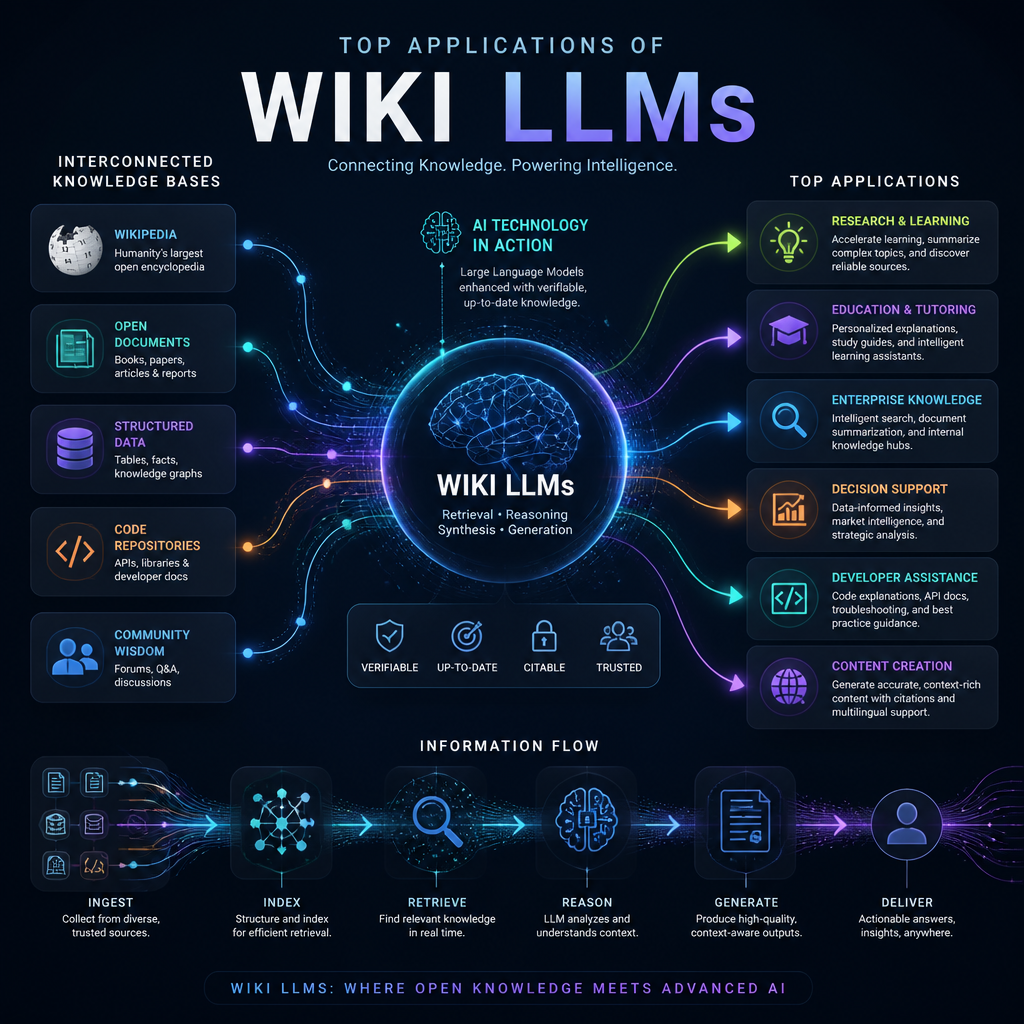
Across education, corporate knowledge management, research, developer documentation, and content workflows, the pattern is the same. Use the LLM to help you write and connect concepts, then use the wiki structure to make those concepts durable and auditable.
If you’re considering adopting one, don’t start by asking “what model should we use?” Start by asking “who will own the pages, and how will updates get approved?” Get that right, and the tech part becomes much easier.
Frequently Asked Questions
1. What is a wiki LLM?
A wiki LLM refers to a large language model that organizes and structures knowledge in a wiki format. It allows users to build, maintain, and query a dynamic knowledge base, which evolves over time.
2. How does an LLM Wiki differ from traditional RAG systems?
Unlike traditional Retrieval-Augmented Generation systems that pull documents for every query, an LLM Wiki creates a persistent knowledge base that can be accessed and updated incrementally, making it more efficient for users.
3. What does LLM actually mean?
LLM stands for Large Language Model, which refers to sophisticated AI models designed to understand and generate human-like text based on extensive linguistic data.
4. Where can I find resources on LLM Wiki implementations?
The LLM Wiki GitHub provides comprehensive resources and tools for developers interested in building LLM-driven wikis tailored to their needs.
5. Can LLM Wikis be used for educational purposes?
Absolutely! LLM Wikis can be tailored to create rich educational resources that help students access and interact with knowledge efficiently.
Leave a Reply