Explore fascinating facts about swan species, their habitats, and conservation efforts in 2026.
Interesting Facts About Swan Behavior
Swans look calm from far away, but up close they’re busy—pair-bonding, defending space, and constantly feeding. Because they spend so much time on water, a lot of their “personality” is really habitat-driven.

Types of Swan Species
There are six recognized species of swans, and mixing them up is common—especially when you’re looking at silhouettes over water at dusk.
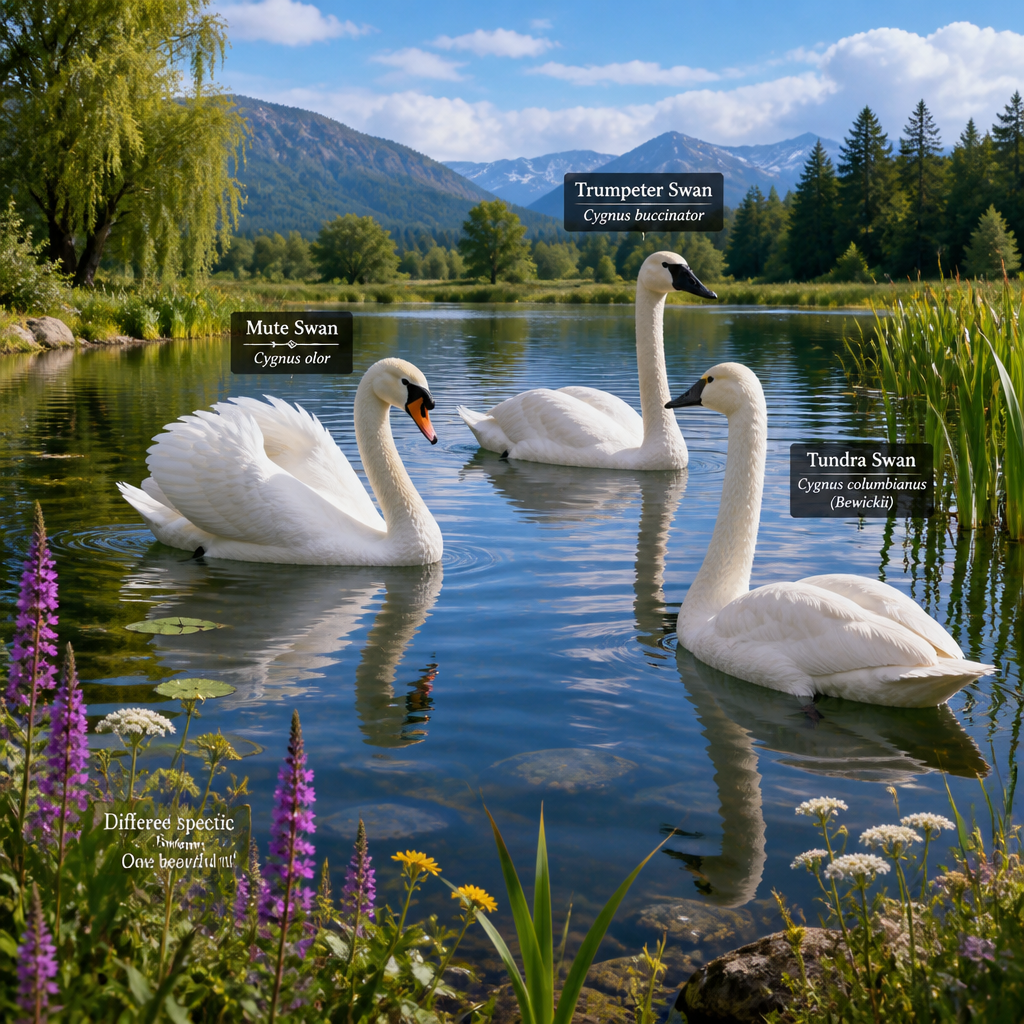
- Mute Swan (Cygnus olor): Identifiable by its distinctive orange bill with a noticeable knob, mute swans are prevalent in North America and Europe. Their length can reach up to 5.5 feet, and they are known for their assertive behavior, especially during nesting.
- Trumpeter Swan (Cygnus buccinator): The largest of the swan species, trumpeter swans can weigh up to 30 pounds and have a wingspan of nearly 10 feet. They are primarily found across North America and are celebrated for their vocalizations, which resemble trumpet-like calls. If you want a quick ID refresher, the Trumpeter Swan Overview has solid photos and field notes.
- Whooper Swan (Cygnus cygnus): Common in Eurasia, whooper swans are easily recognized by their yellow and black bill. They are also known for their migratory patterns, traveling between Europe and Asia.
- Tundra Swan (Cygnus columbianus): Known for their small size and adaptability, tundra swans can be found in North America and the Arctic. They have a more subtle appearance compared to mute swans but are equally stunning.
- Black Swan (Cygnus atratus): Native to Australia, black swans are unique due to their entirely black plumage and red bill. They are social birds often seen in large flocks.
- Black-necked Swan (Cygnus melancoryphus): Found in South America, these swans have a striking black neck and a white body. They are relatively less common compared to their northern counterparts.
Social Behaviors
Swans are known for strong pair bonds, and yes, many do mate for life—but it’s not a fairy tale contract. If a mate dies or breeding fails repeatedly, you’ll sometimes see a re-pairing. That said, when a pair is established, they move like a coordinated unit.
Courtship can be elaborate: synchronized swimming, head-bobbing, mutual preening. Then things get practical. Both parents take nesting shifts, and they’ll actively push away geese, ducks, and curious humans. I’ve seen a “calm” pair flip into full threat posture (wings arched, head low) because someone wandered too close for a shoreline photo.
Swans also flock up, especially during migration and winter feeding. Those V-shaped formations aren’t just pretty—they reduce drag and save energy, so weaker birds can keep pace. If you’re trying to get better at telling swans apart in a group, the photo comparisons in Swan Identification & Behavior help because they highlight posture and bill shape, not just color.
Feeding Habits
Swans are primarily herbivorous, feeding on aquatic vegetation—submerged plants, algae, and shoreline greens. Because they tip up and pull plants from below, they can “mow” a shallow bay fast, which can be good (controlling overgrowth) or damaging (stripping a bed that fish and invertebrates need).
In winter, they’ll graze fields, and you’ll sometimes spot them on leftover crops. That’s where people get tempted to toss food. Don’t. Bread and processed foods can cause malnutrition and concentrate birds into unhealthy, aggressive crowds. If you want to help instead, protect the water: clean shorelines, fewer fertilizers, and intact plant buffers matter more than any handout.
Understanding Swan Habitats and Conservation Efforts
If you understand the habitat, you understand the swan. Water depth, plant density, human disturbance, and winter freeze lines decide where swans settle—and whether they successfully raise cygnets.
Swan Habitats
Swans prefer freshwater habitats—lakes, ponds, marshes, slow rivers—with rich vegetation for food and nesting. Nests are usually bulky piles of reeds and grasses near the water’s edge, and because they’re exposed, disturbance is a big deal. People underestimate this. A few “quick” approaches by dogs or photographers can push a pair off the nest long enough for eggs to chill or get taken.
Seasonal change drives everything. When food drops or water freezes, many species move to more favorable climates. In North America, trumpeter swans often depend on managed refuges and protected wetlands. Those places don’t just “exist,” either—staff control water levels, limit disturbance, and manage vegetation, which is why the work takes years, not weekends.
If you’re curious what organized, long-haul conservation looks like, The Trumpeter Swan Society lays out the on-the-ground stuff (monitoring, habitat support, public education) that actually moves populations.
Conservation Status
Many swan species face threats from habitat loss, pollution, and climate change, but the story changes depending on the species and the region.
Mute swans, for example, are regarded as an invasive species in parts of North America, and they can displace native wildlife while damaging submerged vegetation. As a result, some states allow regulated control to reduce impacts (California’s Invaders: Mute Swan). That can feel harsh until you’ve seen a small wetland get stripped down to mud.
On the other hand, trumpeter swans are a straight-up conservation success story in many areas. In Wisconsin, they’re celebrated as the 2026 Birdathon “Bird of the Year,” which is tied to restoration and population recovery (Wisconsin Conservation). The difference is management: protected habitat, monitoring, and long-term funding.
Migration Patterns
Swans typically migrate in V-shaped formations to conserve energy. That matters because migration is already expensive: headwinds, ice timing, and food gaps can wipe out weaker birds.
Tundra swans are a clear example. They breed in Arctic regions and migrate to warmer wintering areas across North America. Because timing is everything, birders and biologists watch movement closely—late freezes, drought, or early spring melt can shift routes and stopover choices.
If you want a real-world look at what those movements can look like in the field (messy, loud, and weather-dependent), check out this observation post: Tundra swans migrating north. It’s not a peer-reviewed paper, but it shows why migration monitoring is partly science and partly being outside at the right time.
Through conservation and habitat restoration, organizations keep swan populations viable even as pressures pile up. So, if you live near a wetland, your daily choices—fertilizer use, shoreline mowing, letting dogs roam—can either support or quietly sabotage the birds.
FAQ Section
-
Q: What are the different species of swans?
A: Common species include the mute swan, trumpeter swan, and whooper swan, but there are six recognized species total (including tundra, black, and black-necked). If you’re new to ID, start with bills and head shape, not body size—distance and posture fool people. A quick step-by-step I use: (1) bill color/pattern, (2) presence/absence of a knob, (3) neck posture (stiff “S” vs straighter), then (4) sound if you can hear it. -
Q: How do swans migrate?
A: Swans typically migrate in V-shaped formations to save energy, and the lead bird often rotates because that front spot is work. If you’re watching a flyover, count the “wobbles” and regrouping—wind forces them to adjust constantly, so it’s rarely a perfect V for long. One common mistake is assuming every swan you see in winter is “lost”; lots of populations use the same stopovers year after year because the food and ice conditions match. -
Q: What is the conservation status of swans?
A: Many swan species are under threat due to habitat loss and pollution, but management changes the outcome. Trumpeter swans have rebounded in places with protected wetlands and active monitoring, while mute swans can be controlled as invasive in parts of North America. The key is context: before you advocate for “more swans,” figure out which swan and whether the habitat can support them without displacing native birds. -
Q: What do swans eat?
A: Swans are herbivores that primarily eat aquatic plants and shoreline vegetation, and they’ll also graze grains in fields—plus occasional small aquatic animals like frogs or mollusks. If you see a swan tipping up repeatedly in the same spot, it’s basically harvesting a plant bed. The big avoidable problem: feeding bread. It fills them up without real nutrition, and because it gathers birds into tight clusters, it also ramps up aggression and disease risk. -
Q: How can I help swans in my area?
A: Support local conservation efforts and avoid pollution in waterways, but keep it practical: (1) don’t feed them, (2) keep dogs leashed near nesting areas, (3) leave a buffer of natural plants along the shoreline, (4) skip fertilizers right before heavy rain. A park manager once told me their “mystery algae bloom” calmed down after nearby homeowners stopped over-fertilizing—then the swans spread out and behaved normally again because food returned to the wetland instead of floating in a scum layer. -
Q: How can you identify swans?
A: Look for their long necks, large wingspan, and distinctive coloration, but don’t stop there. For clean IDs, focus on the bill pattern and head profile first, then check size against nearby geese as a reference. Also, watch behavior: trumpeters often look heavier-bodied and can sound distinctly resonant, while mute swans tend to show that classic arched-wing display when they’re irritated.
Trumpeter Swan Overview
Swan Identification & Behavior
The Trumpeter Swan Society
Leave a Reply