Discover how AI will reshape daily life by 2026, from job transformations to healthcare advancements. Gain insights from experts on the future of AI.
The Future of AI in 2026
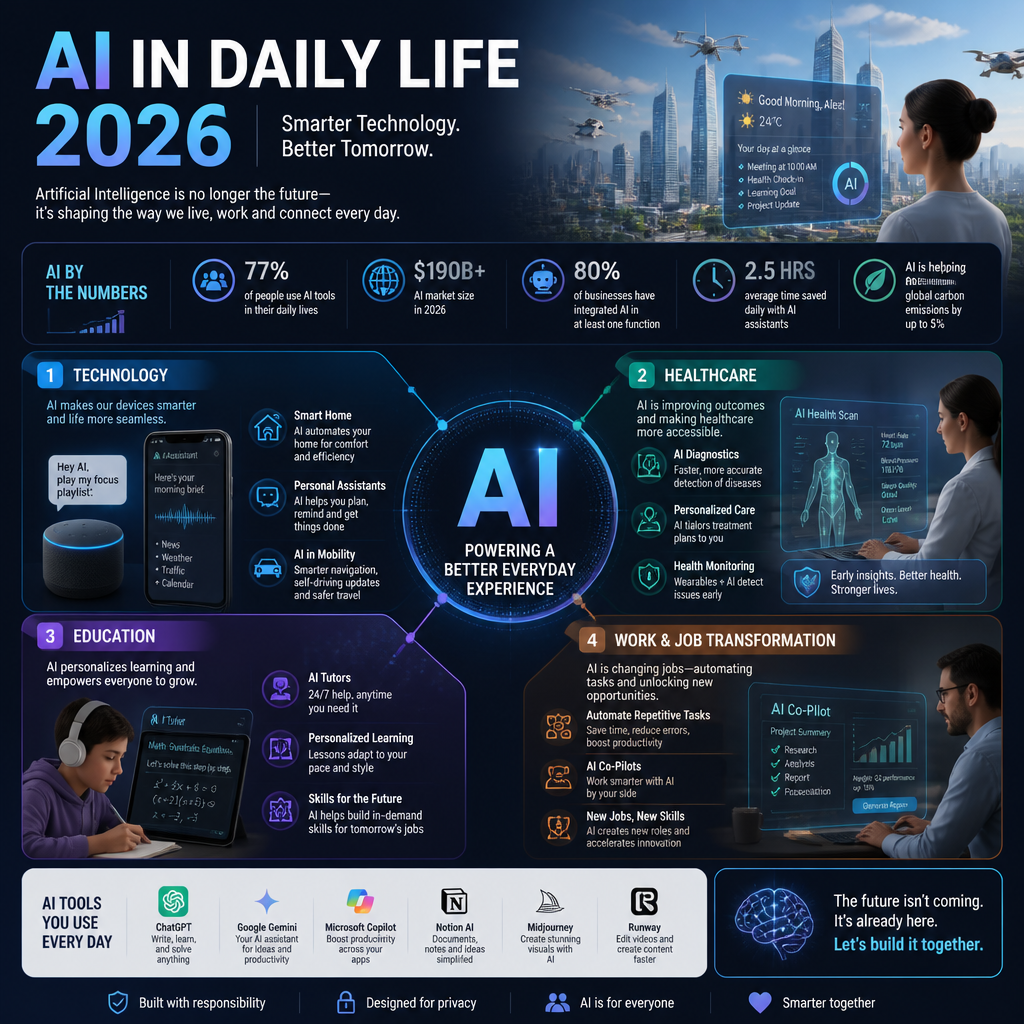
Artificial intelligence is not just about robots or virtual assistants anymore. By 2026, we can expect a significant transformation in how AI integrates into our daily routines, potentially redefining entire industries and job markets. According to a recent article from the Stanford AI Experts, AI will shift toward operational efficacy and seek to provide measurable outcomes that reflect its value in practical applications.
A simple way I explain it to non-technical friends: AI stops being “a thing you open” and becomes “a thing that shows up everywhere.” Your calendar suggests meeting agendas, your email drafts replies, your bank flags weird spending, and your car insurance adjusts rates based on driving patterns. Convenient, sure—but also a lot of invisible decision-making.

What Will Happen in 2026 According to AI?
Experts predict that AI will take a more central role across various sectors, with predictions indicating a seamless blend between human capabilities and AI systems. That sounds fluffy, so here’s what it means on a random Tuesday: you’ll hand the system a messy goal (“get this customer live by Friday”), and it’ll break it into tasks, chase the right people, and surface blockers.
For instance, in industry after industry, AI tools are projected to enhance decision-making processes and optimize productivity. Tasks that once took hours may now be completed in mere minutes. A compelling example is the use of AI in predictive maintenance, where machinery can self-diagnose issues before they lead to failures, saving companies both time and money.
I’ve seen a smaller version of this already. A mid-sized ops team I worked with stopped doing weekly “spreadsheet archaeology” to figure out why orders were late. Instead, they fed shipping logs into a model that flagged the three suppliers most correlated with delays. It didn’t replace their judgment, but it did stop them from guessing.
Moreover, jobs traditionally seen as secure will face challenges. According to Forbes, over 60% of tasks in the workplace could undergo some form of automation by 2026, leading to a shift in the job market and the skills required for employment.
The part people miss: “task automation” isn’t “job deletion,” but it does change what gets rewarded. If 60% of your day is routine reporting and status updates, you’ll feel the squeeze fast. If your day is making calls with incomplete info, managing risk, or calming angry humans, you’ll still have plenty to do.
Change AI Forever
The trajectory of AI suggests a pivotal change towards more autonomous systems, with AI becoming integral to personal and business applications. As discussed in a video by a16z, we are likely to see AI evolve to a stage where its capabilities extend far beyond current productivity enhancements, focusing more on emotional connectivity and user interactions.
I’m cautiously optimistic here, because “emotional connectivity” can mean two very different things. On a good day, it’s a tool that notices you’re overwhelmed and switches to bite-sized steps. On a bad day, it’s a tool that learns exactly how to manipulate attention and spending.
A practical guardrail I like: if an AI system can nudge behavior (buy, vote, stay, quit), then it needs clear disclosure and settings you can actually find. Otherwise, by 2026, we’ll all be arguing with invisible defaults.
AI Predictions for 2026
- Increased Automation: Automation will increase exponentially across various sectors, impacting how we handle mundane tasks, from simple data entry to complex analytical processes.
- Healthcare Innovations: AI’s role in healthcare will expand significantly, aiding in diagnostics and personalized medicine. Machine learning models will likely facilitate quicker and more accurate diagnoses, as illustrated by advancements in telehealth services and AI diagnostics tools.
- Job Market Changes: Many roles requiring repetitive tasks may diminish, but those emphasizing creativity, emotional intelligence, and skilled trades will remain in demand. According to various sources, including Stephen Hawking’s insights, jobs that require human empathy or creativity will be harder to replicate and are thus safe from automation.
If you want one “survival” skill that pays off across all three bullets, it’s this: learn to supervise systems. You don’t need to become a machine learning engineer, but you do need to notice when the tool is confidently wrong, missing context, or optimizing for the wrong metric.
Examples of AI Changing Our Lives
As we look toward 2026, there are numerous tangible examples of AI applications that will reshape our existence, enhancing how we communicate, work, and live.
AI Examples
- Smart Personal Assistants: Beyond voice commands, AI systems will learn user preferences at a much deeper level. For example, ChatGPT is evolving from a helpful tool to a trusted advisor, as it begins to integrate personal context into its responses, offering tailored recommendations and insights.
A real-world way this plays out: you stop asking “what’s the weather,” and start asking “given my schedule and commute, when should I leave?” That’s helpful, but it also means the assistant holds a lot of your life in one place. So, the boring question becomes the important one: where does that data live, and who else can see it?
- Healthcare Improvements: AI applications in healthcare, such as diagnostic tools and virtual health assistants, will become commonplace. According to a recent article from First Line Software, hospitals will leverage AI for predictive analytics to enhance patient care and reduce wait times.
I’ve watched clinics try “AI intake” the wrong way—dumping a chatbot on patients without updating their internal triage process. The win is when it’s integrated end-to-end: symptom capture, risk scoring, routing, and a human who can override instantly.
- Education Restructuring: AI technologies will also personalize learning experiences. EdTech companies are using AI to tailor educational content to individual learning speeds and styles, fundamentally changing how education is accessed and delivered.
The upside is obvious: a student who’s behind gets more reps, while an advanced student stops being bored. The catch is subtle: if the model is trained on weak rubrics, it can “teach to the test” and still fail at real understanding. So, educators will need visibility into why the system made a recommendation, not just what it recommended.
AI Changing the World
The influence of AI will stretch into social domains as well. Consider how apps using AI for mental health support are already making a significant difference. Tools designed to identify emotional stressors and provide coping strategies are being integrated into daily routines, offering support that complements traditional therapeutic practices.
That said, I’d treat these as “support tools,” not replacements. If you’re in a rough patch, an app that helps you name the feeling and suggests a grounding exercise can genuinely help. But if it starts acting like your therapist, and there’s no escalation path to a licensed professional, you’re one policy change away from getting abandoned by the system.
The Influence of AI According to Experts
With such rapid advancements on the horizon, it’s crucial to consider what experts are saying about AI’s future and its implications. In a recent discussion, several AI specialists articulated their viewpoints on how AI will redefine our engagement with technology.
AI Index Report Insights
The AI Index Report highlights a focus on transparency and utility in AI’s evolution, emphasizing that the next few years will reflect a thorough evaluation of AI’s capabilities rather than unfounded optimism. This pivot toward realism is essential as we navigate potential pitfalls and leverage AI for substantial advancements.
In practice, “transparency” gets real when something goes wrong. If an AI denies a refund, flags a transaction, or routes your medical message to the wrong department, you need a traceable reason and a fast appeal. Otherwise, people lose trust—and they should.
Stephen Hawking’s Perspectives
Stephen Hawking, a prominent physicist, warned about the potential of AI to cause significant disruption. As noted in his discussions, the focus should be on ensuring that this technology remains beneficial and does not develop into a tool for oppression or disaster. Hawking articulated that unless society learns to control AI, it could become a double-edged sword, possessing both the potential for remarkable advancements and the risk of catastrophic consequences (World Economic Forum).
In discussing AI’s future, he remarked, “Success in creating effective AI could be the biggest event in the history of our civilization. Or the worst. We just don’t know.”
I agree with the spirit of that warning, but I’ll bring it down to street level: the scariest failures I’ve seen aren’t killer robots. They’re quiet harms—bias in approvals, automated “risk” labels, and people who can’t get a human on the phone because the system insists it’s right.
Conclusion
As we move toward 2026, the emergence of AI will undeniably reshape not only our daily activities but also the broader structures of society. While we cannot predict every nuance of this transformation, it is clear that the future of AI holds immense potential and equally significant responsibilities. By understanding these changes and preparing for them, we can navigate the challenges and embrace the opportunities ahead.
If you do one thing this week, make a list of where AI already touches your life (work tools, banking, health, school). Then decide what you’re willing to automate—and what you want a human override for.
FAQs
- Q: What will happen in 2026 according to AI?
A: AI is expected to advance significantly, reshaping industries and daily activities.
Here’s the more concrete version: by 2026, a lot of AI will stop being “chat” and start being “orchestration.” So, instead of asking for an answer, you’ll ask for an outcome—book the appointment, draft the doc, reconcile the invoices, prepare the interview loop.
A step-by-step way to think about it:
1) You state intent (“ship this proposal by Thursday”).
2) The system pulls context (past proposals, pricing rules, customer history).
3) It produces a draft and a checklist (legal review, approvals, follow-ups).
4) It nags the right people, then logs what happened.
The common mistake I see is assuming the model “knows your business” because it sounds confident. It doesn’t—unless you’ve given it clean context and you’ve validated outputs with real constraints (budgets, policies, timelines). By 2026, people who can supervise this loop—spot missing inputs, correct bad assumptions, and set boundaries—will look like magicians.
- Q: What 3 jobs will not be replaced by AI?
A: Jobs requiring emotional intelligence, creativity, and skilled trades are least likely to be replaced.
I’d phrase it slightly differently: AI will replace chunks of tasks inside most jobs, but three categories stay stubbornly “human-heavy.”
1) Care + trust work (nurses, therapists, social workers, seasoned customer support). Even with great tools, the job is still a relationship. You’re reading the room, not just the notes.
2) Original creative direction (creative directors, product leaders, investigative journalists). Yes, AI can generate drafts. But somebody still has to decide what matters, what’s tasteful, what’s ethical, and what’s on-brand.
3) Skilled trades in messy environments (electricians, HVAC, mechanics). Real buildings are weird, old, and full of surprises. Robots hate that.
A quick anecdote: I watched a team try to “AI-automate” a support role by generating instant replies. Tickets dropped, but refunds spiked, because the bot optimized for speed and sounded polite while being wrong. The human agent who survived wasn’t the fastest typist; it was the person who could de-escalate, negotiate, and fix edge cases.
- Q: Did the Bible warn us about AI?
A: Various interpretations exist; some see ethical AI as a modern ethical dilemma.
People ask this more than you’d think, usually because they’re trying to map a brand-new technology onto an older moral framework. I’m not here to litigate theology, but I’ve found one practical way to answer without hand-waving: treat it like any powerful tool that can be used to help or harm.
If you want a grounded approach, walk through these questions:
1) Authority: Who is accountable when the system causes harm—an individual, a company, a government?
2) Truth: Can the system lie convincingly (intentionally or by error), and how do we detect it?
3) Dignity: Does the system reduce a person to a score, label, or prediction?
4) Temptation: Does it push people toward addiction (doomscrolling, gambling, compulsive spending)?
A common mistake is treating “ethical AI” as a vibes conversation. It’s not. It’s policy, product design, and enforcement—plus the willingness to say, “No, we’re not shipping that feature.” By 2026, the harder questions won’t be about whether AI is allowed. They’ll be about whether AI is bounded.
- Q: What did Stephen Hawking say about AI before he died?
A: He warned that AI could eventually outpace human intelligence, posing potential risks.
The quote that sticks (and still gets cited) is the one about AI being the biggest event in civilization—or the worst—and we not knowing which way it goes (World Economic Forum). I take that seriously, but I also think the “outpace” fear shows up earlier than superintelligence.
Here’s what it can look like in normal life by 2026:
1) Speed: AI systems act faster than humans can review.
2) Scale: A small error (or bias) gets applied to millions of decisions.
3) Opacity: People can’t explain why the system did what it did.
4) Lock-in: Appeals are slow, and humans defer to the model.
I’ve seen “model deference” up close—teams stop challenging outputs because the dashboard looks scientific. That’s when bad decisions become durable. Hawking’s warning, to me, is less about a robot uprising and more about governance: keep humans meaningfully in the loop, require explainability where it matters, and design systems so you can hit the brakes when reality disagrees.
Leave a Reply