Author: dev@revnix.com

  • How to Sync Content Between WordPress and Other CMSs Efficiently

    How to Sync Content Between WordPress and Other CMSs Efficiently

    Sync content between WordPress and other CMSs and you’ll either save your team hours a week—or quietly create a duplicated-content mess that nobody owns.

    I’m abcac. I’ve spent years on the digital marketing side of CMS work, which means I’m usually the one pushing for “publish faster” while also getting yelled at when the article shows up with broken embeds, missing authors, or the wrong canonical tag.

    Efficient synchronization isn’t just automation for automation’s sake. It protects brand consistency, keeps SEO signals clean, and stops editors from doing the same update three times in three places.

    In this guide, I’ll walk through practical ways to integrate WordPress with other CMSs (custom platforms, headless systems, or even another WordPress). You’ll get the tradeoffs, the common traps, and the checks I use so the sync stays boring—and boring is good.

    How to Sync Content Between WordPress and Other CMSs Efficiently

    Synchronizing content between WordPress and other CMSs can feel intimidating, but it’s manageable when you treat it like a data pipeline, not a “copy/paste problem.” The win isn’t just speed. It’s confidence—knowing the WordPress version matches the source, every time.

    Understanding the Basics of WordPress Integration

    WordPress integration means WordPress can reliably send, receive, and reconcile content with another system. The word “reconcile” matters, because two-way sync without rules turns into a tug-of-war.

    1. Using API Integration

    API integration is my default choice when the other CMS has a real API and you have someone who can code (even a little). You get control over mapping, scheduling, and error handling, which is where most integrations succeed or die.

    A simple, sane approach looks like this:

    • Identify the API Endpoints: Every CMS has specific API endpoints for content management. For WordPress, key endpoints include posts, pages, users, and custom post types.
    • Set Up Authentication: Most APIs require authentication. Use OAuth, API keys, or JWT tokens to secure access.
    • Develop the Integration Logic: You can write scripts in languages like PHP or Python to pull data from one CMS and push it to WordPress, or vice versa. This allows for real-time synchronization.

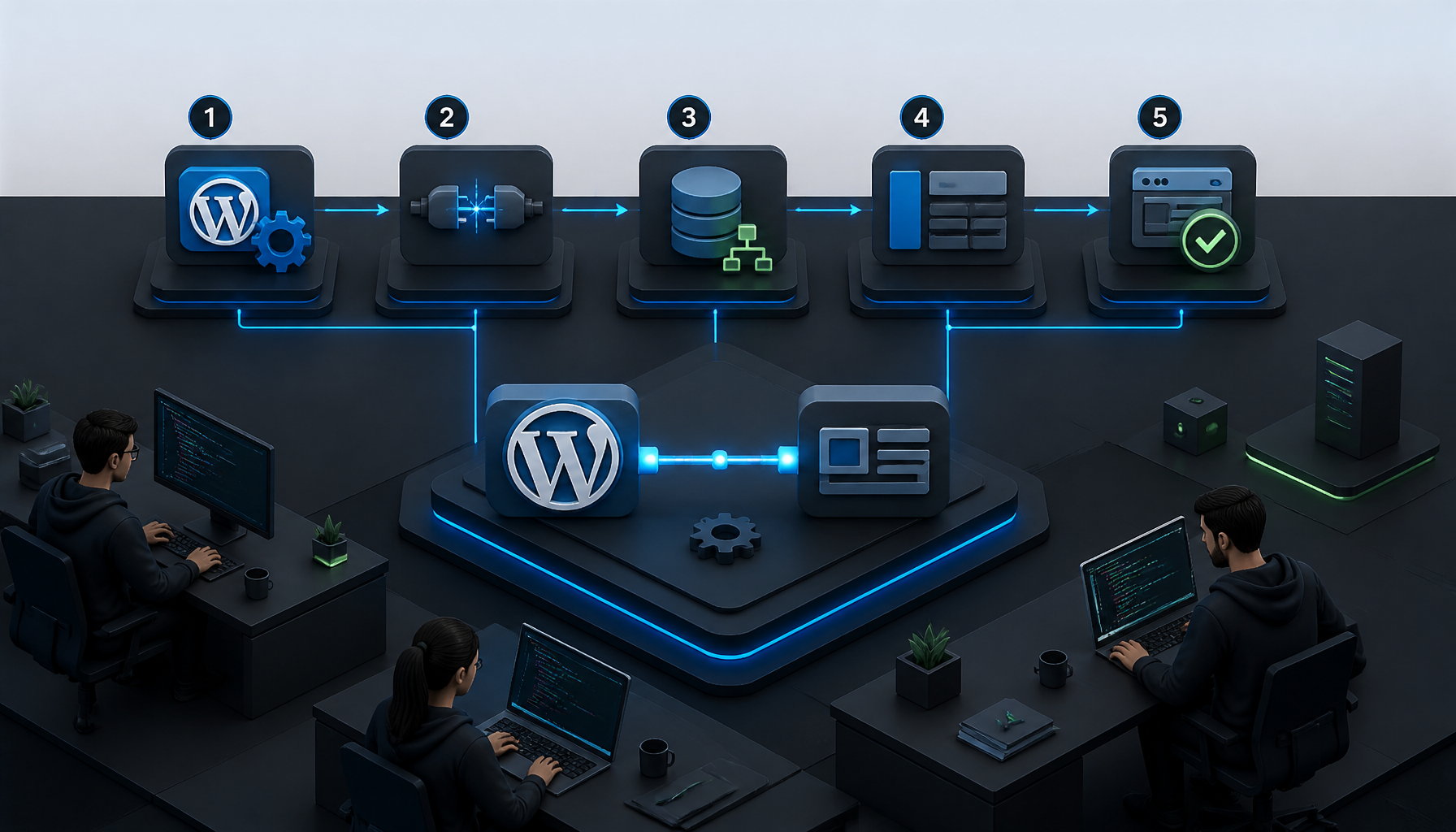
    Here’s the step-by-step breakdown I use on real projects (because “just use the API” is not a plan):

    1. Decide the source of truth. Pick one system that “wins” for each field: title, body, excerpt, author, slug, tags, featured image, SEO meta. If you skip this, editors will overwrite each other and blame the sync.
    2. Create a stable ID mapping. I store the upstream CMS content ID in WordPress post meta (for example, external_id). Then I upsert: if external_id exists, update; if not, create.
    3. Normalize content before pushing. HTML cleaning is the hidden tax. Convert weird line breaks, strip unsupported blocks, and handle embeds. I’ve seen integrations die because someone pasted a table that the target editor can’t render.
    4. Pick your trigger style:
    5. Polling (cron) every X minutes is easy and predictable.
    6. Webhooks are faster and cheaper, but you need to verify signatures and handle retries.
    7. Log everything. Not “we should log.” Actually log. Store request IDs, payload snippets, timestamps, and the WordPress post ID you touched. When an exec asks “why didn’t this publish?”, logs are the difference between a fix and a guessing game.

    A real example: a digital marketing team I worked with needed to pull blog posts from a custom CMS into WordPress. We set up an API integration that automatically fetched posts every hour, significantly reducing manual work and ensuring all posts were live on both platforms quickly.

    The mistake we made early on: we treated “published” as a boolean. Meanwhile, their CMS had states like Draft → Review → Scheduled → Published. So, we accidentally published a few pieces that were only meant for internal review. After that, we mapped states explicitly and required an “ApprovedForSyndication” flag before WordPress would publish.

    2. Utilizing WordPress Plugins

    If you need something running fast, plugins can be the right call—especially when the integration is one-way (import into WordPress) and the content format is consistent.

    • WP All Import: This plugin allows you to import content from various sources into WordPress easily. You can schedule imports and map fields accurately.
    • WP Migrate DB Pro: Great for migrating databases and keeping WordPress synchronized with another CMS database.
    • Zapier: Although not a direct integration plugin, Zapier can connect WordPress with numerous other applications, enabling automated workflows.

    What I like about plugins: you can prove the workflow in a day and iterate. What I don’t like: once a plugin becomes “mission-critical plumbing,” you’re now building your business process on top of someone else’s update cycle.

    A quick “plugin-first” checklist I use:

    • Can it map custom fields cleanly? If the other CMS has structured data, you’ll need reliable field mapping.
    • Does it handle media imports (featured images, galleries) without breaking URLs?
    • Is scheduling native? If you can’t schedule imports, someone will build a fragile workaround.
    • Does it have error reporting you’ll actually read? “Import completed” is meaningless if 30% of items failed silently.

    Common mistake: teams try to use a migration plugin as a synchronization system. Migration tools shine when you move once (or a few times), then cut over. They’re usually not built for ongoing two-way sync with conflict resolution.

    3. Manual Syncing Strategies

    Manual syncing still shows up in the real world, usually for good reasons: legal review, localization, or when the other CMS is ancient and locked down.

    • Content Calendars: Use a shared content calendar to keep track of what content needs to be published on which platform and when.
    • Standard Operating Procedures (SOPs): Develop SOPs for content updates to ensure consistency across teams.
    • Regular Audits: Conduct audits of both CMSs to verify that content is aligned and make necessary adjustments.

    If you’re stuck doing this manually, make it less painful with a “diff mindset.” I’ve had editors use a simple rule: never retype anything you can export. Export to CSV/JSON, paste once, then spot-check.

    One tactic that works surprisingly well: create a shared “Sync Notes” field (even a Google Doc link) where the editor logs what changed and where. That sounds basic, but it prevents the classic problem where someone updates the WordPress post, forgets the other CMS, and then the next sync overwrites it.

    Tools for Efficient WordPress Integration

    Tools matter, but only after you’ve decided your rules (source of truth, IDs, and triggers). Otherwise, you’re just picking a fancier way to create inconsistent content.

    • Integromat (Make): A powerful automation tool that connects different services and automates workflows between them. You can create scenarios that trigger when new content is published.
    • IFTTT (If This Then That): This tool allows you to tie actions across different platforms. For example, you can set it to automatically share new WordPress posts on other platforms.

    Here’s how I’d choose tools in practice, based on the messiness level.

    When Make is the right move

    Make (formerly Integromat) is great when you need “glue logic” without building and hosting your own integration service. So, if you’re syncing WordPress with a headless CMS, an Airtable editorial database, and Slack approvals, Make can be a lifesaver.

    A step-by-step flow I’ve shipped for a content team:

    1. Trigger: “Item marked Approved” in the upstream CMS.
    2. Transform: Convert rich text to HTML, map taxonomy, and generate an excerpt if missing.
    3. Media: Download the hero image, upload to WordPress Media Library, store the new attachment ID.
    4. Upsert: Find post by external_id; update if found, create if not.
    5. Notify: Post a Slack message with the WordPress URL and a checklist: formatting, internal links, featured image, author.

    Why it worked: editors kept control of approval, while WordPress stayed clean and consistent. Also, the Slack “done” message created accountability—someone had to eyeball it.

    Common mistake with Make: people forget idempotency. If the scenario runs twice (and it will), you don’t want duplicates. Always build a “search before create” step, and store the WordPress post ID back in the source system when possible.

    Where IFTTT fits (and where it doesn’t)

    IFTTT is okay for lightweight, low-risk automations—things like “when a WordPress post publishes, share to X” or “copy titles into a spreadsheet.” It’s not my pick for serious CMS-to-CMS sync.

    I’ve seen teams use IFTTT to push drafts around, and then wonder why authorship, categories, and images go missing. The platform just isn’t designed for deep field mapping.

    If you use IFTTT anyway, keep it in the shallow end:

    • Use it for notifications and distribution, not canonical content.
    • Don’t rely on it for scheduled publishing, because timing drift happens.
    • Build a manual QA checkpoint, because you won’t get rich logs.

    Tooling I’d add if you’re scaling

    Once you’re syncing hundreds or thousands of items, you’ll want a few more “boring but useful” pieces:

    • A queue (even a simple one) so you can retry failures without rerunning everything.
    • A staging environment for WordPress so you can test transformations without breaking production.
    • A monitoring view: error rate, average runtime, and a list of items that failed.

    One memorable incident: a team imported 2,000 posts overnight, but their tool didn’t throttle media uploads. WordPress got hammered, the site slowed to a crawl, and their host rate-limited requests. The fix was simple—batching and backoff—but it cost a day of firefighting because nobody planned for load.

    Challenges to Consider

    Sync isn’t “set and forget.” Even good integrations drift over time, because editors change behavior, CMS fields evolve, and plugins update.

    Data integrity (formatting, fields, and drift)

    Data integrity issues usually show up as a thousand small paper cuts: curly quotes turning into garbage characters, tables collapsing, headings changing levels, or custom fields landing in the wrong place.

    What I do to keep integrity high:

    • Define a content contract. Literally write down what fields exist and what they mean.
    • Validate on the way in. If required fields are missing, don’t publish—fail fast and alert someone.
    • Run diff audits. Weekly or monthly, compare a sample set across systems.

    A real-world example: we once synced “reading time” as a number, but the upstream system stored “5 min” as text. WordPress accepted it, then the theme expected an integer and broke the template on a handful of posts. After that, we added basic type checks before updating.

    Common mistake: forgetting taxonomy normalization. “Case Studies” vs “case-studies” vs “Case studies” becomes three categories, and then your archives look amateur.

    Security risks (APIs are doors)

    Opening up APIs is necessary, but it expands your attack surface.

    Practical safeguards that don’t slow you down too much:

    • Scope credentials tightly. The integration should have only the permissions it needs.
    • Rotate keys/tokens on a schedule, and revoke them when staff changes.
    • Verify webhook signatures and reject unknown sources.
    • Rate-limit requests and watch for unusual spikes.

    I’ve seen “quick” integrations ship with a hardcoded API key in a repo that multiple contractors had access to. Nothing bad happened, but that was luck, not design.

    Performance issues (slow sync, slow site)

    Performance problems show up in two places: your sync jobs take forever, and your WordPress site gets sluggish.

    A few fixes that actually move the needle:

    • Send fewer fields. Don’t update the whole post if only the excerpt changed.
    • Batch operations. Pull 50 items at a time, not 1,000.
    • Defer media. If images are heavy, queue them and process off-peak.

    One “hidden” performance killer: doing expensive lookups on every item. If you can cache taxonomy IDs or author mappings during a run, do it. It’s boring, but it’s the difference between a 4-minute sync and a 45-minute sync.

    Conclusion

    Synchronizing content between WordPress and other CMSs works best when you treat it like a system: clear ownership, predictable triggers, and a way to detect when things go wrong.

    If I had to boil it down to what I’d do on a new project, it’s this:

    1. Choose your source of truth for each field (title, body, slug, SEO meta, featured image).
    2. Store an external ID in WordPress so updates don’t create duplicates.
    3. Start with one-way sync (upstream → WordPress), then add two-way only if there’s a real need.
    4. Add QA checkpoints—at least early on—because the first 50 items teach you what the next 5,000 will break.

    A quick persona anecdote from my side: I worked with a regional publisher where marketing owned WordPress, editorial owned a separate CMS, and nobody owned “sync correctness.” So, when a disclaimer changed, it got updated in one system but not the other, and legal escalated. After that, we created a tiny rule: disclaimers live in one place only, and WordPress pulls them as a reusable block. That single decision prevented repeat incidents.

    My Experience With This

    As abcac, I’ve learned the hard way that CMS sync projects fail for human reasons more than technical ones. People disagree on who’s allowed to edit what, and then the integration just amplifies the confusion.

    So, I bias toward boring patterns: one source of truth, explicit mappings, and logs you can read at 2 a.m. when something inevitably publishes wrong.

    Your next step: pick one content type (blog posts, help docs, product pages) and prototype the sync end-to-end with 10 items. You’ll find the real edge cases fast.

    FAQs

    • Q: Why are people moving away from WordPress?
      A: Reasons include performance issues, competition with newer platforms, and user preference for specialized CMS tools.
    • Q: Is WordPress outdated in 2026?
      A: WordPress continues to evolve, but challenges exist with emerging technologies and new competitors.
    • Q: Can WordPress be used as a CMS?
      A: Yes, WordPress is a versatile CMS that supports diverse websites while maintaining ease of use.
    • Q: Which CMS is better than WordPress?
      A: It depends on specific needs; some users prefer platforms tailored to specific functionalities like eCommerce.
  • Top Email Marketing Tools for 2026

    Discover the best email marketing tools for small businesses in 2026. Explore free options and maximize your marketing results.

    Featured image for Top Email Marketing Tools for 2026 You Need to Try

    Top Email Marketing Tools for Small Businesses

    In 2026, the options for email marketing tools are vast, but most small businesses still need the same core things: easy list growth, decent templates, simple automation, and reporting you’ll actually look at.

    1) Mailchimp

    Mailchimp is still the “default choice” for a reason: you can get a campaign out the door fast, and the ecosystem around it is huge.

    • Free tier value: their free tier is particularly attractive, allowing up to 2,000 subscribers and 10,000 email sends per month.
    • What it’s good at: quick setup, templates that don’t look like 2009, and analytics that are readable even if you’re not a data person.
    • Where it bites you: as you scale, costs can jump, and you’ll feel it if you’re doing serious segmentation or multi-step automations.

    If you’re a beginner, Mailchimp is hard to beat because you can ship your first newsletter in an afternoon. But, so you don’t sabotage yourself, do this on day one:

    1. Set up a welcome email (even a single message is fine).
    2. Create two audiences or segments at minimum: “customers” and “non-customers.”
    3. Turn on double opt-in if your lead sources are messy.

    That tiny setup prevents the classic early-stage mistake: emailing everyone the same thing forever.

    2) MailerLite

    MailerLite wins when you want “clean and simple,” but you still need modern features like landing pages and automations.

    • Free plan: supports up to 1,000 subscribers and 12,000 emails per month.
    • Useful extras: landing pages, pop-ups, and automated workflows are built-in, which saves you from duct-taping three tools together.
    • Why I like it for small teams: the UI doesn’t punish you. You’re not hunting through five menus just to edit a button.

    One practical workflow I’ve seen work for creators and local businesses: build a one-page lead magnet funnel inside MailerLite (landing page + form + welcome email). Then, after someone opts in, send a 3-email sequence over 7 days:

    • Email 1: deliver the freebie immediately
    • Email 2: a story + one helpful tip (no hard sell)
    • Email 3: a simple offer or “book a call” link

    It’s not fancy, but it’s consistent—and consistency is what most small businesses lack.

    3) ActiveCampaign

    ActiveCampaign is for when you’re ready to treat email like a system, not a monthly task. It’s not the cheapest, but the automation depth is the point.

    • Strength: powerful automation that triggers based on behavior (opens, clicks, purchases, site activity).
    • Best fit: service businesses, B2B, or any company with a longer buying cycle where follow-up actually matters.
    • Tradeoff: you’ll spend more time setting it up. The upside is you stop manually nudging leads.

    Here’s how I’d roll it out without drowning:

    1. Start with one pipeline (even if you don’t think you “need” a CRM).
    2. Create a lead score that adds points for key actions (opened 3 emails, clicked pricing, booked demo).
    3. Build one automation: “New lead → educational sequence → sales handoff.”

    That’s enough to see value quickly, and then you can layer in complexity.

    Picking the right tool (the non-glamorous checklist)

    People pick email platforms like they pick sneakers—based on vibes. Meanwhile, the real pain shows up later.

    Before you commit, test these things in a sandbox account:

    • Segmentation: can you segment by behavior and tags without pulling your hair out?
    • Automation editor: can you understand the flow a month later?
    • Forms/landing pages: do you need them built-in, or will you use a separate site builder?
    • Reporting: can you see revenue attribution (if eCommerce) or at least conversion events?

    And yes, tool choice depends on your business model. For example, if you’re in eCommerce, platforms like Klaviyo or Omnisend could be beneficial due to their advanced segmentation and multi-channel capabilities that foster higher engagement.

    Email Marketing Resources and Courses

    If you want better results fast, don’t just “read tips.” Instead, pick one course, follow it end-to-end, and ship a real campaign while you learn. That’s how you get past the theory trap.

    1) Email Marketing Courses

    Platforms like Udemy and Coursera offer courses ranging from beginner to advanced levels. They cover fundamentals (list growth, deliverability basics, copy structure) and also the more tactical stuff (automation, segmentation, conversion-focused sequences).

    What I’d actually do, step by step, if you’re starting from scratch:

    1. Pick one course that includes hands-on projects (building a welcome series, not just definitions).
    2. Create a swipe file while you watch—subject lines, CTAs, layouts you’d reuse.
    3. Build a 5-email welcome sequence inside your tool of choice.
    4. Send it to a tiny segment first (even 50 people) and measure: opens, clicks, replies.
    5. Rewrite Email #2 and #4 based on what people clicked and where they dropped off.

    A real example: I watched a founder burn two weeks perfecting a “big launch newsletter,” then sent it to an unsegmented list and got a wave of unsubscribes. The emails weren’t terrible. The targeting was. A decent course would’ve forced the basics: segment by interest, warm up the list, and sequence the offer.

    Common mistakes I see when people take courses:

    • They binge lessons but don’t implement, so nothing changes.
    • They copy “best practices” without checking fit (B2B lifecycle ≠ Shopify flash sale).
    • They overbuild automations on day one, then abandon them when they break.

    2) Email Marketing Jobs

    If you want to get paid to learn, email marketing roles are still a solid entry point. Websites like LinkedIn and Indeed routinely list email marketing positions—everything from coordinator roles to lifecycle marketing and CRM specialists.

    Here’s the underrated move: don’t apply as “I’m passionate.” Apply with proof.

    Build a mini portfolio in a weekend:

    • Write a welcome sequence for a fake product (or your own side project).
    • Mock up two newsletter designs (one plain text, one branded).
    • Create a one-page doc explaining your segmentation plan: who gets what, and why.

    Even if you don’t have “experience,” that package shows you can think like an operator. Hiring managers care because email mistakes are expensive—send the wrong promo to the wrong segment and you’ll hear about it.

    Also, internships and entry-level roles teach the boring but crucial stuff: list hygiene, suppression lists, UTM discipline, and how to work with design/copy stakeholders who have opinions.

    3) Getting Started with Email Marketing

    To kickstart your journey, start with audience clarity, not templates.

    A simple starting framework:

    1. Define your target audience (one sentence). Example: “Local fitness studio members who attend 1–2 times/week and want accountability.”
    2. Choose one primary action you want (book a class, buy a product, request a quote).
    3. Build one list growth path (a lead magnet, a discount, a webinar registration).
    4. Write three emails you’ll send every month (newsletter, offer, customer story).

    Then use the analytics tools inside Mailchimp or ActiveCampaign to adjust. The point isn’t to stare at dashboards; it’s to learn what your customers respond to and iterate.

    One more mistake to avoid: sending too frequently too soon. If you import an old list and hit them with three emails in a week, you’ll spike complaints. Warm the list back up with a “Still want this?” email and a simple value-first sequence.

    Understanding Email Marketing ROI

    ROI is why email keeps winning in 2026, but you only get the payoff if you measure the right things and don’t lie to yourself with vanity metrics.

    1) Email Marketing Salary

    The average salary for email marketers varies based on experience and location. Entry-level email marketers can earn around $50,000 annually, while experienced professionals can make upwards of $90,000 per year.

    That range makes sense because the skill ceiling is high. If you can run deliverability, segmentation, automation, and conversion testing, you’re not “just sending emails.” You’re driving revenue.

    If you’re trying to grow into that higher bracket, focus on three skills:

    • building lifecycle automation that actually converts,
    • writing copy that gets replies (not just clicks),
    • and tying campaigns to revenue or pipeline.

    2) How Much is a 1000 Email List Worth?

    The value of a 1,000-member email list can range between $10 and $100, depending on engagement and subscriber quality.

    This number surprises people, but it’s directionally useful: a dead list is basically a liability, while a small engaged list can outperform a big “discount hunters only” list.

    A quick way to sanity-check list value:

    1. Look at your last 5 campaigns.
    2. Calculate average revenue per campaign.
    3. Divide by active subscribers (people who opened or clicked in the last 60–90 days).

    That gives you a rough “revenue per active subscriber” figure you can improve over time.

    3) Email List Worth

    An engaged email list boosts sales because it lets you follow up without paying per click every time. An effective email campaign can yield an average return of $42 for every dollar spent, which is why businesses keep investing in it.

    The catch is that “spent” isn’t only your tool subscription. It’s also creative time, list acquisition costs, and the opportunity cost of sending the wrong message.

    If you want ROI that doesn’t fade, treat deliverability like maintenance:

    • remove or suppress unengaged subscribers regularly,
    • avoid spammy subject lines,
    • and don’t email people who didn’t consent (it’s not worth it).

    My Experience With This

    I’m Mobeen Abdullah, and I’ve navigated email marketing across different businesses where resources were limited and expectations were high.

    Mailchimp was my early go-to because it let me move quickly. Later, when follow-ups started slipping, I switched to automation-heavy setups (like ActiveCampaign) so leads didn’t go cold just because the team got busy.

    One hard-earned lesson: the “best” platform won’t save a bad workflow. I’ve seen teams pay for premium tools and still send random one-off campaigns with zero segmentation. Meanwhile, a smaller team with a basic welcome series and consistent weekly newsletter quietly outperformed them.

    FAQs

    • How do I start email marketing?
      Begin by choosing a reliable email marketing tool, creating a subscriber list, and designing your first email campaign.

    • How much is a 1000 email list worth?
      The value can range from $10 to $100 depending on the quality and engagement level of the subscribers.

    • Is email marketing still worth it in 2026?
      Absolutely. Email marketing continues to have the highest ROI among digital marketing channels.

    • How do I become an email marketer?
      Take an online course, then get hands-on experience through internships, freelancing, or running campaigns for a small business.

    • Which tools are best for email marketing?
      Mailchimp, MailerLite, and ActiveCampaign are strong options depending on your budget and automation needs.

    • What are common email marketing mistakes?
      Not segmenting your audience, ignoring mobile optimization, sending too frequently, and importing cold lists without warming them up.

    The 21 Best Email Marketing Tools in 2026 (Tested & Compared)
    10 Best Email Marketing Software for 2026 (+ 3 I’d Avoid)
    2026 Email Marketing Software Comparison Guide

  • Top Email Marketing Tools for 2026

    Discover the best email marketing tools for small businesses in 2026. Explore free options and maximize your marketing results.

    Featured image for Top Email Marketing Tools for 2026 You Need to Try

    Top Email Marketing Tools for Small Businesses

    In 2026, the options for email marketing tools are vast, but most small businesses still need the same core things: easy list growth, decent templates, simple automation, and reporting you’ll actually look at.

    1) Mailchimp

    Mailchimp is still the “default choice” for a reason: you can get a campaign out the door fast, and the ecosystem around it is huge.

    • Free tier value: their free tier is particularly attractive, allowing up to 2,000 subscribers and 10,000 email sends per month.
    • What it’s good at: quick setup, templates that don’t look like 2009, and analytics that are readable even if you’re not a data person.
    • Where it bites you: as you scale, costs can jump, and you’ll feel it if you’re doing serious segmentation or multi-step automations.

    If you’re a beginner, Mailchimp is hard to beat because you can ship your first newsletter in an afternoon. But, so you don’t sabotage yourself, do this on day one:

    1. Set up a welcome email (even a single message is fine).
    2. Create two audiences or segments at minimum: “customers” and “non-customers.”
    3. Turn on double opt-in if your lead sources are messy.

    That tiny setup prevents the classic early-stage mistake: emailing everyone the same thing forever.

    2) MailerLite

    MailerLite wins when you want “clean and simple,” but you still need modern features like landing pages and automations.

    • Free plan: supports up to 1,000 subscribers and 12,000 emails per month.
    • Useful extras: landing pages, pop-ups, and automated workflows are built-in, which saves you from duct-taping three tools together.
    • Why I like it for small teams: the UI doesn’t punish you. You’re not hunting through five menus just to edit a button.

    One practical workflow I’ve seen work for creators and local businesses: build a one-page lead magnet funnel inside MailerLite (landing page + form + welcome email). Then, after someone opts in, send a 3-email sequence over 7 days:

    • Email 1: deliver the freebie immediately
    • Email 2: a story + one helpful tip (no hard sell)
    • Email 3: a simple offer or “book a call” link

    It’s not fancy, but it’s consistent—and consistency is what most small businesses lack.

    3) ActiveCampaign

    ActiveCampaign is for when you’re ready to treat email like a system, not a monthly task. It’s not the cheapest, but the automation depth is the point.

    • Strength: powerful automation that triggers based on behavior (opens, clicks, purchases, site activity).
    • Best fit: service businesses, B2B, or any company with a longer buying cycle where follow-up actually matters.
    • Tradeoff: you’ll spend more time setting it up. The upside is you stop manually nudging leads.

    Here’s how I’d roll it out without drowning:

    1. Start with one pipeline (even if you don’t think you “need” a CRM).
    2. Create a lead score that adds points for key actions (opened 3 emails, clicked pricing, booked demo).
    3. Build one automation: “New lead → educational sequence → sales handoff.”

    That’s enough to see value quickly, and then you can layer in complexity.

    Picking the right tool (the non-glamorous checklist)

    People pick email platforms like they pick sneakers—based on vibes. Meanwhile, the real pain shows up later.

    Before you commit, test these things in a sandbox account:

    • Segmentation: can you segment by behavior and tags without pulling your hair out?
    • Automation editor: can you understand the flow a month later?
    • Forms/landing pages: do you need them built-in, or will you use a separate site builder?
    • Reporting: can you see revenue attribution (if eCommerce) or at least conversion events?

    And yes, tool choice depends on your business model. For example, if you’re in eCommerce, platforms like Klaviyo or Omnisend could be beneficial due to their advanced segmentation and multi-channel capabilities that foster higher engagement.

    Email Marketing Resources and Courses

    If you want better results fast, don’t just “read tips.” Instead, pick one course, follow it end-to-end, and ship a real campaign while you learn. That’s how you get past the theory trap.

    1) Email Marketing Courses

    Platforms like Udemy and Coursera offer courses ranging from beginner to advanced levels. They cover fundamentals (list growth, deliverability basics, copy structure) and also the more tactical stuff (automation, segmentation, conversion-focused sequences).

    What I’d actually do, step by step, if you’re starting from scratch:

    1. Pick one course that includes hands-on projects (building a welcome series, not just definitions).
    2. Create a swipe file while you watch—subject lines, CTAs, layouts you’d reuse.
    3. Build a 5-email welcome sequence inside your tool of choice.
    4. Send it to a tiny segment first (even 50 people) and measure: opens, clicks, replies.
    5. Rewrite Email #2 and #4 based on what people clicked and where they dropped off.

    A real example: I watched a founder burn two weeks perfecting a “big launch newsletter,” then sent it to an unsegmented list and got a wave of unsubscribes. The emails weren’t terrible. The targeting was. A decent course would’ve forced the basics: segment by interest, warm up the list, and sequence the offer.

    Common mistakes I see when people take courses:

    • They binge lessons but don’t implement, so nothing changes.
    • They copy “best practices” without checking fit (B2B lifecycle ≠ Shopify flash sale).
    • They overbuild automations on day one, then abandon them when they break.

    2) Email Marketing Jobs

    If you want to get paid to learn, email marketing roles are still a solid entry point. Websites like LinkedIn and Indeed routinely list email marketing positions—everything from coordinator roles to lifecycle marketing and CRM specialists.

    Here’s the underrated move: don’t apply as “I’m passionate.” Apply with proof.

    Build a mini portfolio in a weekend:

    • Write a welcome sequence for a fake product (or your own side project).
    • Mock up two newsletter designs (one plain text, one branded).
    • Create a one-page doc explaining your segmentation plan: who gets what, and why.

    Even if you don’t have “experience,” that package shows you can think like an operator. Hiring managers care because email mistakes are expensive—send the wrong promo to the wrong segment and you’ll hear about it.

    Also, internships and entry-level roles teach the boring but crucial stuff: list hygiene, suppression lists, UTM discipline, and how to work with design/copy stakeholders who have opinions.

    3) Getting Started with Email Marketing

    To kickstart your journey, start with audience clarity, not templates.

    A simple starting framework:

    1. Define your target audience (one sentence). Example: “Local fitness studio members who attend 1–2 times/week and want accountability.”
    2. Choose one primary action you want (book a class, buy a product, request a quote).
    3. Build one list growth path (a lead magnet, a discount, a webinar registration).
    4. Write three emails you’ll send every month (newsletter, offer, customer story).

    Then use the analytics tools inside Mailchimp or ActiveCampaign to adjust. The point isn’t to stare at dashboards; it’s to learn what your customers respond to and iterate.

    One more mistake to avoid: sending too frequently too soon. If you import an old list and hit them with three emails in a week, you’ll spike complaints. Warm the list back up with a “Still want this?” email and a simple value-first sequence.

    Understanding Email Marketing ROI

    ROI is why email keeps winning in 2026, but you only get the payoff if you measure the right things and don’t lie to yourself with vanity metrics.

    1) Email Marketing Salary

    The average salary for email marketers varies based on experience and location. Entry-level email marketers can earn around $50,000 annually, while experienced professionals can make upwards of $90,000 per year.

    That range makes sense because the skill ceiling is high. If you can run deliverability, segmentation, automation, and conversion testing, you’re not “just sending emails.” You’re driving revenue.

    If you’re trying to grow into that higher bracket, focus on three skills:

    • building lifecycle automation that actually converts,
    • writing copy that gets replies (not just clicks),
    • and tying campaigns to revenue or pipeline.

    2) How Much is a 1000 Email List Worth?

    The value of a 1,000-member email list can range between $10 and $100, depending on engagement and subscriber quality.

    This number surprises people, but it’s directionally useful: a dead list is basically a liability, while a small engaged list can outperform a big “discount hunters only” list.

    A quick way to sanity-check list value:

    1. Look at your last 5 campaigns.
    2. Calculate average revenue per campaign.
    3. Divide by active subscribers (people who opened or clicked in the last 60–90 days).

    That gives you a rough “revenue per active subscriber” figure you can improve over time.

    3) Email List Worth

    An engaged email list boosts sales because it lets you follow up without paying per click every time. An effective email campaign can yield an average return of $42 for every dollar spent, which is why businesses keep investing in it.

    The catch is that “spent” isn’t only your tool subscription. It’s also creative time, list acquisition costs, and the opportunity cost of sending the wrong message.

    If you want ROI that doesn’t fade, treat deliverability like maintenance:

    • remove or suppress unengaged subscribers regularly,
    • avoid spammy subject lines,
    • and don’t email people who didn’t consent (it’s not worth it).

    My Experience With This

    I’m Mobeen Abdullah, and I’ve navigated email marketing across different businesses where resources were limited and expectations were high.

    Mailchimp was my early go-to because it let me move quickly. Later, when follow-ups started slipping, I switched to automation-heavy setups (like ActiveCampaign) so leads didn’t go cold just because the team got busy.

    One hard-earned lesson: the “best” platform won’t save a bad workflow. I’ve seen teams pay for premium tools and still send random one-off campaigns with zero segmentation. Meanwhile, a smaller team with a basic welcome series and consistent weekly newsletter quietly outperformed them.

    FAQs

    • How do I start email marketing?
      Begin by choosing a reliable email marketing tool, creating a subscriber list, and designing your first email campaign.

    • How much is a 1000 email list worth?
      The value can range from $10 to $100 depending on the quality and engagement level of the subscribers.

    • Is email marketing still worth it in 2026?
      Absolutely. Email marketing continues to have the highest ROI among digital marketing channels.

    • How do I become an email marketer?
      Take an online course, then get hands-on experience through internships, freelancing, or running campaigns for a small business.

    • Which tools are best for email marketing?
      Mailchimp, MailerLite, and ActiveCampaign are strong options depending on your budget and automation needs.

    • What are common email marketing mistakes?
      Not segmenting your audience, ignoring mobile optimization, sending too frequently, and importing cold lists without warming them up.

    The 21 Best Email Marketing Tools in 2026 (Tested & Compared)
    10 Best Email Marketing Software for 2026 (+ 3 I’d Avoid)
    2026 Email Marketing Software Comparison Guide

  • Top Email Marketing Tools for 2026

    Top Email Marketing Tools for 2026

    Discover the best email marketing tools for small businesses in 2026. Explore free options and maximize your marketing results.

    Top Email Marketing Tools for Small Businesses

    In 2026, the options for email marketing tools are vast, but most small businesses still need the same core things: easy list growth, decent templates, simple automation, and reporting you’ll actually look at.

    1) Mailchimp

    Mailchimp is still the “default choice” for a reason: you can get a campaign out the door fast, and the ecosystem around it is huge.

    • Free tier value: their free tier is particularly attractive, allowing up to 2,000 subscribers and 10,000 email sends per month.
    • What it’s good at: quick setup, templates that don’t look like 2009, and analytics that are readable even if you’re not a data person.
    • Where it bites you: as you scale, costs can jump, and you’ll feel it if you’re doing serious segmentation or multi-step automations.

    If you’re a beginner, Mailchimp is hard to beat because you can ship your first newsletter in an afternoon. But, so you don’t sabotage yourself, do this on day one:

    1. Set up a welcome email (even a single message is fine).
    2. Create two audiences or segments at minimum: “customers” and “non-customers.”
    3. Turn on double opt-in if your lead sources are messy.

    That tiny setup prevents the classic early-stage mistake: emailing everyone the same thing forever.

    2) MailerLite

    MailerLite wins when you want “clean and simple,” but you still need modern features like landing pages and automations.

    • Free plan: supports up to 1,000 subscribers and 12,000 emails per month.
    • Useful extras: landing pages, pop-ups, and automated workflows are built-in, which saves you from duct-taping three tools together.
    • Why I like it for small teams: the UI doesn’t punish you. You’re not hunting through five menus just to edit a button.

    One practical workflow I’ve seen work for creators and local businesses: build a one-page lead magnet funnel inside MailerLite (landing page + form + welcome email). Then, after someone opts in, send a 3-email sequence over 7 days:

    • Email 1: deliver the freebie immediately
    • Email 2: a story + one helpful tip (no hard sell)
    • Email 3: a simple offer or “book a call” link

    It’s not fancy, but it’s consistent—and consistency is what most small businesses lack.

    3) ActiveCampaign

    ActiveCampaign is for when you’re ready to treat email like a system, not a monthly task. It’s not the cheapest, but the automation depth is the point.

    • Strength: powerful automation that triggers based on behavior (opens, clicks, purchases, site activity).
    • Best fit: service businesses, B2B, or any company with a longer buying cycle where follow-up actually matters.
    • Tradeoff: you’ll spend more time setting it up. The upside is you stop manually nudging leads.

    Here’s how I’d roll it out without drowning:

    1. Start with one pipeline (even if you don’t think you “need” a CRM).
    2. Create a lead score that adds points for key actions (opened 3 emails, clicked pricing, booked demo).
    3. Build one automation: “New lead → educational sequence → sales handoff.”

    That’s enough to see value quickly, and then you can layer in complexity.

    Picking the right tool (the non-glamorous checklist)

    People pick email platforms like they pick sneakers—based on vibes. Meanwhile, the real pain shows up later.

    Before you commit, test these things in a sandbox account:

    • Segmentation: can you segment by behavior and tags without pulling your hair out?
    • Automation editor: can you understand the flow a month later?
    • Forms/landing pages: do you need them built-in, or will you use a separate site builder?
    • Reporting: can you see revenue attribution (if eCommerce) or at least conversion events?

    And yes, tool choice depends on your business model. For example, if you’re in eCommerce, platforms like Klaviyo or Omnisend could be beneficial due to their advanced segmentation and multi-channel capabilities that foster higher engagement.

    Email Marketing Resources and Courses

    If you want better results fast, don’t just “read tips.” Instead, pick one course, follow it end-to-end, and ship a real campaign while you learn. That’s how you get past the theory trap.

    1) Email Marketing Courses

    Platforms like Udemy and Coursera offer courses ranging from beginner to advanced levels. They cover fundamentals (list growth, deliverability basics, copy structure) and also the more tactical stuff (automation, segmentation, conversion-focused sequences).

    What I’d actually do, step by step, if you’re starting from scratch:

    1. Pick one course that includes hands-on projects (building a welcome series, not just definitions).
    2. Create a swipe file while you watch—subject lines, CTAs, layouts you’d reuse.
    3. Build a 5-email welcome sequence inside your tool of choice.
    4. Send it to a tiny segment first (even 50 people) and measure: opens, clicks, replies.
    5. Rewrite Email #2 and #4 based on what people clicked and where they dropped off.

    A real example: I watched a founder burn two weeks perfecting a “big launch newsletter,” then sent it to an unsegmented list and got a wave of unsubscribes. The emails weren’t terrible. The targeting was. A decent course would’ve forced the basics: segment by interest, warm up the list, and sequence the offer.

    Common mistakes I see when people take courses:

    • They binge lessons but don’t implement, so nothing changes.
    • They copy “best practices” without checking fit (B2B lifecycle ≠ Shopify flash sale).
    • They overbuild automations on day one, then abandon them when they break.

    2) Email Marketing Jobs

    If you want to get paid to learn, email marketing roles are still a solid entry point. Websites like LinkedIn and Indeed routinely list email marketing positions—everything from coordinator roles to lifecycle marketing and CRM specialists.

    Here’s the underrated move: don’t apply as “I’m passionate.” Apply with proof.

    Build a mini portfolio in a weekend:

    • Write a welcome sequence for a fake product (or your own side project).
    • Mock up two newsletter designs (one plain text, one branded).
    • Create a one-page doc explaining your segmentation plan: who gets what, and why.

    Even if you don’t have “experience,” that package shows you can think like an operator. Hiring managers care because email mistakes are expensive—send the wrong promo to the wrong segment and you’ll hear about it.

    Also, internships and entry-level roles teach the boring but crucial stuff: list hygiene, suppression lists, UTM discipline, and how to work with design/copy stakeholders who have opinions.

    3) Getting Started with Email Marketing

    To kickstart your journey, start with audience clarity, not templates.

    A simple starting framework:

    1. Define your target audience (one sentence). Example: “Local fitness studio members who attend 1–2 times/week and want accountability.”
    2. Choose one primary action you want (book a class, buy a product, request a quote).
    3. Build one list growth path (a lead magnet, a discount, a webinar registration).
    4. Write three emails you’ll send every month (newsletter, offer, customer story).

    Then use the analytics tools inside Mailchimp or ActiveCampaign to adjust. The point isn’t to stare at dashboards; it’s to learn what your customers respond to and iterate.

    One more mistake to avoid: sending too frequently too soon. If you import an old list and hit them with three emails in a week, you’ll spike complaints. Warm the list back up with a “Still want this?” email and a simple value-first sequence.

    Understanding Email Marketing ROI

    ROI is why email keeps winning in 2026, but you only get the payoff if you measure the right things and don’t lie to yourself with vanity metrics.

    1) Email Marketing Salary

    The average salary for email marketers varies based on experience and location. Entry-level email marketers can earn around $50,000 annually, while experienced professionals can make upwards of $90,000 per year.

    That range makes sense because the skill ceiling is high. If you can run deliverability, segmentation, automation, and conversion testing, you’re not “just sending emails.” You’re driving revenue.

    If you’re trying to grow into that higher bracket, focus on three skills:

    • building lifecycle automation that actually converts,
    • writing copy that gets replies (not just clicks),
    • and tying campaigns to revenue or pipeline.

    2) How Much is a 1000 Email List Worth?

    The value of a 1,000-member email list can range between $10 and $100, depending on engagement and subscriber quality.

    This number surprises people, but it’s directionally useful: a dead list is basically a liability, while a small engaged list can outperform a big “discount hunters only” list.

    A quick way to sanity-check list value:

    1. Look at your last 5 campaigns.
    2. Calculate average revenue per campaign.
    3. Divide by active subscribers (people who opened or clicked in the last 60–90 days).

    That gives you a rough “revenue per active subscriber” figure you can improve over time.

    3) Email List Worth

    An engaged email list boosts sales because it lets you follow up without paying per click every time. An effective email campaign can yield an average return of $42 for every dollar spent, which is why businesses keep investing in it.

    The catch is that “spent” isn’t only your tool subscription. It’s also creative time, list acquisition costs, and the opportunity cost of sending the wrong message.

    If you want ROI that doesn’t fade, treat deliverability like maintenance:

    • remove or suppress unengaged subscribers regularly,
    • avoid spammy subject lines,
    • and don’t email people who didn’t consent (it’s not worth it).

    My Experience With This

    I’m Mobeen Abdullah, and I’ve navigated email marketing across different businesses where resources were limited and expectations were high.

    Mailchimp was my early go-to because it let me move quickly. Later, when follow-ups started slipping, I switched to automation-heavy setups (like ActiveCampaign) so leads didn’t go cold just because the team got busy.

    One hard-earned lesson: the “best” platform won’t save a bad workflow. I’ve seen teams pay for premium tools and still send random one-off campaigns with zero segmentation. Meanwhile, a smaller team with a basic welcome series and consistent weekly newsletter quietly outperformed them.

    FAQs

    • How do I start email marketing?
      Begin by choosing a reliable email marketing tool, creating a subscriber list, and designing your first email campaign.

    • How much is a 1000 email list worth?
      The value can range from $10 to $100 depending on the quality and engagement level of the subscribers.

    • Is email marketing still worth it in 2026?
      Absolutely. Email marketing continues to have the highest ROI among digital marketing channels.

    • How do I become an email marketer?
      Take an online course, then get hands-on experience through internships, freelancing, or running campaigns for a small business.

    • Which tools are best for email marketing?
      Mailchimp, MailerLite, and ActiveCampaign are strong options depending on your budget and automation needs.

    • What are common email marketing mistakes?
      Not segmenting your audience, ignoring mobile optimization, sending too frequently, and importing cold lists without warming them up.

    The 21 Best Email Marketing Tools in 2026 (Tested & Compared)
    10 Best Email Marketing Software for 2026 (+ 3 I’d Avoid)
    2026 Email Marketing Software Comparison Guide

  • Top 10 Sustainable Living Tips for 2026

    Top 10 Sustainable Living Tips for 2026

    Discover effective sustainable living tips for 2026 and learn eco-friendly practices to reduce waste and conserve energy.

    Introduction

    Sustainable living in 2026 isn’t a vibe — it’s a set of boring, repeatable choices that compound. If your plan relies on motivation, you’ll quit the first week you get busy.

    I’m Mobeen Abdullah, Founder and CEO, and I’ve spent a decade building full-stack systems while also working on environmental advocacy projects. Because of that mix, I’m biased toward changes that are measurable, low-friction, and hard to “accidentally” undo.

    These tips are meant to work in the real world: apartments, families, tight schedules, limited budgets. Some of them save money fast (energy, food waste), while others pay off socially (cleanups, policy) because your impact multiplies once other people join in.

    Top 10 Sustainable Living Tips for 2026 checklist on a kitchen counter

    1. Reduce Single-Use Plastics

    Single-use plastics are the classic “tiny choice, massive scale” problem.

    What I do week-to-week

    A staggering 300 million tons of plastic are produced every year, and a significant portion ends up in oceans and landfills. Because of that, I focus on the repeat offenders first: shopping bags, takeout packaging, water bottles, and snack wrappers.

    My baseline kit is simple: a cloth bag that lives in the car (or by the door), a stainless steel bottle, and one collapsible container for leftovers. Then, when I’m ordering food, I add one line to the order notes: “No cutlery/napkins, please.” It’s not glamorous, but it cuts a surprising amount of trash.

    A quick step-by-step swap plan

    1. Do a 2-day “trash audit.” Don’t judge it — just notice what shows up.
    2. Pick the top two items by volume (usually bottles + bags).
    3. Replace them with one durable option you’ll actually carry.
    4. Set a rule: replacements don’t leave the house. They live in your bag/car.
    5. Re-check your trash after 2 weeks and adjust.

    Common mistakes I see

    People buy a bunch of eco-stuff and then forget it at home. So the habit dies. Put the reusables where the problem happens (door, car, work bag), because that’s what makes the behavior automatic.

    2. Composting

    Composting is one of the fastest ways to cut your household waste without “trying harder.”

    Start small (and avoid the stink)

    Kitchen scraps, yard debris, and paper can all be composted, transforming waste into a valuable resource for gardening. The key is balance. If you dump only wet food scraps, you’ll get odors and fruit flies.

    Here’s the beginner setup that works in apartments and houses:

    • A small kitchen caddy with a lid (or a big yogurt container).
    • “Browns” stored nearby: shredded cardboard, dry leaves, or paper.
    • A drop-off point (municipal green bin, community compost, or backyard pile).

    A simple routine that actually sticks

    1. Collect scraps during cooking (veg peelings, coffee grounds, eggshells).
    2. Each time you empty the caddy, add a handful of browns on top.
    3. Rinse the caddy quickly — no need to scrub like it’s surgery.
    4. If you’re doing backyard compost, turn the pile once a week.

    The payoff (and why it matters)

    This practice diverts organic waste from landfills, where it produces methane, a potent greenhouse gas, and it improves soil health. Also, if you garden even a little, the “free soil” effect is real. I’ve watched sad, compacted dirt turn into something that actually holds moisture just from consistent compost use.

    3. Energy Conservation

    Energy is where sustainability and “I like having money” overlap.

    The 30-minute fixes I’d do first

    Switching to LED lighting is the easiest win. After that, I go after hidden waste:

    • Unplug idle chargers and devices (or use a smart power strip).
    • Seal obvious drafts (weatherstripping is cheap and weirdly satisfying).
    • Set a thermostat schedule instead of manually fiddling all day.

    According to the International Institute for Sustainable Development, proper energy management can cut your energy use by up to 20%. I’ve seen that kind of drop in real homes when people combine LEDs + thermostat control + basic draft sealing.

    Step-by-step: one weekend energy reset

    1. Replace the 5 most-used bulbs with LEDs (kitchen, living room, entry).
    2. Set your thermostat: warmer in summer, cooler in winter, with sleep setbacks.
    3. Kill standby power: TV area, desk area, and kitchen counter appliances.
    4. Run one “bill check” the next month and see what changed.

    Common mistakes

    People start with solar panels before fixing the leaks. That’s backwards. Reduce demand first, then consider upgrades.

    4. Choose Sustainable Products

    Every purchase is a tiny policy decision — you’re funding a supply chain.

    How I shop without turning it into homework

    I use a three-question filter:

    1. Do I already own something that does this job?
    2. Can I buy it used/refurbished?
    3. If I must buy new, is there a credible certification?

    Look for certifications like Fair Trade, Organic, or Energy Star. Those labels aren’t magic, but they’re better than vibes-based “eco” marketing.

    Where sustainable shopping goes wrong

    The biggest trap is buying “sustainable” versions of things you didn’t need. That’s just clutter with better branding. If you want one rule that saves you money and emissions: delay purchases 48 hours unless it’s essential.

    A real example

    I once watched a friend replace half their kitchen with “eco” gadgets after one documentary. Six months later, most of it sat unused, and they felt guilty instead of empowered. We fixed it by returning what they could, then focusing on one durable pan, one good bottle, and a meal plan that cut food waste. Less stuff, more impact.

    5. Grow Your Own Food

    Growing some of your food makes you respect it more, and that alone reduces waste.

    Start with the easiest wins

    If you’re new, don’t start with tomatoes in a heatwave and then swear off gardening forever. Start with herbs and greens:

    • Basil and mint in pots (they’re forgiving).
    • Green onions regrown in a glass of water.
    • Lettuce in a shallow container.

    Cultivating your own vegetables and fruits can reduce the carbon footprint associated with food transportation, and it builds a direct connection with what you eat.

    Step-by-step: a small-space setup

    1. Pick a sunny window or balcony corner (6 hours of light is great, but take what you can).
    2. Buy decent soil once. Cheap soil causes most “why is this dying?” moments.
    3. Water on a schedule for two weeks (set a reminder).
    4. Harvest often — herbs get bushier when you use them.

    Studies often link gardening with lower stress and improved mental well-being, and honestly, I believe it because I’ve felt it after a long day staring at screens.

    A Bit About My Background

    I’m Mobeen Abdullah, and my day job has been full-stack engineering and AI systems for over a decade. The sustainability angle didn’t come from a brand pivot — it came from watching how quickly “small” technical decisions create big downstream effects. Energy use, supply chains, waste streams… they behave like systems, not isolated choices.

    A few years back, I helped a small team modernize an internal platform. We did the usual performance work (caching, fewer background jobs, better scheduling). The surprise was how quickly that translated into fewer servers running hot, lower cloud spend, and less power draw. That was a lightbulb moment for me: efficiency isn’t just a cost thing, it’s an emissions thing too.

    On the personal side, I’ve also messed this up. Early on, I tried to “go zero waste” overnight. I bought containers, jars, fancy organizers — and still ended up with trash because I hadn’t changed the routine that produced it (takeout, impulse snacks, random Amazon orders). So now I push a simpler approach:

    • Fix the repeatable behaviors first (food, energy, transport).
    • Buy fewer tools.
    • Track one metric for a month (trash bag count, kWh, or grocery waste).

    That’s the method I’ve seen work for busy people who don’t want sustainability to become a second job.

    6. Use Public Transport or Eco-Friendly Transportation

    Transportation is usually the biggest lever after home energy.

    Practical options that don’t require a life overhaul

    Opt for public transport, carpooling, biking, or walking whenever possible. If your city’s transit is decent, try a “transit-first” rule two days a week. If it isn’t, carpooling with one coworker still cuts emissions per person.

    When investing in a vehicle, consider hybrid or electric options. That said, the greenest car is the one you don’t drive, so I try to bundle errands into one trip and avoid the “one item, one drive” habit.

    A small challenge that works

    For the next 14 days:

    1. Pick one recurring trip (gym, coffee, groceries).
    2. Replace it with walking, biking, or transit.
    3. Keep a note of time saved/spent.

    You’ll learn what’s realistic fast, and then you can expand from there.

    7. Educate Yourself and Others

    Sustainability isn’t a one-and-done checklist. It changes with tech, policy, and what your community supports.

    Where I’d start (without doomscrolling)

    Pick one area and go deeper for a month: food waste, plastics, energy, or transport. Then share what you learn in a useful way:

    • A short post about what actually worked.
    • A mini workshop at work.
    • A neighborhood group chat thread with concrete tips.

    If you want a ready-made resource to share, the Sustainable Living Guide from the City of Foster City has practical ideas you can turn into weekly challenges.

    Common mistakes

    People try to “teach” by shaming. That backfires. If you want others to join you, lead with convenience and savings, then talk impact.

    8. Reduce Food Waste

    Food waste is an environmental problem and a budgeting problem.

    According to the Food and Agriculture Organization, roughly one-third of all food produced globally is wasted. That number is wild, but you can shrink your slice of it quickly.

    Step-by-step: a low-effort system

    1. Plan 3 dinners, not 7. Leave room for leftovers.
    2. Keep a “use first” bin in the fridge for soon-to-expire items.
    3. Use FIFO (First In, First Out) in your pantry and freezer.
    4. Cook one “salvage meal” weekly: stir-fry, soup, fried rice, or pasta.

    A mistake I’ve made (and fixed)

    I used to buy “aspirational produce” — the healthy stuff I imagined I’d cook. Then Thursday hit, work got chaotic, and it wilted.

    Now I buy fewer fresh items, but I actually use them. Frozen veg fills the gap, and my waste dropped immediately.

    9. Organize or Participate in Community Clean-Up Events

    Cleanups look small, but they’re one of the fastest ways to turn sustainability into a social norm.

    A real example (how these usually go)

    I joined a neighborhood park cleanup that started with six people and a single group text. We expected a quick sweep, but we ended up pulling out a ridiculous amount of plastic packaging near a storm drain. The gross part was the lesson: that drain feeds into bigger waterways, so the “local” trash wasn’t staying local.

    By the third cleanup, more people showed up — not because we guilted them, but because we posted before/after photos and made it easy to join.

    Step-by-step: run a cleanup that doesn’t flop

    1. Pick a tight area (one park edge, one block, one beach access point).
    2. Get basic supplies: heavy-duty bags, gloves, grabbers if possible.
    3. Coordinate disposal ahead of time (city pickup, dumpster access, or drop-off).
    4. Set a 60–90 minute cap. Short events get higher turnout.
    5. Assign two roles: one person for safety brief + one for photos.
    6. End with data: number of bags, weirdest item found, and what you’ll do next.

    Common mistakes

    • No plan for trash disposal, so the bags sit around.
    • Making it a 4-hour marathon, then nobody returns.
    • Ignoring safety (glass, needles, unstable banks). Do a quick safety talk. It matters.

    10. Advocate for Policy Changes

    Personal habits help, but policy determines the defaults — what’s cheap, easy, and available.

    What advocacy looks like in real life

    This doesn’t have to mean shouting at a city council meeting (though sometimes that’s needed). It can be:

    • Requesting compost pickup in your neighborhood.
    • Supporting a local renewable energy initiative.
    • Asking for safer bike lanes so people can actually choose not to drive.

    Step-by-step: a “normal person” advocacy plan

    1. Pick one issue you can explain in two sentences (ex: curbside composting).
    2. Gather one page of proof: photos, cost comparisons, or neighbor signatures.
    3. Email your local representative with a clear ask and a deadline.
    4. Show up once (a meeting, a call, a hearing). One appearance beats ten angry posts.
    5. Follow up after 2 weeks with a short update request.

    I’ve seen people skip steps 2 and 4, then wonder why nothing happens. Decision-makers respond to organized, specific requests — especially when they come with community support.

    A quick anecdote

    A friend of mine wanted better recycling signage in their apartment complex because everyone was contaminating bins. Instead of arguing with neighbors, they collected three weeks of “what gets tossed wrong,” drafted simple sign mockups, and presented it to management with a cost estimate. Management approved it in a month. Small policy, real impact.

    FAQs

    • Q: What are some practical steps I can take towards sustainability?
      A: Start by reducing single-use plastics, composting, and using public transport.

    • Q: How can I reduce waste in my daily life?
      A: Implement recycling, upcycling, and mindful shopping practices to minimize waste.

    • Q: What is the impact of energy conservation on the environment?
      A: Energy conservation leads to decreased greenhouse gas emissions, aiding in climate change mitigation.

    • Q: Why is choosing sustainable products important?
      A: Sustainable products minimize environmental impact, support ethical sourcing, and promote a green economy.

    • Q: How can I promote sustainability in my community?
      A: Organize clean-up events, educate others, and share knowledge through social media.

    • Q: What are the benefits of a green lifestyle?
      A: A green lifestyle improves health, reduces costs, and contributes to a sustainable future.

  • How Quantum Computing Algorithms Work: A Beginner’s Guide

    How Quantum Computing Algorithms Work: A Beginner’s Guide

    Explore the fascinating world of quantum computing algorithms, their workings, and applications in this comprehensive beginner’s guide.

    Understanding Quantum Computing Algorithms

    Quantum computing algorithms are a set of instructions designed to run on quantum computers. They differ fundamentally from classical algorithms, which rely on classical bits as the basic unit of information. In quantum computing, we work with quantum bits, or qubits, which can exist in multiple states simultaneously thanks to the principles of superposition. This characteristic allows quantum computers to process information in ways that traditional computers simply cannot match.

    That said, “process information” is easy to oversell. A quantum computer doesn’t magically evaluate every possibility and hand you the best one. Instead, you build a quantum state where wrong answers interfere destructively and right answers interfere constructively, and then you measure. If you didn’t shape that interference correctly, you just get noise (or an answer that’s right only some percentage of the time).

    How Quantum Computing Algorithms Work: A Beginner’s Guide

    At the heart of quantum computing is the interaction of qubits through specific algorithms. One of the most notable aspects of quantum algorithms is their ability to handle exponentially larger datasets than classical algorithms can. For example, Shor’s algorithm, a prominent quantum algorithm, can factor large numbers much more efficiently than classical methods, which is significant for cryptography. Here’s a brief overview of how quantum computing algorithms work:

    1. Superposition: This principle allows qubits to be in a state of 0, 1, or both at the same time. It enables quantum algorithms to process numerous possibilities simultaneously.

    2. Entanglement: When qubits become entangled, the state of one qubit can depend on the state of another, no matter how far apart they are. This interdependence is a crucial feature that enhances computational power in quantum systems.

    3. Quantum Gates: Similar to classical logic gates, quantum gates manipulate the state of qubits. They perform operations such as rotations and flips, allowing quantum algorithms to explore complex computational paths.

    To make those less abstract, imagine you’re writing a program where the “data” is a vector, and every gate is a matrix multiplication. That’s basically it. The weirdness comes from two rules:

    • You’re not allowed to copy an unknown quantum state (no-cloning), so you can’t just “duplicate a variable.”
    • If you measure halfway through “to see what’s going on,” you collapse the state and change the computation.

    So, a quantum algorithm often looks like: prepare an initial state → apply a circuit of gates → measure → repeat many times → do statistics on outcomes.

    Quantum Algorithms for Beginners

    For beginners, understanding specific algorithms can help demystify quantum computing. Here are some of the most significant quantum algorithms:

    • Shor’s Algorithm: Used for integer factorization, this algorithm can potentially break current cryptographic systems based on factorization problems.
    • Grover’s Algorithm: This algorithm searches unsorted databases with quadratic speedup over classical counterparts, showcasing the efficiency of quantum computing in search problems.
    • Quantum Approximate Optimization Algorithm (QAOA): This algorithm is designed for combinatorial optimization problems and is an example of how quantum computers can solve practical problems more efficiently than classical methods.

    If you’re trying to decide what to study first, I’d do it in this order: Grover (simpler mental model), then QAOA (because NISQ-era hardware can actually run small instances), then Shor (because it’s a masterpiece but has more moving parts).

    Also, one practical note: beginners sometimes assume “quantum advantage” means “always faster.” It doesn’t. Each of these algorithms has a very specific problem shape where the speedup shows up, and outside that shape you may get no benefit—or you may get a slower, noisier solution.

    Quantum Computing Algorithms Explained

    Quantum computing algorithms exhibit several advantages over classical algorithms. They excel particularly in solving complex problems related to optimization, cryptography, and materials science. For example, in drug discovery, quantum algorithms can simulate the behavior of molecules to predict their reactions, potentially leading to the development of new medications faster than traditional methods.

    Additionally, quantum algorithms can tackle problems that are intractable for classical computers. As research progresses, we are witnessing advancements in quantum computing platforms and algorithms, with companies like IBM, Google, and startups innovating in this space.

    Here’s the nuance I wish more articles spelled out: quantum algorithms typically don’t “compute an answer” the way classical algorithms do. They manipulate amplitudes. The outcome is probabilistic, so you care about the distribution of measurement results.

    A quick, real-feeling example: I once built a toy Grover search demo and expected a single run to pop out the target every time. Nope. You run the circuit many times (shots), and if you chose the right number of Grover iterations, the target shows up most of the time—not all the time. That’s not a bug. That’s the contract.

    What a quantum circuit really is

    A useful model: treat a quantum algorithm as a circuit made of three layers.

    • State prep: you start with
      (|0rangle^{otimes n}) and push it into something more interesting (often a uniform superposition).
    • Compute / mix: you apply gates that encode the problem structure—an “oracle,” a phase kickback, a mixer, a Fourier transform, whatever fits.
    • Readout: you measure, then post-process the bitstrings classically.

    Because measurement is destructive, you plan for that. You decide ahead of time what you want to measure, and you build the circuit so that measurement has a good chance of revealing it.

    Also, you don’t need to memorize matrices day one, but you should internalize that most gates are rotations on a Bloch sphere. That’s why people talk about angles, phases, and interference so much.

    Superposition is not “parallel universes”

    Superposition gets explained as “doing all computations at once.” That metaphor causes trouble. What you really have is a weighted combination of basis states.

    If you put one qubit into superposition, you get something like:

    • (|psirangle = alpha|0rangle + beta|1rangle)

    Then you apply gates that change (alpha) and (beta) (including their phases). The power comes from the fact that amplitudes can cancel. So, while it can feel like parallelism, the speedup comes from interference patterns you engineer.

    A concrete way to think about it: superposition gives you a canvas with many basis states “lit up.” The algorithm’s job is to dim the wrong ones and brighten the right ones without looking directly.

    Entanglement is a correlation you can’t fake

    Entanglement is where beginners either get mystical or dismissive. Keep it boring: it’s a joint state that can’t be factored into independent qubits.

    Why it matters for algorithms: entanglement lets you represent correlations compactly, and it enables tricks like phase kickback (where the phase of one register depends on the value of another). That’s a workhorse technique in Shor-style algorithms.

    One caution, though: entanglement is also where hardware pain shows up. Two-qubit gates are typically noisier than single-qubit gates, and deep circuits get wrecked fast on today’s devices. So, algorithm designers spend a lot of time reducing two-qubit gate count, even if the math looks elegant on paper.

    Quantum gates: think geometry, not logic

    Classical gates feel like logic: AND, OR, XOR. Quantum gates feel like geometry: rotations, reflections, phase shifts.

    • Hadamard (H) spreads amplitude evenly (great for state prep).
    • Phase gates (S, T, Rz) tweak relative phase (this is how you “steer” interference).
    • CNOT / CZ create entanglement and conditional changes.

    If you’ve ever optimized a slow piece of code, this will resonate: the gates you pick determine whether the algorithm is feasible on real hardware. Two circuits can implement the same unitary, yet one runs with 10× fewer error-prone operations.

    Shor’s algorithm: why cryptographers care

    Shor’s algorithm is famous because it factors integers in polynomial time (on an ideal fault-tolerant quantum computer). The factoring part is the headline, but the real engine is period finding.

    In plain terms:

    • You turn factoring into “find the period of a function” (number theory trick).
    • You build a quantum circuit that encodes that function.
    • You use a Quantum Fourier Transform to extract the period.

    That Fourier transform step is where interference does real work. It concentrates probability mass on measurement outcomes that reveal the period.

    Tradeoff: Shor is deep. On noisy devices, it’s mostly a teaching demo today. But it’s still the north star for why post-quantum cryptography exists.

    Grover’s algorithm: the speedup you can explain on a napkin

    Grover’s algorithm searches an unstructured space of size (N) in about (sqrt{N}) queries. The trick is amplitude amplification:

    • Start in a uniform superposition.
    • Flip the phase of the “marked” state (oracle).
    • Reflect around the average amplitude.
    • Repeat a tuned number of times.

    That reflection step is basically “push probability toward the marked state.”

    Real-world caveat: Grover doesn’t speed up everything. It speeds up problems that truly look like brute-force search with an oracle. If you already have structure (like sorting, indexes, heuristics), classical methods can be extremely competitive.

    QAOA: practical, messy, and worth knowing

    QAOA matters because it’s designed for near-term hardware. You alternate two kinds of operations:

    • A cost Hamiltonian that encodes the objective (penalize bad solutions).
    • A mixer Hamiltonian that explores the space.

    You do this for (p) layers, then you measure and use a classical optimizer to tune the angles.

    This hybrid loop is where real engineering shows up. A few pain points I’ve seen:

    • Classical optimizers get stuck because the landscape can be flat (“barren plateaus”).
    • Noise makes gradients unreliable.
    • The best parameter initialization often comes from problem-specific heuristics, not theory.

    Still, if you want to connect quantum algorithms to actual business-ish problems (routing, scheduling, portfolio constraints), QAOA is the bridge.

    Real-World Applications of Quantum Computing Algorithms

    Quantum computing applications are vast and varied. They range from cryptography (where quantum-safe encryption methods are developed) to optimization problems in logistics and finance. Here are a few notable real-world use cases:

    • Cryptography: With algorithms such as Shor’s making traditional encryption vulnerable, researchers are developing quantum-safe encryption techniques to secure data against future quantum attacks.
    • Drug Development: Companies are using quantum algorithms to model complex molecular structures, which can accelerate the discovery of new drugs.
    • Supply Chain Optimization: Quantum computing can significantly enhance logistical operations by optimizing routes and inventory management, providing businesses with a competitive advantage.

    The honest version: most “applications” today are pilots, proofs of concept, or research collaborations. That’s not a knock—it’s just where the hardware is.

    Where I do see consistent value already is in:

    • Better modeling workflows: even when quantum doesn’t win yet, teams tighten their classical baselines, clean up data, and formalize objectives. That progress sticks.
    • Chemistry and materials research: quantum systems are a natural fit for quantum simulation, even if large-scale usefulness still needs better devices.

    Cryptography: the realistic risk window

    People hear “Shor breaks RSA” and assume doom tomorrow. The timing depends on fault-tolerant quantum computers, error correction, and scale.

    Still, there’s a practical reason security folks act early: data can be harvested now and decrypted later (“store now, decrypt later”). So, if you have long-lived secrets—health data, government records, trade secrets—you migrate earlier.

    If you’re curious how organizations plan this, IBM’s roadmap style materials are a decent snapshot of how the industry thinks about timelines and milestones (even if you should read them skeptically): (IBM Roadmap).

    Drug discovery: why simulation matters

    Chemistry is where quantum computing feels least like a parlor trick. Molecules are quantum systems, and classical simulation scales badly as systems grow.

    In practice, what teams do today is smaller-scale simulation, benchmarking, and method development: which ansatz works, how to reduce noise impact, how to map molecular Hamiltonians efficiently.

    Even incremental improvements can matter because wet-lab work is expensive. If a simulation filters out a chunk of dead-end candidates earlier, that’s money and time saved.

    Logistics and finance: optimization with constraints

    Optimization is seductive because everything looks like an optimization problem. The trap is that “looks like” doesn’t mean “maps cleanly.”

    To use QAOA (or annealing-style approaches), you often need to convert constraints into penalties. That’s doable, but tuning penalty weights can be finicky. Too small, and you violate constraints. Too big, and the landscape becomes hard to search.

    A story I’ve seen: a team tries to encode a real portfolio problem with 30+ constraints, then wonders why the circuit balloons and results get noisy. The fix wasn’t “more qubits.” It was simplifying the model, picking constraints that actually move the needle, and validating against a strong classical solver first.

    Quantum Computing Algorithms Examples

    To elucidate the power of quantum computing algorithms, consider the following reported achievements:

    1. Drug Discovery: Researchers at Aalto University utilized a quantum algorithm to simulate complex materials and chemical reactions, which could lead to more efficient drug discovery processes (Science Daily).
    2. Cryptography Solutions: A new quantum encryption method was developed to enhance cybersecurity, providing robust protections against potential quantum threats in the future (Quantum Computing Report).
    3. Optimization in Finance: Financial institutions are adopting quantum algorithms to optimize portfolio management and risk assessment, showcasing practical applications of quantum computing in critical industries.1

    When you read examples like these, I’d recommend one habit: separate algorithmic progress from hardware progress.

    • If an article says “a quantum algorithm simulated X,” check the system size, error mitigation used, and whether it beat a classical method or just matched it.
    • If a vendor claims “quantum encryption,” ask whether it’s quantum key distribution (QKD), post-quantum cryptography (PQC), or something else. Those are different tools with different deployment realities.

    None of this is meant to be cynical. It’s just how you avoid getting whiplash from headlines.

    Resources for Learning Quantum Computing Algorithms

    When diving deeper into quantum algorithms, several resources can facilitate your learning. Whether you are looking for textbooks, online courses, or tools to implement your knowledge, the following resources are invaluable:

    1. Books: Consider titles such as Quantum Computation and Quantum Information by Nielsen and Chuang, which is a classic in the field.
    2. Online Courses: Platforms like Coursera and edX offer courses on quantum computing that range from beginner to advanced levels.
    3. PDF Resources: Many institutions publish free papers and guides. For example, a comprehensive guide to quantum algorithms is available in PDF format from various educational institutions (IBM Roadmap).

    If you want a practical learning path (the one I use when mentoring juniors), do this:

    Build your “minimum circuit” toolbox

    Start with a tiny set of gates and patterns, and actually run them in a simulator.

    • Make a Bell pair and measure correlations.
    • Build a 2-qubit Grover search.
    • Implement a simple QAOA layer for MaxCut on a 4-node graph.

    You’ll learn faster because you’ll hit the real questions immediately: What does measurement output look like? How many shots do I need? Why does my histogram change when I add noise?

    Read papers, but keep a scoreboard

    Reading lists are great, but you need a filter. Keep a little scoreboard in a notebook:

    • problem type
    • qubit count
    • circuit depth / two-qubit gates
    • simulator vs hardware
    • baseline comparison

    That single habit stops “paper fatigue,” since you can see patterns in what’s improving.

    A curated place to find what people are excited about right now is PennyLane’s seasonal roundups: Top quantum algorithms papers — Winter 2026 edition.

    Use one solid reference guide

    When you hit a term like “oracle,” “phase kickback,” or “Trotterization,” you want one page you trust. This guide is broad and beginner-friendly, so it’s handy as a second opinion while you’re learning: What Is a Quantum Algorithm? Complete 2026 Guide.

    In conclusion, understanding quantum computing algorithms opens up a world of possibilities in technology and other fields. As these algorithms mature, they promise to revolutionize the way we solve problems that are currently beyond our reach. Keep exploring, and you’ll be ready to engage with this exciting frontier of technology!

    Top quantum algorithms papers — Winter 2026 edition
    What Is a Quantum Algorithm? Complete 2026 Guide

  • How to Start Developing Blockchain Games in 2026

    How to Start Developing Blockchain Games in 2026

    Learn the essentials of blockchain gaming development for 2026. Understand how to build engaging blockchain games and navigate the evolving landscape.

    How to Start Developing Blockchain Games in 2026

    What is Blockchain Game Development?

    Blockchain game development is building a game where some part of the game state (usually assets, trades, crafting results, tournament payouts, or governance) lives on a blockchain. That on-chain layer lets players actually own items as tokens, verify scarcity, and trade peer-to-peer without you acting as the middleman for every transaction.

    The important nuance: not everything belongs on-chain. Moment-to-moment gameplay (movement, combat, physics, matchmaking) stays off-chain because latency and fees will wreck the feel. Instead, you put the “high-trust” moments on-chain—minting a sword, upgrading it, selling it, staking it for an event pass, splitting rewards after a raid.

    By 2026, the blockchain gaming market is projected to be worth USD 22.30 billion, reaching USD 398.06 billion by 2033 with a CAGR of 52.0% (Coherent Market Insights). That growth attracts builders, but it also attracts speculators, so your job is to make the game enjoyable even when the market’s boring.

    Here’s the “sanity test” I use: if you removed the tokens, would anyone still play for 30 minutes? If the answer is no, you’re building a financial product with a joystick.

    Steps to Develop Your Blockchain Game

    1. Choose the Right Blockchain Platform
      Pick the chain based on user experience constraints, not vibes. Fees, finality time, wallet support, and ecosystem tooling will shape your entire game.

    Here’s how I’d evaluate Ethereum vs. Polygon vs. BSC in real life:
    – If you expect lots of small transactions (crafting, trading, rerolls), you’ll care about predictable fees and fast confirmations.
    – If your players are mainstream, you’ll care about how painful wallets and onboarding feel.
    – If you want “credible” asset value, you’ll care about liquidity and marketplace support.

    Also, decide early whether you’re using L1 directly, an L2, or some hybrid. Changing later is a migration project, not a toggle.

    1. Define Your Game Concept
      Start with the loop, then justify the chain. A few mechanics that actually benefit from blockchain:
    2. Player-made items with provable creators and royalties
    3. Limited drops where scarcity is verifiable
    4. Tournament escrow where payouts happen automatically
    5. Cross-game items (rare, but real if you control multiple titles)

    A practical approach: write a one-page “design + economy brief.” Include (a) what’s fun minute-to-minute, (b) what’s tokenized, (c) why the tokenization can’t be done better with a database.

    1. Build an Engaging User Experience
      Wallet prompts are the fastest way to lose normal players, so reduce friction aggressively.

    What I’d do in 2026:
    – Let players start as a guest, then “claim” ownership later.
    – Batch transactions where possible (one signature for a bundle of actions).
    – Make failure states human (no “execution reverted” messages—ever).

    Community features matter too, but don’t overbuild. A simple guild system with shared goals beats a complicated DAO no one votes in.

    1. Develop Smart Contracts
      Smart contracts aren’t your “feature.” They’re your rules engine for assets and value transfer.

    I’d design contracts around these questions:
    – What can players mint?
    – Who can burn or upgrade items?
    – How do you prevent dupes and replay attacks?
    – What happens if you need to pause trading during an exploit?

    Use battle-tested standards when you can, then customize carefully. If you hire a contractor, insist on tests and a threat model write-up, even if it’s lightweight.

    1. Test Your Game
      Test like you expect people to try to break it—because they will.

    A test plan that’s saved teams I’ve worked with:
    – Unit test contract math (especially mint limits, fees, royalties).
    – Simulate high-volume trading (bots flipping items, not friendly players).
    – Run a closed alpha with a wipe, then an open beta with small-value assets.

    And yes, test the “boring” stuff: chain congestion, RPC outages, wallet timeouts, and what happens when a transaction sits pending for 3 minutes.

    1. Launch Your Game
      Don’t launch with a giant token sale just because you can. Launch with a fun playable and a clear economy that doesn’t require infinite new players.

    Marketing that actually works for early blockchain games tends to be:
    – A tight gameplay trailer (not a tokenomics spreadsheet)
    – A creator-friendly test environment (streamers love “drops” they can show)
    – A real community manager who can handle support and scams

    1. Monitor and Update
      Post-launch, treat your economy like a live service. Track:
    2. Item velocity (how often assets trade)
    3. Concentration (are whales controlling the market)
    4. Drop rates vs. churn

    Then patch fast. If crafting is printing value, fix it this week, not “next season.”

    Common Pitfalls to Avoid in Blockchain Game Development

    • Ignoring User Experience: If your first-time user flow requires three apps, two signatures, and a gas token they’ve never heard of, you’re done. So, design onboarding like you’d design a mobile game tutorial—tight, visual, forgiving.

    • Putting too much on-chain: On-chain combat sounds cool until every action costs money or lags. Store gameplay state off-chain, then commit outcomes on-chain (loot, rankings, ownership changes). That split is how most shippable games survive.

    • Unsustainable Tokenomics: If rewards come mainly from new money entering the system, you built a treadmill. Build sinks (repair costs, crafting inputs, limited events), cap emissions, and avoid “daily APR” bait. Players notice when the math feels like a spreadsheet hustle.

    • Overlooking Regulations: Token sales, gambling-like mechanics, and “guaranteed returns” language can drag you into legal trouble fast. Talk to counsel early if you’re touching real-money value, and don’t market your in-game token like a security.

    • No incident plan: Someone will find an exploit. If you don’t have pause switches, a rollback strategy for off-chain state, and a comms playbook, you’ll lose trust in a weekend.

    Understanding Blockchain Gaming Development

    If you want to build blockchain games that last, you need to understand the ecosystem you’re shipping into—not just chains, but marketplaces, wallets, studios, and player expectations.

    Key Players in Blockchain Game Development

    Big studios dipping into blockchain matters because it normalizes the tech, even when their first experiments are clunky.

    Notable names and what they signal:
    Ubisoft: Actively exploring blockchain technology for integrating NFTs into their game offerings. Their experiments have pushed the conversation around ownership vs. “cosmetics with receipts.”
    EA: Examining the potential of blockchain to enhance game monetization strategies. That usually means they’re watching how secondary markets change lifetime value.
    Epic Games: Working on integrating blockchain technology into their platform, providing developers with tools to build decentralized games. (source)
    – Other blockchain gaming development companies to consider include Antier and RevInfotech.

    My take: treat these companies as “signal,” not “validation.” Just because a giant studio tried NFTs doesn’t mean your indie project should copy their approach. Their constraints (brand risk, giant audiences, PR blowback) are different.

    Current Trends in Blockchain Gaming

    The trendline is moving away from “play-to-earn as a job” and toward “play-and-own” where ownership is a perk, not the whole pitch.

    • Player Ownership of Assets: Players want items they can keep, trade, or show off without begging support tickets. NFTs make that legible.
    • Decentralized Economies: More games are letting players run markets, set prices, and profit from their time, but that also invites bots and cartel behavior.
    • Play-to-Earn Models: Although interest in play-to-earn models has waned since the cryptocurrency boom, refined approaches are emerging that focus on sustainable player engagement and satisfaction. According to a report, more than 90% of Web3 games failed due to poor engagement and unsustainable models (CoinDesk).

    A real example I’ve seen (and it’s common): a team launches a “daily quest” that prints tokens. The first month looks amazing—Discord grows, floor prices rise, everyone feels smart. Then players optimize. Bots farm the quests 24/7, inflation spikes, real players feel behind, and the only way to keep payouts attractive is to bring in more buyers. That’s the failure pattern behind a lot of that “90% failed” number.

    So here’s a step-by-step way to align with the better trend:
    1. Make the core loop fun off-chain (prototype it in Unity/Godot/Unreal first).
    2. Pick one on-chain promise (ownership of cosmetics, or crafting provenance, not everything).
    3. Design sinks before rewards (repair, merging, entry fees, limited-time forging).
    4. Assume adversaries (bots, multi-accounting, wash trading) and build basic detection.

    Common mistakes I’d avoid:
    – Launching with a token before you have retention data.
    – Pricing mints in volatile tokens without guardrails.
    – Treating “open economy” as hands-off—economies need moderation.

    Conclusion

    If you’re starting blockchain gaming development in 2026, the win condition is simple: ship a game people would play even if the tokens were paused for a month. Everything else—NFT drops, marketplaces, secondary royalties—sits on top of that.

    Here’s the “last-mile” checklist I use before telling a team to go public:
    1. Onboarding works without crypto knowledge (guest mode, clear prompts, no jargon).
    2. Contracts are test-covered and you’ve done at least one external review or a serious internal audit pass.
    3. Economy has sinks that scale with activity (if players trade more, they also pay more in some form).
    4. Exploit response is ready (pause functions, support channels, clear comms templates).
    5. Your roadmap isn’t hostage to token price—because it will swing.

    One quick persona anecdote: a small studio I advised built a genuinely fun arena battler, then bolted on NFTs for “weapons.” Their first implementation made every loadout change require a transaction. Players hated it—too slow, too many prompts. We moved loadouts off-chain, kept ownership on-chain, and only wrote to the chain when a player sold, upgraded, or fused a weapon. Same “ownership” pitch, dramatically better gameplay feel.

    That’s the pattern I’d copy: keep the chain for trust and trade, keep the game for fun.

    FAQs

    • What is blockchain game development?
      Blockchain game development involves creating games that utilize blockchain technology for ownership and transparency.
    • Why did NFT games fail?
      Several NFT games failed due to market saturation, lack of genuine engagement, and regulatory challenges.
    • Does blockchain gaming have a future?
      Yes, there is significant growth potential in blockchain gaming, particularly with evolving technologies.
    • Who are the big 3 game developers involved in blockchain?
      Major developers include Ubisoft, EA, and Epic Games, all exploring blockchain integration.

    top blockchain game development companies

  • What Makes Machine Learning Different in 2026?

    What Makes Machine Learning Different in 2026?

    Explore the evolution and future of machine learning in 2026, including trends and practical examples for beginners and professionals.

    The Evolution of Machine Learning by 2026

    Machine learning (ML), a subset of artificial intelligence (AI), has evolved less in “what it is” and more in how it gets built and deployed. The core idea is unchanged: systems learn from data to make decisions or predictions. But by 2026, the ecosystem around that idea—tooling, evaluation habits, and expectations—has matured fast.

    If you want a crisp grounding before the nuance, IBM’s overview is still a solid reference: What is Machine Learning?. Databricks also frames the modern workflow well because it reflects how many teams actually build this stuff today: What is Machine Learning? How It Works, Types and Use Cases | Databricks Blog.

    In practice, ML in 2026 looks more like an engineering discipline than a science fair. You version datasets, you track experiments, you watch drift, and you care about unit economics (latency, GPU time, inference spend). And because models now touch regulated or high-stakes workflows, teams treat evaluation like a first-class artifact, not an afterthought.

    What is Machine Learning in Simple Terms?

    Machine learning is a branch of AI where systems learn from data to make decisions or predictions. Algorithms ingest training data, adjust internal parameters to reduce error, and then generalize to new inputs.

    Here’s the “simple but honest” version I use when I explain ML to non-technical teammates:

    1. You collect examples (inputs + the outcome you care about).
    2. You clean and label them (usually the most painful part).
    3. You train a model to map input → output.
    4. You test it on data it hasn’t seen so you don’t fool yourself.
    5. You deploy it with monitoring, because reality changes.

    The 2026 twist is step 5. Drift is the norm now—customer behavior changes, attackers adapt, medical protocols update, markets shift. So, if you don’t plan for re-training and evaluation cycles, you’ll ship something that degrades quietly.

    What’s the Difference Between AI and ML?

    AI is the broad umbrella: systems that perform tasks we associate with “intelligence.” ML is one major approach under that umbrella: it learns patterns from data rather than following only hand-coded rules.

    That distinction matters because people still buy “AI” when they really need one of these:

    • Rules + automation (fast to ship, easy to audit, brittle at edges).
    • Classic ML (great for scoring, ranking, forecasting, classification).
    • Deep learning (best when you have tons of data and messy inputs like images, audio, text).

    Self-driving cars and chatbots are ML-heavy, sure, but they’re also systems: sensors, retrieval, safety filters, UI/UX, and a bunch of glue code. Confusing “AI = model” is how teams end up with a clever prototype that can’t survive production.

    Understanding Machine Learning

    Machine learning turns raw data into decisions. The part people underestimate is all the work wrapped around the model—especially data quality, evaluation, and feedback loops.

    If you’ve ever watched an ML project stall, it usually wasn’t because gradient descent failed. It was because the data didn’t match the business question, labels were inconsistent, or nobody agreed on what “good” means.

    Machine Learning Definition and Examples

    Machine learning allows computers to learn from data. Common techniques include supervised learning, unsupervised learning, and reinforcement learning, and each one fits different realities.

    A few examples that show what ML looks like in 2026:

    • Healthcare: Predictive models that forecast patient outcomes based on historical data, improving treatment strategies and patient care (Uvik Software). What’s changed is the workflow: hospitals don’t just ask “is the model accurate?” They ask “does it reduce readmissions without introducing bias, and can clinicians override it?”
    • Finance: Automated trading and risk systems that score patterns in real time. However, modern teams spend serious effort on monitoring because market regimes change and yesterday’s signal becomes today’s noise.
    • Retail: Recommendation systems that personalize shopping by predicting consumer preferences based on past behavior. Meanwhile, privacy constraints and consent tracking increasingly shape what data you can even use.

    A real scenario I’ve seen: a team built a strong churn predictor, then watched performance crater after a pricing change. Nothing “broke” technically. The data distribution shifted, and the model kept acting confident anyway. In 2026, the difference is that more teams expect this, so they build drift checks and retraining triggers from day one.

    If you want a broader survey of where the field is heading, this list is a decent jumping-off point: Machine Learning Statistics for 2026: The Ultimate List. I don’t treat lists like gospel, but they’re useful for pressure-testing assumptions about adoption and investment.

    Exploring the Different Types of Machine Learning

    The “types” of machine learning aren’t academic categories—they’re decision tools. Pick the wrong type and you’ll waste months.

    The big 2026 pattern: many teams combine approaches. They’ll use supervised learning for scoring, deep learning for perception or text, and then rules for guardrails. That hybrid is often more reliable than betting everything on a single giant model.

    What is Deep Learning?

    Deep learning is a subset of machine learning that uses neural networks with multiple layers to analyze data. It shines when inputs are high-dimensional and messy—images, audio, free-form text, video.

    IBM’s explainer is clear and practical: deep learning.

    What’s “different” in 2026 is how deep learning gets applied:

    • Better defaults, faster iteration. Frameworks and pretrained models cut time-to-first-result dramatically.
    • Higher expectations. Stakeholders assume the system can explain itself, behave safely, and fail gracefully.
    • Cost becomes a feature. Training and inference can get expensive, so architecture choices get judged like cloud spend.

    Step-by-step, here’s how I’d sanity-check a deep learning use case before committing:

    1. Confirm the input is truly unstructured. If a spreadsheet model works, use that.
    2. Inventory your labels. If you can’t define “correct,” deep learning won’t save you.
    3. Start with a pretrained baseline and measure it.
    4. Define unacceptable errors (false negatives in medicine, false positives in fraud, etc.).
    5. Set a budget for latency and cost per prediction, then design around it.

    Common mistake: teams chase a fancy architecture while ignoring labeling quality. I’ve watched a medical imaging POC spend weeks tuning the network, only to discover two radiologists labeled the same condition differently. Once they aligned definitions, accuracy jumped—no new model required.

    Comparing Machine Learning and Artificial Intelligence

    People still use “AI” and “ML” interchangeably, but the difference matters when you’re scoping work. AI can include symbolic reasoning, planning, rule-based systems, and human-in-the-loop workflows. ML is the learning-from-data piece.

    In 2026, the practical distinction shows up in ownership: ML systems need ongoing care. If nobody owns the feedback loop, performance decays, and the business loses trust.

    Is ChatGPT AI or Machine Learning?

    ChatGPT is AI, and it’s built using machine learning—specifically advanced ML techniques trained on large datasets to generate text responses (Coursera).

    The more useful question for builders is: what role does a ChatGPT-like model play inside a product? In many shipped systems, it’s one component among others:

    • Retrieval (pull correct docs)
    • Generation (draft response)
    • Guardrails (block unsafe output)
    • Review/feedback (human edits become training signals)

    Without those pieces, teams end up with a bot that sounds confident while making things up. That’s not a “model problem” as much as a system design problem.

    Is Machine Learning Difficult?

    It can be, but the difficulty is uneven. Getting a toy model working is easier than ever. Shipping a reliable ML feature is where people struggle.

    The hard parts usually look like this:

    • Data wrangling: missing values, shifting definitions, weird edge cases.
    • Evaluation: picking metrics that match the real-world cost of mistakes.
    • Deployment: latency, scaling, rollbacks, and monitoring.

    If you’re learning, I’d focus on one complete loop—data → model → evaluation → deployment—before you dive into exotic algorithms. You’ll learn faster, and you’ll also build intuition for what breaks.

    Conclusion

    Machine learning in 2026 isn’t magic—it’s infrastructure. The leap forward is that more teams treat ML like a product surface that needs monitoring, governance, and iteration, not a one-time research deliverable.

    Here’s a concrete example I’ve seen play out: a mid-sized e-commerce company added an ML model to flag “high-risk” orders for manual review. Week one looked amazing—chargebacks dropped. Then the ops team started drowning because the model’s threshold was tuned for accuracy, not workload. So, they added a simple step-by-step process: (1) set a daily review capacity target, (2) tune the threshold to hit that volume, (3) sample the auto-approved orders weekly to catch false negatives, and (4) retrain monthly or when drift alerts fire. Performance stayed strong, and the humans stopped hating the system.

    If you take one next step after reading this, make it this: pick a real problem you care about, define what “good” means with a metric and a constraint (cost, time, risk), then build the smallest ML loop you can actually maintain.

    FAQs

    • Q: What is machine learning in simple terms?
      A: Machine learning is a branch of AI where systems learn from data to make decisions or predictions.

    • Q: What’s the difference between AI and ML?
      A: AI is the broader concept of machines executing tasks intelligently, while ML specifically involves algorithms that learn from data.

    • Q: Is ChatGPT AI or machine learning?
      A: ChatGPT is a product of machine learning trained on a large dataset to generate conversational responses.

    • Q: Is machine learning difficult?
      A: Machine learning can be complex due to the need for a solid foundation in statistics and programming.

    What is Machine Learning?
    What is Machine Learning? How It Works, Types and Use Cases | Databricks Blog
    Machine Learning Statistics for 2026: The Ultimate List

  • How to Choose the Best WordPress Security Plugin in 2026

    How to Choose the Best WordPress Security Plugin in 2026

    How to choose the best WordPress security plugin in 2026 comes down to one thing: you’re buying time—time to detect, block, and recover before a bad day turns into a week-long incident.

    I’m Mobeen Abdullah. As a founder/CEO who’s spent 10+ years building and tearing down web stacks (including WordPress), I’ve learned the hard way that “I’ll set this up later” is how sites get popped. Not always by some movie-hacker either—usually by automated bots slamming login pages, or a vulnerable plugin that didn’t get patched.

    In 2026, WordPress is still a big target because it’s everywhere and it’s modular. That’s good for publishing, but it also means one sloppy plugin choice (or one ignored update) can expose the whole site. So this guide focuses on picking a plugin that fits your risk level, your team, and your tolerance for false alarms.

    If you’re a blogger, a small business owner, or a developer juggling multiple sites, you’ll walk away knowing what features actually matter, how to install and configure safely, and which mistakes I see over and over when people “add security” but don’t really change outcomes.

    Understanding the Need for Security Plugins in WordPress

    If your WordPress site matters to your business (or even your sleep), a security plugin isn’t optional anymore. WordPress powers more than 43% of websites, and that popularity cuts both ways: huge ecosystem, huge attack surface. According to MiniOrange, an average of 13,000 WordPress sites are compromised daily (MiniOrange).

    That stat tracks with what I see in the real world. Most attacks aren’t personal. They’re automated scripts scanning for known weak spots—old versions, exposed XML-RPC, weak admin passwords, abandoned plugins, writable directories. So, yes, “security plugin” sounds like a single purchase, but it’s really part of a routine.

    What Do WordPress Security Plugins Do?

    A good WordPress security plugin does three jobs: reduce exposure, detect changes, and help you respond.

    First, it reduces exposure. That’s your firewall, rate limiting, brute-force protection, and rules that block obvious junk before WordPress has to process it. This matters because even “failed” login attempts can chew CPU on smaller hosts, and then you’re paying for downtime with your wallet.

    Second, it detects changes. File integrity checks, malware scans, and alerts when someone edits core files or drops a weird PHP file into /wp-content/uploads/ (which is, unfortunately, a classic). Detection is where a lot of plugins over-promise. Some scan well, while others mostly do security theater.

    Third, it helps you respond. Quarantining files, repair tools, and clean-up guidance are the difference between “I fixed it in 30 minutes” and “I rebuilt the site from a month-old backup.”

    That said, a plugin is not a magic shield. You still need updates, sane admin practices, and decent hosting. Think of the plugin as the bouncer at the door—useful, but not the entire security program.

    Key Features to Look for in a WordPress Security Plugin

    If you only compare feature lists, you’ll pick wrong. I look for features that change outcomes under stress—when you’re tired, it’s 2am, and your client texts “why is the site redirecting to a casino?”

    Malware scanning that’s practical

    “Malware scanning” can mean anything from a lightweight checksum check to a deep scan that actually flags obfuscated payloads.

    Here’s what I care about:

    • Scheduled scans you can tune (daily is fine for most sites; more often for WooCommerce or membership sites).
    • File integrity monitoring (core + known plugin/theme files). Checksums catch a lot of cheap infections.
    • Database scan options (malware loves injecting into wp_options or post content for spam links).
    • Clear remediation guidance. If the tool says “malicious,” but won’t tell you where, you’re stuck.

    A real-world gotcha: I’ve seen scanners that flag minified JS or caching artifacts as “malware” constantly. That alert fatigue is brutal—people start ignoring the plugin entirely. So, I’d rather have a scanner with fewer, higher-confidence alerts than one that screams all day.

    Firewall protection that blocks early

    “Firewall” is overloaded. In WordPress plugins, it typically means one of two things:

    • Application-level rules (PHP-based) that run after WordPress boots.
    • Endpoint/WAF-style filtering that blocks earlier (usually better, because WordPress doesn’t waste cycles).

    For most sites, an application firewall is still valuable—especially if it includes rules for common exploits and rate limiting. But if you’re running a store or anything revenue-critical, I’m biased toward earlier blocking whenever possible because it reduces load during attack spikes.

    Login security you’ll actually keep enabled

    Login hardening is the cheapest win in WordPress security. Still, it’s also where people lock themselves out.

    I look for:

    • 2FA (TOTP apps are fine; passkeys are even better if supported)
    • Login attempt limits (with sane defaults)
    • reCAPTCHA or similar challenge where it makes sense
    • Safe lockout behavior (so you don’t ban your own office IP forever)

    One tip from experience: if you enable aggressive lockouts on a site with lots of real users (membership, course, community), you’ll end up DoS’ing yourself. Tune it for your traffic profile, not for your fear.

    Backups and recovery (even if the plugin doesn’t do them)

    Some security plugins include backups. Many don’t, and that’s okay.

    What I want is a clean story for recovery:

    • Can I roll back quickly?
    • Do I have off-site backups?
    • Can I restore without reintroducing the infection?

    If a plugin claims “cleanup,” I check whether it’s DIY steps or an actual service. Both can be valid, but they’re different products. The DIY route is fine when you have time and access. When you’re mid-incident with a client watching, a service starts to look cheap.

    User role management and audit trails

    The boring stuff pays off. If a plugin gives you audit logs—who logged in, what changed, which plugin got installed—that’s gold during incident response.

    I’ve dealt with cases where the site owner swore they “didn’t change anything,” but the logs showed a compromised editor account installing a sketchy plugin. Without logs, you’re guessing, and guessing is expensive.

    Maintenance signals: updates and ecosystem fit

    Finally, I check whether the plugin looks alive:

    • Recent updates (not “last updated 2 years ago”)
    • Clear documentation
    • Compatibility with your host/caching stack
    • Predictable pricing (surprise renewals cause people to disable protection)

    If I had to pick one principle: choose a plugin you’ll keep running and updating. The “best” tool that you abandon is worse than a decent one you maintain.

    Best WordPress Security Plugins for 2026

    These are common picks in 2026 because they’re widely used and generally cover the basics well. The trick is matching the plugin to the site’s risk level and your ability to manage it.

    1. Wordfence

    Wordfence is usually my default starting point when someone asks, “What’s the safest choice I can deploy today?” It’s feature-rich: firewall rules, malware scanning, and tooling that helps you interpret what’s happening.

    Where Wordfence shines is visibility. You can see login attempts, blocked requests, and scan results in a way that’s understandable even if you’re not a security person.

    Tradeoff: it can be heavy on some hosting setups, especially if you crank scans up and your site is already CPU-bound. If you’re on cheap shared hosting with a busy site, watch performance and tune scanning schedules.

    2. Sucuri

    Sucuri is a strong option if you want a security approach that blends protection and response, and it’s often brought in when a site has already been infected.

    What I like: it tends to focus on the broader picture—firewalling, DDoS considerations, and cleanup flows. It also plays nicely with a lot of hosting environments.

    Tradeoff: you need to be clear on what you’re buying (plugin features vs. service coverage). People sometimes assume “installed Sucuri plugin” equals “full protection,” then get surprised later.

    3. All-in-One WP Security & Firewall

    All-in-One WP Security & Firewall is approachable. If you’re less technical, its UI nudges you toward hardening basics without throwing you into an incident-response dashboard.

    This is the plugin I’ll sometimes use for simpler sites that still need real improvements—locking down logins, reducing obvious exposure, and adding guardrails.

    Tradeoff: the more “one-click hardening” you do, the more you need to test the site afterward. Some settings can break legitimate behavior (custom login flows, API calls, certain plugins).

    4. iThemes Security

    iThemes Security is popular because it guides you through securing a site without requiring you to know what every header or file permission does.

    Useful features include brute-force protection, 2FA, and file change detection. For teams, its settings can be a nice middle ground—enough control to be effective, without being a full-time job.

    Tradeoff: like most security tools, it’s easy to enable too much at once. I prefer enabling protections in stages, verifying nothing breaks, then tightening further.

    Installing a WordPress Security Plugin

    Installing is easy. Installing without breaking your site (or locking yourself out) takes a little more care.

    A safer install checklist (what I actually do)

    Before I click “Install,” I do three quick things. They’re boring, but they save you from panic later.

    1) Take a backup first
    If your host provides backups, verify you can restore. If you use a backup plugin, run one now. If something goes sideways—white screen, broken login, misconfigured firewall—you want a clean rollback.

    2) Make sure you still control admin access
    Confirm you have access to the admin email and that at least two admin accounts exist (one can be a break-glass account stored securely). If the plugin enables 2FA or changes login URLs, you don’t want a single point of failure.

    3) Update WordPress core + plugins
    Installing security tooling on a stale site is like adding a deadbolt to a door that’s already off the hinges.

    Step-by-step install (the standard flow)

    Now the actual steps are straightforward:

    1. Log into your WordPress Dashboard
    2. Navigate to Plugins > Add New
    3. Search for the plugin of your choice (e.g., Wordfence, Sucuri).
    4. Click on Install Now and activate the plugin.
    5. Follow the setup instructions to configure your security settings.

    For a visual guide, refer to this article on installing WordPress security plugins.

    Post-install configuration I recommend (first 30 minutes)

    This is where most people stop too early. I like to do a quick “baseline hardening” right after activation:

    • Enable 2FA for all admins first. Then roll it out to editors/authors.
    • Set login rate limiting conservatively (avoid nuking real users).
    • Turn on file change detection and set alerts to an inbox you actually read.
    • Run an initial scan and fix easy issues (outdated plugins, weak passwords).
    • Whitelist your IP only if you understand the risk (static office IP can help; dynamic home IP usually isn’t worth it).

    One small habit: I screenshot the key settings page after configuration. Later, when someone says “it changed,” I can prove whether it did.

    Common Mistakes to Avoid

    Most WordPress security failures I see aren’t clever hacks. They’re predictable mistakes that quietly undo the protection you thought you had.

    Neglecting updates (the classic)

    Yes, updates can break things. Still, unpatched software breaks things too—like your business.

    The pattern is always the same: a plugin update looks annoying, so it gets postponed. Then a vulnerability becomes widely exploited, bots start scanning, and suddenly your logs show weird requests hammering endpoints.

    My rule of thumb:

    • Weekly: update on low-risk sites (brochure sites, blogs)
    • Staging-first: for stores or membership sites
    • Same-day: for security patches when they’re clearly labeled as such

    Running multiple security plugins “for extra safety”

    Stacking security plugins feels responsible. In practice, it often causes conflicts:

    • Two firewalls double-block legitimate traffic
    • Overlapping brute-force rules lock out real users
    • Duplicate scans spike CPU and make the admin slow

    Pick one primary security plugin. If you need additional layers, use complementary tools (server-side WAF, CDN protections, good backups), not three plugins fighting each other.

    Ignoring user permissions (quiet but deadly)

    A lot of compromised sites weren’t breached through the admin account. They were breached through a weaker user:

    • An editor with a reused password
    • A contractor account that never got removed
    • A subscriber account on a membership site with a predictable password

    If your plugin supports audit logs, use them. Then, prune roles monthly. It’s not dramatic work, but it shuts down common entry points.

    Turning on every “hardening” toggle at once

    I’ve watched people enable 15 hardening settings, refresh the site, and suddenly WooCommerce checkout breaks or REST API calls fail.

    Go in phases:

    1) Login protections
    2) File integrity + scan scheduling
    3) Firewall tightening
    4) Advanced stuff (XML-RPC rules, REST restrictions, admin URL changes)

    When you break something, you’ll know which change did it.

    Not testing incident response

    This is the one nobody does. They install a plugin, feel safe, and move on.

    At least once, do a mini drill:

    • Can you still log in if 2FA fails?
    • Where do alerts go?
    • How do you restore a backup?
    • Who has access to DNS and hosting?

    During a real incident, you won’t have time to “figure it out.”

    WordPress Security Best Practices

    A security plugin is one layer. The sites that hold up under real pressure combine plugin protection with a few non-negotiable habits.

    Backups you can actually restore

    “Regular backups” is easy to say. The part that matters is restore testing.

    What I like in practice:

    • Daily backups for dynamic sites (stores, memberships)
    • Weekly for low-change sites
    • Off-site storage (not just the same server)
    • A monthly restore test to staging

    I’ve seen backups that quietly failed for months. Nobody noticed until after an infection, when “restore” produced an empty site. Don’t be that story.

    Strong passwords (and fewer logins)

    Strong passwords help, but fewer login opportunities help more.

    • Use a password manager
    • Remove old accounts
    • Disable shared “admin/admin” style behaviors
    • Turn on 2FA for privileged roles

    If you manage multiple client sites, don’t reuse anything. One credential leak can cascade.

    Monitor user activity and changes

    Audit logs aren’t just for security people. They’re for answering basic questions fast:

    • Who installed that plugin?
    • When did the redirect start?
    • Which account logged in from a new country?

    Even lightweight monitoring beats guessing.

    Utilize SSL certificates (HTTPS)

    HTTPS is table stakes. It protects data in transit and prevents easy credential interception on hostile networks.

    Most hosts make SSL easy now. Once enabled, force HTTPS site-wide and fix mixed content warnings. If you leave mixed content lingering, you invite weird edge-case behavior and sometimes broken admin flows.

    Keep the boring infrastructure clean

    This is where developers quietly win:

    • Limit plugin count (each one is code you didn’t write)
    • Delete unused themes and plugins (inactive isn’t the same as gone)
    • Use a reputable host and keep PHP versions current
    • Put WP admin behind additional protection when appropriate (not always necessary, but useful for high-risk sites)

    Security is usually the accumulation of small, unsexy choices.

    Conclusion

    The best WordPress security plugin in 2026 is the one that fits your site’s risk and your ability to maintain it—then actually gets configured and kept up to date.

    If you’re running a personal blog, you can get a lot of value from solid login protection, sensible scanning, and clean backups. On the other hand, if you run WooCommerce or handle customer data, you want stronger blocking, clearer audit trails, and a tested recovery path.

    The uncomfortable truth: most site owners don’t fail at choosing a plugin. They fail at follow-through—updates get skipped, alerts go to an inbox nobody checks, and backups never get tested.

    Pick one solid plugin, set it up in phases, and run one quick incident drill this week. Future-you will be grateful.

    best WordPress security plugin dashboard showing firewall and malware scan status

    My Experience With This

    I’m Mobeen Abdullah, a founder with over ten years of hands-on full-stack work, including WordPress builds, performance tuning, and security cleanups. I’ve been the person on the call when a site starts redirecting to spam, and I’ve also been the person explaining to a client why “we installed a security plugin” didn’t help—because it was installed, but never configured.

    One situation that sticks with me: a small business site with a simple contact form and a handful of plugins. Nothing fancy. They got compromised anyway because an old plugin hadn’t been updated in ages, and the admin password was reused from an unrelated breach. The attacker didn’t deface the homepage. They injected spam links into old blog posts and created a hidden admin user.

    The fix wasn’t heroic. We removed the vulnerable plugin, rotated credentials, enabled 2FA, cleaned the database, and tightened file permissions. Then we set scan schedules and made sure alerts went to the right people. Traffic recovered, but it took time—Google doesn’t instantly forgive.

    That’s why I’m biased toward boring, repeatable security: one primary plugin, strong login controls, tested backups, and a routine you’ll stick to.

    FAQ

    Q: What is the best WordPress security plugin in 2026?
    A: There isn’t one universal “best.” Wordfence and Sucuri are common top contenders, but the right pick depends on whether you need lightweight hardening, deep monitoring, or incident response help.

    Q: How do I install a WordPress security plugin?
    A: Go to your WordPress dashboard, navigate to Plugins > Add New, search for your chosen plugin, install, activate, then configure essentials like 2FA, firewall settings, and scan schedules.

    Q: Are free security plugins effective?
    A: For basic protection, yes—especially login hardening and simple scans. That said, free tiers often lack advanced firewall rules, real-time threat intel, or hands-on cleanup support.

    Q: How often should I update my security plugin?
    A: Update as soon as practical when releases drop, and prioritize security-related updates. If your site is revenue-critical, test updates on staging first, then push to production quickly.

    Q: Can I use multiple security plugins?
    A: I don’t recommend it. Overlapping firewalls and lockout rules can conflict and create new problems. Use one primary security plugin, then add complementary layers like backups and CDN/WAF where needed.

    Q: What are common features to look for in a security plugin?
    A: Malware scanning, firewall protection, login security (2FA + rate limiting), audit logs, and frequent updates.

    Q: What’s the first setting I should enable after installing?
    A: 2FA for admin accounts. Then enable login rate limiting. Those two steps block a huge chunk of low-effort attacks.

    Q: Will a security plugin fix a hacked site automatically?
    A: Sometimes it can help identify and remove obvious issues, but many infections require manual cleanup (files + database) and credential rotation. If the plugin offers a cleanup service, that can be worth paying for when time matters.

  • What is Agile Methodology? A Beginner’s Guide for 2026

    Agile methodology is the fastest way I know to ship useful work without betting the whole project on a perfect plan.

    In 2026, that matters more than ever because requirements don’t “change”—they show up late, half-formed, and tied to a real customer problem you didn’t see coming. Agile isn’t a magic framework you install. It’s a mindset and a set of habits that keep teams talking, delivering, and adjusting while the work is still cheap to change.

    I’ve spent 10+ years watching teams adopt Agile (and, honestly, sometimes cosplay it). The teams that win don’t obsess over ceremonies. They build a feedback loop: short cycles, visible work, real demos, and uncomfortable conversations early—before the schedule and budget harden.

    This guide breaks down what Agile methodology is, where Scrum fits (and where it doesn’t), how it compares to Waterfall, and how it looks in real projects. If you’re new, you’ll get a practical map. If you’ve “done Agile” before, you’ll probably spot a couple of fixes you can try next sprint.

    Featured image for What is Agile Methodology? A Beginner's Guide for 2026

    Understanding Agile Methodology

    Agile methodology is a project management framework that emphasizes iterative development, collaboration, customer feedback, and rapid adaptation to change. The important bit is the loop: build something small, learn from it, then adjust—on purpose.

    Agile has evolved into a broad philosophy that includes frameworks like Scrum, Kanban, and Lean. So when someone says “we do Agile,” you should politely ask, “Cool—how do you plan, how do you prioritize, and how do you measure ‘done’?” Otherwise you’ll end up with a sticky-note festival and the same old delivery problems.

    Agile Principles

    The core principles of Agile come from the Agile Manifesto: four values and twelve principles that steer Agile practices. If you don’t know them, you can still run sprints, but you’ll miss why Agile works when it works.

    Here are four principles that show up in real life every week (including the messy parts).

    1. Satisfy the customer through early and continuous delivery

    Early delivery sounds obvious, but teams still avoid it because it exposes uncertainty. I’ve found the trick is to define “valuable” smaller than your ego wants. Ship a thin slice that a user can touch, even if it’s ugly. Then listen.

    For example, instead of “build the entire reporting dashboard,” you might deliver “download a CSV for last 7 days.” That’s not glamorous, but it creates a real feedback loop. As a result, you stop guessing.

    1. Welcome changing requirements, even late in development

    This principle gets abused. “Agile welcomes change” doesn’t mean “anything goes.” It means you keep the cost of change low by working in small batches, keeping quality high, and re-checking priorities often.

    When a late change appears, I ask two questions: what problem are we solving, and what do we drop to make room? If nobody will trade scope, you’re not doing Agile—you’re doing overtime.

    1. Deliver working software frequently

    Frequent delivery isn’t about shipping every day for bragging rights. It’s about reducing risk. Smaller releases mean smaller rollback blasts, clearer root causes, and fewer “surprises” at the end.

    In practice, “working software” also means the basics: tests, monitoring, and a definition of done that includes documentation where it matters. Otherwise you’ll deliver faster while quality quietly decays.

    1. Collaborate daily with stakeholders

    Daily collaboration doesn’t mean dragging a VP into standup. It means tight feedback between the people building the thing and the people who define value.

    A lightweight habit that works: a 15-minute mid-sprint check-in with a real stakeholder plus a 5-minute demo of what changed since last time. That tiny demo prevents a week of wrong-direction work.

    These principles require a cultural shift. If leadership still rewards individual heroics and punishes bad news, Agile ceremonies won’t save you.

    Agile vs Scrum

    Agile and Scrum get blended together so often that beginners think they’re synonyms. They’re not.

    Agile is the philosophy: iterate, learn, adapt. Scrum is one structured way to do it, with defined roles, events, and time-boxed sprints.

    Key Differences:

    • Scope: Agile is an umbrella. Scrum is one framework under it.
    • Structure: Scrum specifies roles (Scrum Master, Product Owner, Development Team) and events (Sprints, Stand-ups, Reviews, Retrospectives). Agile itself doesn’t tell you exactly how to run your week.
    • Iteration: Scrum uses time-boxed iterations called sprints (often two weeks, sometimes one or three). Agile can be iterative without fixed sprints—Kanban is a common example.

    Here’s how I decide in the real world:

    • If your work arrives unpredictably (support tickets, ops requests, a steady stream of small enhancements), Scrum can feel like you’re constantly “breaking sprint.” In that case, Kanban—or a hybrid—usually fits better.
    • If you’re building a new product or doing a chunky rebuild, Scrum’s sprint cadence can help because it forces planning, demos, and retrospectives on a schedule.

    Common mistake: teams pick Scrum, copy the ceremonies, and ignore the outcomes. If your sprint review isn’t showing working increments, or your retro doesn’t change anything next sprint, you’re running meetings—not Scrum.

    Agile vs Waterfall

    Waterfall is linear: requirements, design, build, test, deliver. It can work when the problem is stable and the cost of change is low—or when the change cost is so high you have to plan heavily (think regulated hardware or infrastructure projects).

    Agile is iterative and incremental: you can revisit earlier decisions as you learn. That flexibility is the selling point, but it comes with a price—you have to manage priorities constantly.

    Key Differences:

    • Flexibility: Agile adapts mid-development. Waterfall commits early, so late changes hurt.
    • Delivery: Agile delivers increments frequently. Waterfall often delivers “the thing” at the end.
    • Approach: Agile leans on collaboration and continuous stakeholder engagement. Waterfall leans on up-front agreements and formal handoffs.

    A nuance beginners miss: Agile doesn’t remove planning. It changes the timing and granularity of planning. You still plan. You just stop pretending your first plan will survive contact with reality.

    Examples and Illustrations of Agile Methodology

    Examples are where Agile stops being a slogan and starts being a set of choices. I’ll give you one large-scale example (Spotify), one “normal company” example, and a concrete step-by-step you can copy next week.

    Agile Methodology Example

    Many organizations have successfully implemented Agile to improve outcomes and productivity. Spotify’s well-known “squad framework” is often cited because it shows how cross-functional teams can move fast without everything going through one central queue.

    That said, I want to be careful here: people copy the Spotify org chart and expect it to magically fix delivery. The better lesson is simpler—Spotify aligned teams around ownership, autonomy, and frequent user feedback.

    Here’s a more relatable example I’ve personally seen work (and also seen go sideways).

    Scenario: a mid-sized B2B SaaS team shipping a billing overhaul

    • Team size: 8 engineers, 1 product manager, 1 designer
    • Risk: billing touches revenue, support load, and trust
    • Timeline pressure: “we need it this quarter” (classic)

    What we did in an Agile way

    1. We wrote outcomes, not a giant spec.

    Instead of a 30-page requirements doc, we wrote three outcomes in plain language:

    • Customers can update payment methods without contacting support.
    • Failed payments trigger a clear email + in-app banner within 10 minutes.
    • Finance can reconcile invoices weekly without manual exports.

    Because outcomes were visible, prioritization got easier when stakeholders argued. We could ask, “Which outcome is most at risk right now?”

    1. We sliced the work into thin, demo-able increments.

    The first increment wasn’t “new billing system.” It was: “store payment method tokens and display last four digits.” Boring, but demonstrable.

    Then we added: update flow, retry logic, invoice preview, reconciliation export, and so on.

    1. We ran short sprints with real demos.

    Every two weeks, we demoed to support and finance, not just product leadership. As a result, we caught confusing invoice language early—before it became a thousand angry tickets.

    1. We built a feedback loop on purpose.

    We added lightweight metrics: payment failure rates, number of billing-related tickets, and time-to-reconcile. That meant “done” was measurable, not emotional.

    What went wrong (and what we fixed)

    • We initially treated “QA later” as acceptable because the team was moving fast.

    That lasted about one sprint. Then regressions piled up, and velocity dipped anyway. So we pulled testing and monitoring into the definition of done. It felt slower for a week, but it sped us up after that.

    • We let a stakeholder slip in “one small change” mid-sprint without trading scope.

    Predictably, it wasn’t small. The fix was a simple rule: mid-sprint changes require dropping an equivalent story. People complained once, then stopped doing it.

    Why I’m confident this is Agile working: we reduced billing tickets by shipping small, validated increments and adjusting based on real user behavior and internal workflows. We didn’t guess our way to “perfect.” We learned our way there.

    If you’re a beginner, copy the pattern: outcomes → thin slices → frequent demos → measured feedback. The tooling can come later.

    Agile Methodology Diagram

    A visual model helps because Agile is cyclical. You don’t “finish planning” forever; you plan, do, review, and adapt repeatedly.

    When I explain that loop to teams, I map it to what actually happens in a sprint:

    1. Plan: pick a small set of work that supports a goal.
    2. Execute: build the increment with quality checks baked in.
    3. Review: demo working output to real stakeholders.
    4. Adapt: change the backlog and the way you work based on what you learned.

    A practical tip: if your loop doesn’t include a demo of something running (not slides), your “review” becomes abstract. Then feedback gets vague, and you lose the benefit of Agile.

    Mini exercise you can do in 30 minutes

    • Write your current project goal in one sentence.
    • List the next 5 things you could deliver that a user could actually interact with.
    • Pick the smallest one and ask, “How could we demo this by Friday?”

    That exercise alone usually reveals hidden dependencies and oversized stories.

    Recommended Resources for Agile Methodology

    Most Agile learning fails because people read one book, memorize jargon, then try to run a perfect Scrum ceremony calendar. The better approach is to mix: one practical book, one planning/estimation reference, and one resource that helps you write better work items.

    Recommended Agile Books

    1. Scrum: The Art of Doing Twice the Work in Half the Time by Jeff Sutherland

    Good for motivation and storytelling. I don’t agree with every claim or every team applying Scrum the same way, but it’s an accessible entry point.

    How I use it: I hand it to stakeholders who think Scrum is “just more meetings.” It frames why small batches and inspection/adaptation can outperform long plans.

    1. Agile Estimating and Planning by Mike Cohn

    This one is the antidote to “we don’t estimate in Agile.” You can estimate without pretending you’re omniscient.

    If you’re stuck, start with: story points for relative size, a simple velocity trend, then plan one iteration at a time. Keep it humble.

    1. The Lean Startup by Eric Ries

    Not an Agile book in the strict sense, but it pushes the same core behavior: shorten the cycle from idea → test → learning.

    This is especially useful outside software—marketing teams, ops teams, and product folks can all steal the build-measure-learn loop.

    1. User Story Mapping: Discover the Whole Story, Build the Right Product by Jeff Patton

    If your backlog feels like a junk drawer, story mapping helps you turn a pile of tickets into a coherent product narrative.

    I’ve seen story mapping cut weeks of wasted effort because it exposes what’s actually necessary for a usable first release.

    A resource plan I’d give a beginner (2 weeks, no burnout)

    • Days 1–3: read summaries/chapters on Agile values + principles.
    • Days 4–7: learn one framework deeply (Scrum or Kanban).
    • Week 2: run one small experiment at work (smaller stories, a real demo, or a retro action item that actually ships).

    You’ll learn more from one real iteration than from ten hours of theory.

    Agile Methodology Interview Questions

    Agile interviews tend to split into two types: “do you know the vocabulary?” and “have you actually shipped using these practices?” You want to answer both.

    Below are common questions, plus what I’d listen for if I were hiring.

    1. What are the core principles of Agile?

    A solid answer mentions iterative delivery, customer feedback, collaboration, and responding to change. A stronger answer adds a real example: “We cut our release risk by shipping smaller increments and demoing every two weeks.”

    If you only recite the manifesto, you’ll sound untested.

    1. How do you handle changes in project requirements?

    Don’t say, “We welcome change” and stop there.

    Talk about a mechanism:

    • “We refine the backlog weekly.”
    • “We re-prioritize based on impact.”
    • “If something urgent comes in mid-sprint, we trade scope—nothing is free.”

    That last line shows you understand reality.

    1. What is your experience with Scrum?

    Mention roles/events, sure, but anchor it in outcomes.

    For example: “I facilitated sprint reviews where we demoed working increments to support and sales, and we used that feedback to reorder the next sprint.” That tells me you used Scrum as a learning system, not a ritual.

    1. Can you describe a successful Agile project you managed?

    Use a simple structure:

    • Context: team size, product, constraints.
    • What you tried: sprints, Kanban limits, story slicing, frequent demos.
    • What changed: faster feedback, fewer defects, better stakeholder alignment.
    • What you’d do differently next time.

    Interviewers love that last part because it signals you reflect instead of posture.

    Common interview trap (I’ve seen it repeatedly): candidates say “we did Agile” and then describe a Waterfall project broken into two-week status meetings. If you didn’t ship increments or change direction based on feedback, call it what it was.

    Conclusion

    Agile methodology works when you treat it like a feedback engine, not a buzzword. You plan in smaller chunks, you deliver something real, and you let what you learn change what you do next.

    If you only take one thing from this guide, make it this: shorten the distance between an idea and a user seeing it. That’s where Agile pays off—because reality shows up early.

    A practical next step (especially if you’re new): pick one project that’s currently “in progress,” then run a two-week experiment.

    • Define a single sprint goal that a stakeholder would care about.
    • Slice work until you can demo something useful by the end of the sprint.
    • Hold a review where you show the working increment.
    • Run a retro where you pick one improvement you’ll actually implement next sprint (one, not ten).

    I’ve watched teams turn around within 4–6 weeks just by getting ruthless about smaller stories and real demos. Meanwhile, I’ve also seen “Agile transformations” burn a year because they chased process perfection.

    So keep it grounded. Ship, learn, adjust. Then do it again.

    FAQs

    Q: What are the 4 principles of Agile?
    A: The four principles highlighted in this guide are: 1) Satisfy the customer through early and continuous delivery, 2) Welcome changing requirements, even late in development, 3) Deliver working software frequently, and 4) Collaborate daily with stakeholders.

    A useful way to remember them is that each one forces earlier truth: you ship earlier, you confront change earlier, you see working results earlier, and you talk to the right people earlier.

    Q: What is Agile methodology in simple words?
    A: Agile methodology is a way of working where you deliver small pieces of value, get feedback, and adjust as you go instead of trying to perfect a big plan up front.

    If you want the simplest test: if your team can show meaningful progress every couple of weeks (or faster) and can change direction without chaos, you’re doing something Agile.

    Q: How is Agile different from Scrum?
    A: Agile is a philosophy about iterative delivery and adaptability. Scrum is a specific framework that applies Agile ideas through roles (like Product Owner and Scrum Master), time-boxed sprints, and ceremonies (like reviews and retrospectives).

    A lot of teams do Agile without Scrum. Likewise, plenty of teams “do Scrum” without behaving Agile—usually because they keep the meetings but don’t empower the team to change priorities or improve how they work.

    Q: What is Agile vs Jira?
    A: Agile is a methodology. Jira is a tool often used to track work (backlogs, boards, sprint tickets) in Agile teams.

    Jira can support Agile habits, but it can’t create them. I’ve seen teams with pristine Jira boards still fail because nobody talks to users, stories are too big, and demos don’t happen. Conversely, I’ve seen a whiteboard and a shared doc outperform a complicated setup—because the team kept the feedback loop alive.

    Q: What are common Agile mistakes beginners make?
    A: The big ones I see are: writing stories that are too large to finish in a sprint, skipping real demos (or demoing slides), treating QA as a separate phase “later,” and accepting mid-sprint changes without trading scope.

    Fixing one mistake—usually story slicing—often improves everything else because it makes planning, testing, and feedback easier.

    Q: How do I start Agile if my org is skeptical?
    A: Start small and measurable. Pick one team and one project, then run a short pilot where you demo every two weeks and track one or two metrics (cycle time, defect rate, customer tickets, or lead time).

    Skeptical stakeholders don’t need a manifesto recital. They need to see better outcomes, quickly.