Discover the step-by-step guide on how to become a project manager in 2026, even without experience. Explore career pathways in project management today!
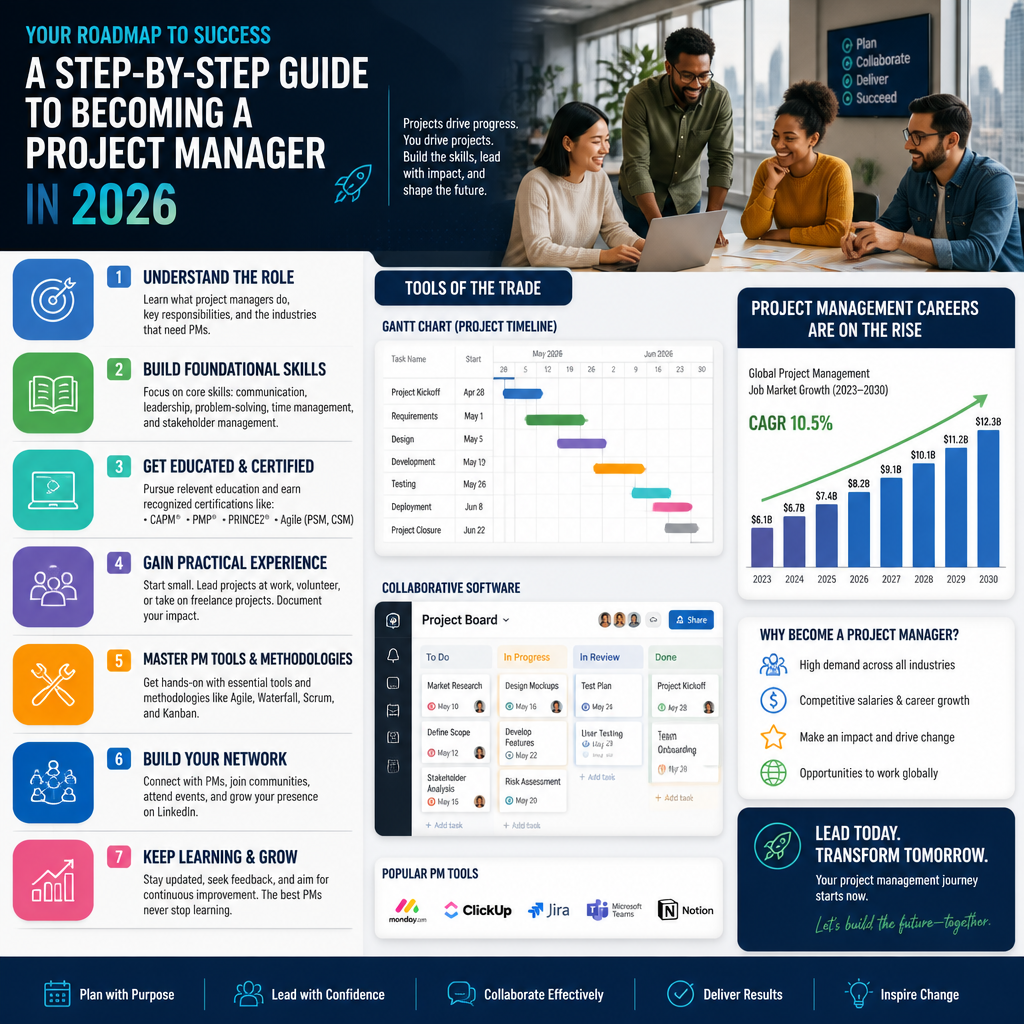
Step-by-Step Guide: How to Become a Project Manager
Getting started in project management can feel daunting, especially if you don't have prior experience. However, there are various routes you can take to secure a project management position. Here’s a step-by-step guide on how to become a project manager, including insights on breaking into the field without existing experience.
1. Understand the Role of a Project Manager
Before you dive into courses and applications, get painfully clear on what the job is.
A project manager’s real job isn’t “being organized.” It’s making sure the team delivers the agreed outcome by the agreed date, within the agreed constraints—while reality keeps changing.
In practice, that means you’re doing four buckets of work over and over:
- Define: What are we doing, for whom, by when, and what’s not included?
- Plan: Tasks, owners, dependencies, risks, budget/time tradeoffs.
- Run the work: Meetings that matter, unblock people, keep decisions moving.
- Close: Confirm acceptance, capture learnings, stop the project from limping along forever.
Common early-career misconception: PMs “own the work.” You don’t. You own the system around the work—clarity, commitments, and follow-through.
A quick self-check I use when coaching someone new: if you can explain the project’s goal, current status, top 3 risks, and next 3 decisions in under 60 seconds, you’re already thinking like a PM.
2. Identify Your Transferable Skills
You might be surprised to realize that you already possess many skills relevant to project management from previous jobs, school projects, or volunteer work. Skills such as communication, leadership, organization, and problem-solving are key assets.
But “transferable skills” only help if you translate them into project-shaped stories.
Here’s a simple way to do that—take anything you’ve done and map it into a mini project:
- Goal: What was the outcome?
- Stakeholders: Who cared (boss, customer, teammates, vendors)?
- Constraints: Time, budget, tools, rules.
- Plan: How did you break it down?
- Execution: How did you coordinate people?
- Result: What changed because you did it?
For instance, coordinating a group project during college or managing a community event can be classified as project management experience, even if it’s informal. As mentioned in a recent article, "this reflects what employers value: an individual's ability to lead regardless of the title or role" (FlashGenius).
Real example (the kind hiring managers actually respect):
You worked retail and got tired of closing shifts being chaos. So you:
- Listed the recurring closing tasks (cleaning, cash, restock, signage).
- Noticed two tasks blocked each other (restock couldn’t happen until inventory count finished).
- Swapped the order, made a one-page checklist, and assigned owners by shift.
- Tracked close time for two weeks.
That’s project management. Not glamorous, but it’s scope, sequencing, ownership, and measurement.
Common mistake: writing “strong communicator” on a resume. Nobody cares. Write: “Aligned 6 stakeholders on scope, reduced rework by standardizing intake checklist.” Even if your “stakeholders” were classmates—own it.
3. Pursue Relevant Education or Certifications
While a degree is not strictly necessary, pursuing a formal education in project management can be beneficial. Consider obtaining certifications such as:
- PMI Project Management Professional (PMP): Highly recognized in the industry.
- Certified Associate in Project Management (CAPM): Ideal for beginners looking to enter the field.
- Agile Certifications: Particularly valuable in tech and construction sectors.
Courses are often available online, making them accessible while you work or study. In fact, online platforms like Coursera and Udemy offer courses that can help you quickly gain the knowledge necessary for this field.
My opinionated take after seeing a lot of resumes:
- If you’re brand new, CAPM or a solid fundamentals course is usually enough to get interviews.
- If you already run work informally (ops lead, coordinator, team lead), PMP can help you break through HR filters.
- If you’re applying in software teams, you don’t need to cosplay a Scrum Master—but you do need to speak “backlog, sprint, dependency, release.” Agile certs can help, but only if you can back them up with examples.
Step-by-step: how I’d choose a cert (without wasting money):
- Pull 15 job postings in your target niche (construction, IT, healthcare, etc.).
- Make a tally of what shows up repeatedly (PMP, CAPM, Agile, tools).
- If a cert appears in more than half, it’s a signal—not gospel, but a signal.
- Pick one program and finish it. Don’t collect half-certificates like merit badges.
Common mistakes:
- Getting certified and stopping there. A certificate is vocabulary; experience is proof.
- Listing “Agile” because you used Trello once. Interviewers will probe.
4. Gain Practical Experience
Getting hands-on experience might be easier than you think. Look for opportunities to volunteer for project management roles in community organizations, or take on additional responsibilities at your current job. Even shadowing a project manager can provide invaluable insights.
The key is to gather experience that demonstrates your ability to handle projects effectively, which can set you apart from other candidates. As a recent guide notes, you can leverage existing skills and find ways to showcase them (Medium).
If you need a practical “experience plan” that isn’t vague, here’s what works:
The 30-day project you can run inside almost any job
- Pick a tiny problem with a clear finish line. Examples: reduce customer response time, clean up a shared drive, improve onboarding, coordinate a small launch.
- Write a one-paragraph charter. Objective, scope (in/out), deadline, success metric.
- Build a simple plan. 10–25 tasks max. Owners + dates.
- Run one weekly check-in. 20 minutes. Decisions and blockers only.
- Close it loudly. Share results: metric before/after, what you learned, what’s next.
Do that twice and you can truthfully say you’ve managed projects end-to-end.
A persona anecdote I see a lot:
A customer support rep wants to pivot to PM. She starts owning a “help center refresh” project—pulls top 20 ticket topics, rewrites articles, coordinates reviews with product/legal, publishes, measures ticket deflection. That’s stakeholder management, scope control, and delivery. In interviews, that story lands harder than “I’m passionate about project management.”
Common mistake: taking on “extra responsibility” that never ends. If there’s no definition of done, it’s not a project—it’s unpaid operations. Put a deadline on it.
5. Networking and Building Connections
Networking is crucial in any career path, but especially in project management. Attend industry conferences, join professional organizations like the Project Management Institute, and connect with individuals on platforms like LinkedIn. Engaging with the community can often lead to job opportunities and mentorship.
According to my experience, attending meetups frequently resulted in discovering unadvertised job openings.
Here’s how to network in a way that doesn’t feel like begging:
- Ask for a 15-minute “role reality check.” Not a job.
- Bring three specific questions:
- “What’s the hardest part of PM in your org?”
- “What do you wish new PMs did in their first 30 days?”
- “What would make a junior candidate stand out to you?”
- End with: “Is there anyone else you think I should talk to?”
Do that five times and you’ll have better intel than any generic career article.
Common mistake: only networking with other beginners. Talk to hiring managers, senior PMs, ops leads—people who actually feel the pain when projects go sideways.
6. Tailor Your Resume and Apply for Positions
When you're ready, it’s time to apply. Tailor your resume to highlight your transferable skills and any relevant experiences. Be sure to emphasize your ability to communicate, lead teams, and manage timelines effectively. Many job postings often list desired soft skills like adaptability, and these should be mirrored in your application materials.
What “tailor your resume” should mean in practice:
- Match the job posting’s language without copying it.
- Put your best project story in the top third of page one.
- Use numbers wherever you can—time saved, dollars avoided, cycle time reduced, stakeholders aligned.
A structure that works (especially for career changers):
- Headline: “Project coordinator / aspiring PM — ops + delivery”
- Core skills: scope, scheduling, stakeholder comms, risk tracking, tools
- Selected projects: 2–4 mini case studies
- Project name
- Goal + constraints
- What you owned
- Result
If you don’t have “project” job titles yet, make a “Projects” section anyway. That’s not a trick; it’s clarity.
7. Prepare for Interviews
Finally, prepare for your interviews. Be ready to articulate how your past experiences relate to project management. Use the STAR method (Situation, Task, Action, Result) to structure your responses, making it easier to convey your capabilities.
I’d add one more layer: interviewers want to know how you think when things break.
So prep these stories:
- A time scope changed late—what did you cut or renegotiate?
- A time a stakeholder disagreed—how did you align them?
- A time a dependency blocked you—what did you do in the first 24 hours?
Step-by-step: the “PM interview drill” I recommend
- Pick one project story.
- Write it in STAR.
- Add a “what I’d do differently next time” line.
- Practice out loud until it’s under 2 minutes.
That last part matters. Rambling is the silent killer in PM interviews.
With over 25 million new project management roles expected globally by 2030, the demand for skilled project managers is significant, especially in sectors like construction and tech. But remember, even entry-level positions may require demonstrable skills, so showcasing what you already have is critical (FlashGenius).
Exploring Pathways in Project Management Careers
You don’t have to take the same route everyone else takes. In fact, most good PMs I’ve worked with came in sideways—from operations, support, design, engineering, the military, events, you name it.
The trick is picking a pathway where your existing strengths are already valued, then adding just enough PM skill to become “obvious” for the role.
Here are a few concrete paths, what they actually look like day-to-day, and how I’d break into each.
Project Management in Construction
The construction industry is among the most significant arenas for project managers. Construction project managers oversee building projects from inception to completion, ensuring compliance with safety regulations and budgets.
To get into construction project management, consider pursuing courses that include:
- Construction Management Certificates: These often cover essential topics such as budgeting, scheduling, and safety regulations.
According to the U.S. Bureau of Labor Statistics, construction managers are projected to grow by 9% through 2033, which translates to about 45,800 job openings each year (The Birmingham Group).
What people underestimate about construction PM: your calendar is the project. Site visits, inspections, permit timing, subcontractor schedules, material lead times—if you miss one dependency, everything wobbles.
Step-by-step entry plan (if you’re outside construction today):
- Learn the basics of scheduling. Get comfortable reading a Gantt chart and understanding critical path.
- Pick up the language. RFIs, change orders, punch lists—know what they are.
- Shadow or coordinate. Even a role like project coordinator/assistant PM is gold.
- Build one portfolio story. Example: “Coordinated vendor schedules and inspections for a small renovation; reduced delays by tightening the weekly lookahead.”
Common mistakes I’ve seen (and they’re expensive):
- Treating change orders as paperwork instead of a scope negotiation.
- Not documenting decisions. Verbal agreements vanish the moment there’s a dispute.
- Overpromising on timelines because you didn’t validate lead times.
Project Management in Tech
The tech industry also offers diverse opportunities for aspiring project managers. Here, project managers often work with software development teams to oversee project timelines and deliverables.
Experience in Agile methodologies can be particularly advantageous. Familiarize yourself with tools like Jira or Trello, which are commonly used in tech environments.
Moreover, the project management software market is expected to grow significantly, from $9.76 billion in 2025 to $11.27 billion in 2026 (monday.com).
What tech PM work actually feels like: less “schedule everything to the hour,” more “keep priorities clean and decisions unblocked.” You’re constantly translating between product, engineering, design, support, and leadership.
A real example (small but real):
I once watched a new PM get crushed because they ran sprint planning like a lecture. Tickets were vague, acceptance criteria were missing, and devs kept discovering requirements mid-sprint. Velocity tanked. The fix wasn’t more meetings—it was better inputs.
Here’s the exact approach that got the team back on track:
- Add a lightweight “definition of ready” (clear title, problem statement, acceptance criteria, dependencies).
- Run a 30-minute backlog grooming before planning.
- Limit WIP and stop pulling in surprise work unless someone explicitly trades it for something.
- Track one metric for a month (carryover work, cycle time, or escaped bugs).
That’s PM value in tech: making the work legible so the team can ship.
Common mistakes in tech PM:
- Confusing “Agile” with “no deadlines.” Leadership will still ask for dates.
- Letting stakeholders inject work mid-stream without a tradeoff.
- Reporting status without highlighting decisions needed. Status isn’t the point—movement is.
Engineering Project Managers
For those with an engineering background, becoming a project manager in engineering can be a natural progression. Here, project managers are needed to coordinate technical teams and ensure projects meet engineering standards. The specialized knowledge you have can set you apart in this competitive field.
What I’d watch out for if you’re an engineer moving into PM:
- Your instinct will be to solve the technical problem yourself. Sometimes that helps. Often it hurts—because the team still needs coordination, and you’ll become the bottleneck.
- Practice saying: “Who owns this?” and “What’s the next decision?” That’s the PM muscle.
A clean way to transition without whiplash:
Start by owning one cross-team initiative (tooling migration, reliability improvements, compliance project). Keep your technical credibility, but deliberately shift your energy to aligning people, sequencing work, and communicating risk.
Conclusion
Stepping into a project management career is entirely possible, but the path that works isn’t “wait until you’re ready.” It’s: start managing small projects now, collect proof, then level up your scope.
If you take only one idea from this: hiring managers don’t need you to have the title—they need you to have evidence. A tight project story with a measurable result beats a fluffy resume every time.
Here’s a practical next step you can do this week (seriously, in a few hours):
- Pick one project you’ve already done (work, school, volunteering).
- Write a 6-line case study:
- Goal
- Stakeholders
- Timeline
- Your actions
- Result (number if possible)
- What you learned
- Turn that into:
- One resume bullet
- One LinkedIn post (optional)
- One interview story
A quick “I’ve seen this work” anecdote:
A friend of mine was stuck in an admin role, constantly told she wasn’t “technical enough” to be a PM. She started running a small internal rollout—new intake form, new process, training session, two-week check-in cycle. She documented the before/after (fewer missed requests, clearer priorities), and she brought that one-page write-up to interviews. She didn’t just say she could manage projects; she showed she already had.
Also—don’t ignore the messy reality: you will mess up a timeline, you’ll underestimate a dependency, you’ll have a stakeholder go silent. That’s the job. The difference between a beginner and a pro is how fast you surface the risk, how clearly you communicate tradeoffs, and whether you close the loop.
For assistance in crafting content that aligns with project management strategies, tools like Sibgha Jamil can streamline your process significantly.
Pick your first small project, ship it, write it up, and go apply. That’s the whole game.
Leave a Reply