Discover what machine learning is in 2026, including its types, applications, and core concepts.
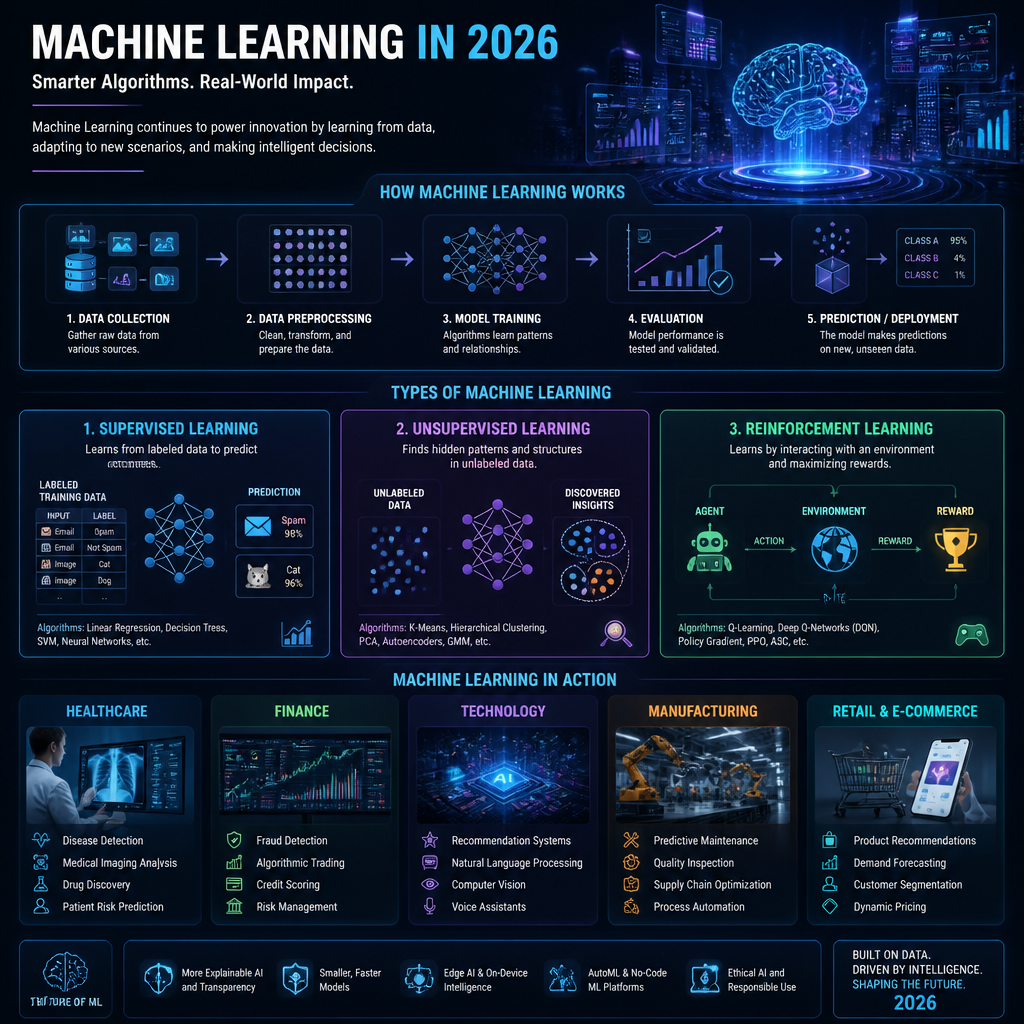
Exploring Types and Applications of Machine Learning
Machine learning is a subset of artificial intelligence (AI) that learns patterns from data and then uses those patterns to predict, rank, classify, or generate outputs. So instead of writing a pile of if/else rules, you feed it examples, pick a learning approach, and measure how well it performs.

Applications of Machine Learning
Machine learning is not just a buzzword—it’s a set of tools that companies use to reduce manual decisions, spot patterns humans miss, and move faster with fewer mistakes. That said, the “best” application is usually the boring one that ties directly to cost, risk, or revenue.
-
Healthcare: ML models help with early diagnosis, patient risk scoring, and operational planning. A common use is predictive models that flag patients who might deteriorate, so clinicians can intervene earlier. That doesn’t mean a model replaces a doctor—usually it’s a triage and prioritization tool that helps the team spend attention where it matters. According to a Helpware article, machine learning is used in predictive healthcare models to improve patient outcomes dramatically.
-
Finance: Fraud detection is the classic example, but it’s only half the story. Banks also use ML for credit risk signals, anti-money-laundering alert ranking, and even customer support routing. The trick is tuning for the right tradeoff: if you catch 99% of fraud but block 5% of legit transactions, you’ll lose customers fast.
-
E-commerce: Recommendations, search ranking, “customers also bought,” dynamic pricing, inventory forecasting—this is where ML prints money when it’s done right. But it can also backfire. I’ve seen recommendation models overfit to short-term clicks and accidentally push low-margin products, which looked good in dashboards and terrible in profit.
-
Transportation: Autonomous driving grabs headlines, but plenty of ML value is quieter—route optimization, predictive maintenance, demand forecasting, and anomaly detection on sensor data. A fleet that avoids downtime by predicting failures a week early will beat a fleet chasing full autonomy demos.
-
Marketing: ML can segment audiences, score leads, and optimize ad spend, but the real gain is usually measurement. If your attribution data is noisy, the model will confidently optimize the wrong thing. So you end up paying more for “better performance” that isn’t real.
A real-world example (recommendations)
Here’s a simple, realistic scenario I’ve seen: an online store wants to increase average order value.
- Naive approach: “Recommend the most popular items.” Easy, but it mostly shows what people already know.
- ML approach: Train a model on sessions (views, add-to-cart, purchases) to predict “next product likely to be purchased.”
- Messy part: returns and cancellations. If you train on raw purchases only, you may recommend items that sell a lot but get returned constantly.
When teams add return-rate as a negative signal, the recommendations usually get less flashy, but margins improve. That’s the kind of tradeoff that matters in production.
What’s the Difference Between AI and ML?
AI is the umbrella term: any system that does something we’d call “smart” (reasoning, planning, perception, language). Machine learning is one way to build AI, and it’s the dominant way now because it adapts to data.
I explain it like this:
- AI is the goal: “make the machine behave intelligently.”
- ML is one method: “learn the behavior from data.”
So, yes—most modern AI products you touch daily are powered by ML. But no—rule-based systems, search algorithms, and hand-built decision engines can still be “AI” even if they don’t learn.
Understanding Machine Learning: A Simple Explanation
If you remember one thing, make it this: machine learning is a workflow, not magic. You decide what you want to predict, gather the right data, train a model, test it honestly, then deploy it with guardrails.
What is Machine Learning How Does it Work?
Most ML projects follow a loop. The loop is the work.
Step-by-step: the basic ML pipeline
-
Define the task: Are you predicting a number (demand forecasting), choosing a category (spam vs not spam), or ranking options (which product to show first)? This sounds obvious, but teams mess it up by starting with “we need AI” instead of “we need fewer chargebacks” or “we need faster triage.”
-
Collect and label data: In supervised learning, you need examples with correct answers (labels). In fraud, labels might be “confirmed fraud” vs “legit.” In support, labels might be “billing issue” vs “technical issue.” Labeling is slow and expensive, so people cut corners—and then wonder why the model fails.
-
Split the dataset: Train set, validation set, and test set. If you don’t do this properly, you’ll fool yourself. I’ve watched teams celebrate a 98% accuracy score… until we realized the same customer IDs appeared in both train and test data.
-
Choose a baseline first: Before neural networks, try something dumb and measurable. Logistic regression, a small decision tree, even “predict last week’s value.” Baselines keep you honest, and they’re often surprisingly competitive.
-
Train the model: The algorithm adjusts internal parameters to reduce error. In deep learning, that’s weight updates via backpropagation. In trees, that’s splitting rules. Either way, you’re optimizing for a metric.
-
Evaluate with the right metric: Accuracy is a trap for imbalanced problems. Fraud detection often needs precision/recall, AUC, or cost-based metrics. A model that flags every transaction as fraud can be “accurate” if fraud is rare—while still being useless.
-
Deploy with monitoring: This is where ML becomes real software. You track latency, error rates, and also model drift (when the world changes and the model’s assumptions stop matching reality).
-
Retrain and iterate: Data changes, users change, products change. In 2026, mature teams schedule retraining (weekly/monthly), run canary releases, and keep rollback plans.
Common mistakes I see (and how to avoid them)
- Training on data you won’t have later: If you use “chargeback confirmed” as a feature at prediction time, congrats—you built a time machine. Keep features limited to what exists at the moment you need a decision.
- Leaking the label: Anything that directly encodes the target (or future info) will inflate performance.
- Ignoring feedback loops: Your model changes user behavior, which changes the data, which changes the model. Recommendations are notorious for this.
- Shipping without a fallback: If the model fails, what happens? A safe default beats a broken “smart” feature.
Machine Learning Definition and Examples
In simple terms, machine learning lets a computer learn from past examples to make a decision on new data. It’s pattern learning with measurement.
Example 1: spam detection (the classic)
Email services label messages as spam or not spam based on:
- word patterns (but also metadata like sender reputation)
- user actions (marking spam, deleting, replying)
- message structure (links, domains, attachment types)
A practical detail: spam models don’t just classify; they often score. Then the product team sets thresholds. Raise the threshold and you catch more spam but risk false positives (missing important emails). Lower it and inbox quality drops.
Example 2: streaming recommendations (Netflix-style)
Recommendation systems learn from:
- what you watched
- what you stopped watching after 3 minutes
- what you searched for
- what people similar to you watched next
The “gotcha” is that you can optimize for the wrong target. If you optimize only for clicks, you can end up with a feed that feels addictive but not satisfying. Good teams include longer-term signals (completion rate, return visits, thumbs-up/down) so the model aligns with user happiness, not just short-term engagement.
My Experience With This
I’ve watched ML projects succeed for one reason: the team treated it like a product, not a science fair.
One of the most useful patterns I’ve used (and re-used) is prediction + workflow. The model doesn’t “solve fraud” or “solve churn.” It produces a score, then the business wraps a workflow around it—review queues, thresholds, approvals, and auditing.
A mini story: the dashboard that lied
A while back, I helped a team rolling out an ML feature to rank support tickets by urgency. The model looked great in offline tests. Then we deployed it and support agents complained within a week.
What happened?
- The training labels came from historical “priority” fields.
- Those fields were inconsistent—different managers used different definitions.
- The model learned the inconsistencies perfectly.
So, yes, the metrics were “good,” because we trained the model to match messy labels. After we fixed the labeling process (clear rubric + quick sampling audits), performance actually improved in the real world.
What I do now by default
- I insist on a baseline (even a simple rules engine) because it forces clarity.
- I review the data schema early (null rates, outliers, timestamp sanity). It saves weeks.
- I ship with monitoring: latency, drift, and a human override. If your model can’t be overridden, it will eventually cause an incident.
If you’re new to this, that might sound cautious. It is. I’m biased toward boring and reliable, because production ML punishes ego.
Frequently Asked Questions
- Q: What is machine learning in simple terms?
A: Machine learning is when computers learn patterns from data so they can make a decision on new data—without you writing every rule.
Think of it like training a new teammate: you show them lots of examples (good and bad), you correct them, and over time they get better at making the call. The difference is that a model “learns” as math, not as understanding.
- Q: What’s the difference between AI and ML?
A: AI is the broad goal (machines doing intelligent tasks). ML is a common way to reach that goal (learning behavior from data). So ML sits inside AI.
A quick litmus test: if the system improves because it retrains on new data, that’s usually ML. If it improves because a developer rewrote rules, it may still be AI, but it’s not learning.
- Q: Is ChatGPT AI or machine learning?
A: ChatGPT is AI built using machine learning—specifically large neural networks trained for natural language processing.
Practically, that means it learned statistical patterns from huge amounts of text and then generates the next token (word-piece) based on context. It doesn’t “know” facts the way a human does, so you still need verification when stakes are high.
- Q: Is machine learning difficult?
A: The math can get deep, but you don’t need a PhD to build useful ML systems. The harder part for most teams is the operational side: data quality, evaluation, deployment, monitoring, and dealing with edge cases.
If you want a sane learning path, start by building one small project end-to-end (data → model → evaluation → simple deployment). You’ll learn more from that than from reading 20 definitions.
- Q: What should I learn first in 2026?
A: Start with fundamentals that transfer: how to frame a problem, basic supervised learning, evaluation metrics, and data handling. Then move into one applied area (recommendations, time series, NLP, computer vision) based on what you actually want to build.
If you’re building for a business, learn how to connect model outputs to a workflow. That’s where ML becomes valuable.
Leave a Reply