Author: dev@revnix.com

  • AI Email Transformation: The Future of Email in 2026

    Discover how AI will revolutionize email experiences by 2026, enhancing personalization, efficiency, and deliverability.

    Featured image for How AI Will Transform Your Email Experience in 2026

    Featured image for How AI Will Transform Your Email Experience in 2026

    Understanding Email in 2026

    By 2026, email won’t feel like a dumb pipe for messages. It’ll behave more like an adaptive workspace—AI sitting between you and the inbox, constantly deciding what deserves attention, what can wait, and what’s probably junk.

    That matters because email is still massive. We’re talking nearly 4.7 billion email users globally, projected to reach around 4.89 billion by 2027 (Statista). At that scale, tiny improvements—better timing, better relevance, fewer spam complaints—compound fast.

    Here’s the part people miss: AI doesn’t just “write emails.” In the real world, the biggest gains come from three unsexy areas:

    1. Decisioning (who gets what, when)
    2. Deliverability hygiene (auth + reputation protection)
    3. Feedback loops (learning from results without waiting for a quarterly report)

    AI-Driven Personalization

    In 2026, personalization is less about sprinkling in a first name and more about predicting intent. AI will generate content and choose offers based on behavior, preferences, and interactions—not just what you say you like, but what you actually do.

    Organizations using AI in email marketing can see a 17–26% lift in revenue per send (Digital Applied). I believe that range because I’ve watched “batch-and-blast” lists turn into behavior-based segments and suddenly the same list size produces noticeably more revenue—without increasing volume.

    A concrete 2026-style personalization stack usually looks like this:

    • Behavioral inputs: pages viewed, product usage, support tickets, previous clicks
    • Context signals: device, time zone, typical open time, purchase cycle stage
    • Creative assembly: subject line + intro + offer block chosen dynamically
    • Send-time optimization: AI picks a window when the user is historically receptive

    Real example I’ve seen (and fixed): a SaaS company personalized only the hero image and subject line. Looked fancy. Revenue didn’t move. Once we switched to behavior-based branching (trial user who hit a feature limit vs. trial user who never invited teammates), conversions jumped—not because the copy was prettier, but because the email finally matched the moment.

    Common mistake: letting AI “personalize” itself into nonsense. If your product data is messy (duplicate events, wrong lifecycle stage, stale attributes), the model confidently produces the wrong email. The fix isn’t more prompts; it’s cleaning your tracking and enforcing a few hard rules (like “don’t pitch an upgrade to someone who churned last week”).

    Enhanced Deliverability

    Deliverability is where AI will quietly earn its keep. Not by “beating spam filters” with tricks—those tricks tend to die fast—but by keeping your sending program aligned with modern requirements and reputation signals.

    With evolving authentication standards like SPF, DKIM, and DMARC, emails sent without proper authentication can see inbox placement rates drop to as low as 44% (Topol). That number tracks with what I’ve seen when a domain’s auth breaks or a new subdomain is spun up without the right records—sends don’t bounce, they just vanish into spam/promo purgatory.

    By 2026, AI systems will do more of the “boring checks” automatically:

    • Verify SPF/DKIM/DMARC alignment before a campaign launches
    • Detect unusual bounce/complaint spikes early (before the damage spreads)
    • Predict which segments or subject lines are likely to trigger spam complaints
    • Recommend throttling or warm-up when volume jumps

    Step-by-step deliverability workflow I’d run in 2026 (still works now):

    1. Preflight auth: confirm SPF/DKIM/DMARC pass for the exact from-domain.
    2. Segment risk scoring: new recipients, old recipients, recent engagers.
    3. Send in waves: start with high-engagement users, then expand.
    4. Monitor complaints + bounces: adjust fast, don’t “wait and see.”
    5. Post-send learning: feed outcomes back into segmentation rules.

    Common mistake: people treat authentication as a one-time setup. Then someone changes DNS, migrates ESPs, or adds a new sending domain—and nobody re-validates. AI-driven compliance checks should catch that stuff before it costs you weeks of reputation recovery.

    AI-Powered Campaign Analysis

    The analysis piece is where AI stops being “automation” and becomes decision support. By late 2026, it’s expected that 61% of enterprise email programs will incorporate AI across multiple elements of campaign development (Digital Applied).

    In practice, that looks like:

    • Subject line tests that don’t just pick winners, but explain why something won
    • Content recommendations based on downstream metrics (not just opens)
    • Segmentation suggestions that you can approve (or reject) with guardrails
    • Real-time monitoring that flags anomalies (deliverability dip, CTA fatigue)

    Anecdote: I once watched a team celebrate a huge open-rate lift from AI-written subject lines—then revenue stayed flat. The AI had learned how to trigger curiosity opens, but the body didn’t deliver value. In 2026, better systems will optimize for what you actually care about: conversions, retention, pipeline—whatever your north star is.

    Setting Up Your Gmail Experience

    If you want to benefit from AI in email—not just read about it—your daily inbox setup matters. Gmail is where a lot of this gets productized first, and it’s also where bad habits (chaos labeling, “I’ll search later,” 9,000 unread) will punish you.

    Even if you’re focused on marketing, the way you handle email is a decent proxy for how your customers experience it. If your own inbox is a mess, odds are your program is too.

    Creating Your Gmail Account

    Creating a Gmail account is still the front door. Go to the Gmail account creation page, set the basics, and then do one thing most people skip: decide what this inbox is for.

    Quick setup that saves headaches later:

    1. Create the account.
    2. Turn on 2-step verification (not glamorous, but it prevents account takeover).
    3. Decide whether this inbox is personal, business, or “testing/newsletters.”
    4. If it’s for business, use a consistent identity (name + profile) so people recognize you.

    Why so strict? Because AI features like priority sorting and suggested replies work better when the inbox has consistent patterns—real conversations vs. random promotional junk.

    Optimizing Gmail Features

    Gmail will keep expanding AI features in 2026. Some of them are legitimately useful; some are “nice demos” that can also create risk if you blindly trust them.

    Here are the ones I’d actually bet on:

    • Smart Compose: speeds drafting. Great for repetitive replies, dangerous for nuance. I use it for structure, then I rewrite the sentence that matters.
    • Priority Inbox: reduces cognitive load by surfacing what you tend to respond to. The win isn’t magic sorting—it’s fewer context switches.
    • Smart Reply: useful for quick acknowledgments, but it can make you sound like a robot if you never edit.
    • Dynamic Email Content: emails that update based on interaction, status changes, or preferences.

    Step-by-step: a Gmail setup I’ve shipped for busy teams (support leads, founders, sales):

    1. Pick one inbox style: Priority Inbox or a clean default. Don’t keep switching.
    2. Create 3–5 labels max: “Waiting on,” “Finance,” “Customers,” “Internal,” etc.
    3. Add filters for the obvious noise: receipts, system alerts, newsletters—label them and skip the inbox when appropriate.
    4. Turn on nudges/follow-ups: the AI reminder features are worth it if you’re prone to dropping threads.
    5. Use templates cautiously: templates + AI can speed replies, but review the first two lines every time (tone mistakes happen there).

    Common mistakes I see:

    • Turning on every feature, then blaming Gmail when it feels chaotic.
    • Using Smart Reply in sensitive situations (refunds, escalations) and sounding cold.
    • Letting “Priority” hide things you actually needed—then missing a deadline.

    The goal is simple: set Gmail up so AI reduces your workload without quietly making decisions you didn’t approve.

    The Future of AI in Email Environments

    As we head into 2026, AI in email shifts from “help me write” to “help me decide.” The best systems will act like a sharp assistant: summarizing threads, suggesting next actions, and preventing avoidable mistakes.

    The worst systems will confidently do the wrong thing at scale. So you’ll want guardrails.

    Intelligent Automation

    Automation is going to eat the low-value parts of email. According to Qualtir, AI will handle low-priority emails, freeing professionals to focus on higher-value communication.

    That aligns with what I’m seeing already: the most valuable automation isn’t auto-writing full messages—it’s:

    • Summarizing long threads into decisions + open questions
    • Drafting a reply you can approve in 20 seconds
    • Auto-labeling and routing (billing vs. support vs. sales)
    • Detecting when a message shouldn’t be sent yet (missing info, wrong recipient)

    Real scenario: a support manager gets 120 emails/day. AI triage can route 40 of those to the right queue, summarize 30, and mark 20 as “FYI.” Now they’re only truly writing maybe 30. That’s a different job.

    Common mistake: automating without an “escape hatch.” Always keep a manual review path for edge cases—VIP customers, legal requests, chargebacks, anything reputational.

    Behavioral Analysis

    AI will get much better at understanding behavior patterns and using them to segment. Done right, you send fewer emails and earn more.

    Campaigns leveraging behavioral data can generate up to 760% more revenue than traditional broadcast sends (Digital Applied). Big number, but believable when you compare “everyone gets the same promo” to “only people showing intent get the right message.”

    Step-by-step: how I’d implement behavioral segmentation without making it creepy

    1. Start with 3 intent buckets: high intent, warm, cold.
    2. Define the events that move someone between buckets (pricing page view, trial activation, repeat purchase).
    3. Cap frequency per bucket (cold users get fewer emails).
    4. Add a fallback for missing data (don’t guess wildly).
    5. Measure outcomes beyond opens: revenue per send, churn, unsubscribes.

    Mistake I’ve cleaned up: teams ingest every event they can, then let AI decide. You end up targeting someone because they opened a random transactional email, not because they actually wanted the product. Fewer, higher-signal events beat “everything plus AI.”

    Enhanced User Experience

    By 2026, more emails will be interactive and preference-driven. Think:

    • Embedded actions (confirm, schedule, update preferences)
    • More transparent data use (explicit preferences, “zero-party” data)
    • Tone and accessibility improvements (clearer language, better formatting)

    This is where trust becomes the real KPI. If your AI-generated emails feel manipulative, you’ll pay for it in spam complaints and unsubscribes. If they feel helpful—short, relevant, timely—people keep you.

    A quick gut-check I use: if a recipient could reasonably say “wait, how did they know that?” then you’re probably over-targeting. Make the relevance explainable.

    Conclusion

    AI will transform your email experience in 2026, but not in the sci-fi way people pitch on slides. The practical transformation is this: less manual sorting, fewer wasted sends, faster iteration, and more pressure to be trustworthy because the tools are powerful.

    If you’re a business, the advantage won’t come from “using AI.” It’ll come from using AI with constraints: clean data, sane segmentation, authentication locked down, and humans reviewing the handful of messages where tone and judgment matter.

    If you’re an individual living in Gmail all day, set up your inbox so the AI is working for you, not just adding another layer of suggestions to ignore. Spend an hour on filters, labels, and priority rules—you’ll get that time back in a week.

    Next step: pick one area—personalization, deliverability, or automation—and improve it end-to-end. Half-implementations are where email programs go to die.

    FAQ

    What is AI email transformation?

    AI email transformation is using artificial intelligence to improve how email is created, delivered, and managed—especially personalization, deliverability, automation, and performance analysis.

    A real-world example: instead of manually writing 10 versions of an email, AI helps draft variants, predicts the best send time per segment, and flags deliverability risks before you push send.

    How will AI improve email personalization by 2026?

    By 2026, AI will use behavior and preferences to tailor content, timing, and offers. The big shift is from “static segments” (like industry or job title) to dynamic intent (what the user is doing right now).

    Practical example: a user visits your pricing page twice in 48 hours. AI can trigger a short email that answers the top objections for that plan, rather than dumping them into your next generic newsletter.

    Common mistake: over-personalizing with weak signals. If you personalize based on one accidental click, it feels random—and people unsubscribe.

    What should I do to prepare my email marketing for 2026?

    Do three things in order:

    1. Fix authentication and sending discipline (SPF/DKIM/DMARC, list hygiene, frequency caps).
    2. Define a simple behavioral model (3–5 lifecycle stages max) and map triggers.
    3. Introduce AI where it saves time safely (drafting, summarization, analysis) and keep humans in the loop for sensitive flows.

    If you can’t explain why a customer got an email in one sentence, your system’s too complicated—or your data’s lying to you.

  • Top Email Marketing Platforms for 2026

    Discover the best email marketing platforms for small businesses in 2026. Compare features, costs, and user satisfaction.

    Featured image for Email Marketing Platforms: Which Is Best for 2026?

    Featured image for Email Marketing Platforms: Which Is Best for 2026?

    Comparing Email Marketing Platforms for 2026

    If you’re doing email marketing for small businesses, your platform choice shows up everywhere: how quickly you can ship campaigns, how clean your list stays, whether automations actually run, and whether you can tie email to revenue without a spreadsheet circus.

    In 2026, most platforms can “send newsletters.” That’s table stakes. What separates them is:

    • Automation depth (can you build real branching journeys, or just simple autoresponders?)
    • Segmentation (behavioral, purchase-based, lead-source-based, engagement-based)
    • Integrations (Shopify/WooCommerce, booking tools, CRMs, forms, ad platforms)
    • Reporting that you’ll actually use (revenue attribution, cohort performance, deliverability signals)
    • Team workflow (approvals, roles, templates, multi-brand setups)

    One opinion upfront: don’t buy a “power platform” because you feel like you should. Buy it because you have a specific automation or segmentation problem you can’t solve otherwise. I’ve seen small teams spend months building elaborate flows… when two clean segments and a weekly send would’ve outperformed everything.

    Top Email Marketing Platforms

    Here are the common players you’ll keep running into, plus what they’re genuinely good at.

    1. Mailchimp

      • Best for: Small businesses focusing on ease of use.
      • Strengths: Comprehensive integrations, user-friendly interface, and strong analytics.
      • Pricing: Starts at $11/month.
    2. Klaviyo

      • Best for: E-commerce brands wanting deep insights.
      • Strengths: Advanced segmentation and reporting features.
      • Pricing: Free tier, paid plans from $20/month.
    3. ActiveCampaign

      • Best for: Marketing teams needing multi-channel engagement.
      • Strengths: Robust automation and CRM capabilities.
      • Pricing: Plans start at $39/month.
    4. MailerLite

      • Best for: Beginners and those on a tight budget.
      • Strengths: Simple drag-and-drop editor and landing page features.
      • Pricing: Free plan available, paid plans from $10/month.
    5. ConvertKit

      • Best for: Creators and bloggers.
      • Strengths: Easy funnels for lead generation and digital products.
      • Pricing: Free tier, paid plans from $15/month.

    If you’re stuck, start by labeling yourself honestly:

    • Local service business (dentist, salon, contractor): you need reminders, seasonal promos, simple segmentation.
    • E-commerce (DTC or niche retail): you need product-driven flows, purchase segmentation, abandoned cart, post-purchase, winback.
    • Creator/education (courses, coaching, newsletter): you need opt-ins, lead magnets, tagging, and simple sales sequences.
    • B2B services/SaaS-lite: you need lead scoring, CRM-ish behavior, longer nurturing.

    Then choose the platform that’s “boring and reliable” for that model. You’re not buying potential—you’re buying a system you’ll use every week.

    What I’d evaluate first

    People love comparing feature checklists. I don’t. I evaluate platforms in a practical order:

    1) Deliverability basics

    If your emails don’t land in the inbox, nothing else matters. Most reputable tools handle the fundamentals, but your outcomes depend on your list hygiene and sending habits.

    What I look for:

    • Easy-to-find unsubscribe management
    • Bounce and complaint handling that isn’t buried
    • Simple segmentation by engagement (opened/clicked in last X days)

    2) Automation you can maintain

    The best automation is the one you’ll maintain when you’re busy.

    A simple, high-performing starter set for many small businesses:

    • Welcome sequence (2–4 emails)
    • Abandoned cart (if e-commerce)
    • Post-purchase follow-up (care tips, review request, cross-sell)
    • Lapsed customer winback (after 60–120 days, depending on your cycle)

    If a platform makes those hard to build, or hard to understand six months later, you’ll pay for it later.

    3) Segmentation that matches how you make money

    Segmentation isn’t “advanced.” It’s just relevance.

    Examples that actually move revenue:

    • Customers vs. non-customers
    • High AOV buyers vs. bargain buyers
    • People who bought Category A but not Category B
    • Leads from “discount popup” vs. “content download”

    Klaviyo is particularly strong for e-commerce-style segmentation. ActiveCampaign is strong when segmentation needs to blend with CRM-ish behavior.

    4) Integrations you won’t regret

    This is where hidden cost lives.

    Common integration traps I’ve seen:

    • Your form tool doesn’t pass source/UTM cleanly, so you can’t segment by acquisition channel.
    • Your checkout tool syncs customers but not line items, so product-based segmentation becomes a hack.
    • Your booking tool doesn’t trigger events reliably, so reminders and follow-ups misfire.

    If you’re on Shopify, you’ll feel these issues immediately. If you’re on a service stack (Squarespace + Acuity/Calendly + Zapier), you’ll feel them slowly—then all at once.

    Real-world examples

    Here’s what “platform fit” looks like when it’s real, not theoretical.

    • A recent case study showed that small businesses using Klaviyo experienced an average revenue growth of 20% after implementing targeted email automation. That tracks with what I’ve seen when an e-commerce brand goes from “blast everyone” to a few tight segments plus lifecycle flows.

    • Similarly, businesses that transitioned to ActiveCampaign reported improved engagement rates by over 30% after personalizing their email campaigns. In practice, this often happens when a business stops sending generic newsletters and starts sending role- or interest-based sequences.

    A quick story from the trenches: I once watched a small online shop move to a more “powerful” platform because they wanted smarter automations. The tool wasn’t the problem—their data was. Product names were inconsistent, events were firing twice, and half the list came from an old giveaway. They spent weeks building flows that looked gorgeous and performed… fine.

    The fix wasn’t new software. It was:

    • cleaning the list,
    • standardizing product categories,
    • setting a hard rule to suppress unengaged subscribers,
    • and simplifying flows to match their actual buying cycle.

    Once that happened, the same platform finally looked “amazing.”

    Getting started with email marketing

    If you’re asking, “How do I start email marketing?”, don’t start with a 20-email automation masterpiece. Start with a system you can run every week.

    Here’s a step-by-step setup I’d recommend for most small businesses:

    1. Build your audience (opt-in only)

      • Put a signup form in obvious places: homepage, blog, checkout, booking confirmation.
      • Offer a simple reason to join (discount helps e-commerce; a useful checklist works great for services).
    2. Set up your minimum viable segments

      • New subscribers (last 30 days)
      • Active engaged (opened/clicked in last 60–90 days)
      • Customers (if you can track purchases)
      • Lapsed (no open/click in 90–180 days, depending on send frequency)
    3. Write two campaigns before you write ten

      • One “value” email (teach, show before/after, answer a common question)
      • One “offer” email (specific product/service, clear deadline, clear CTA)
    4. Create a short welcome sequence

      • Email 1: deliver the offer/lead magnet + set expectations
      • Email 2: your best proof (reviews, results, story)
      • Email 3: a clear next step (book, buy, reply)
    5. Track the right metrics

      • Don’t obsess over vanity opens.
      • Watch clicks, conversions, revenue (if applicable), unsubscribe rate, and list growth.

    Common early mistakes (I’ve made some of these myself):

    • Sending to the whole list forever (no segmentation)
    • Never cleaning unengaged subscribers (deliverability slowly tanks)
    • Over-designing emails instead of writing clear copy
    • Testing subject lines while ignoring the offer and landing page

    Assessing the Costs of Email Marketing

    Email looks cheap—until you add up the real operating cost: list growth, higher tiers, integrations, time spent building automations, and sometimes outside help to stop things from breaking.

    Still, the channel is usually worth it. As of 2026, the average ROI for email marketing continues to be impressive, with estimates showing that for every $1 spent, businesses can expect between $36 to $42 in return. I treat that range as “possible when you’re doing the basics well,” not a guarantee. But I’ve seen enough accounts where email is the highest-margin channel that I’m comfortable budgeting for it early.

    The cost buckets that actually matter

    Most small business owners only look at the monthly plan price. That’s only one slice. Here’s the full picture.

    1) Platform fees (the obvious part)

    • Basic Plans: Many platforms offer free tiers or basic packages starting around $10 to $20 per month.
    • Paid Plans: These can range from $50 to $300 monthly, depending on features and the size of your email list.

    The gotcha: pricing often scales on contacts, not sends. If you never clean your list, you’ll pay for ghosts.

    2) Integration and tooling costs (the sneaky part)

    Even if your platform is $20/month, you might also be paying for:

    • a form tool
    • an SMS add-on
    • Zapier/Make automations
    • Shopify/WooCommerce apps
    • a landing page builder

    None of those are “wrong.” But this is how a $20/month email stack turns into $180/month.

    My bias: consolidate when you can. Fewer moving parts means fewer broken zaps, fewer missing tags, fewer support tickets.

    3) Creative + operational time (the part you feel)

    Some teams do everything in-house. Others need help.

    • Freelancer/Agency Costs: Hiring external help typically ranges from $50 to $150 per hour, depending on expertise.

    Where that money tends to go:

    • template setup and brand styling
    • automation building (welcome, cart, post-purchase)
    • segmentation logic
    • monthly campaign production
    • reporting and experimentation

    If you’re hiring help, be clear about outcomes. “Build me a welcome flow” is vague. “Build a 3-email welcome flow for new leads that pushes a first purchase within 10 days” is actionable.

    A practical step-by-step cost estimate

    Let’s do a realistic scenario. Say you’re a small e-commerce brand or local business with an online booking flow.

    Assumptions (keep it simple):

    • You start on a $10–$20/month plan.
    • You send 4 campaigns per month.
    • You have one short welcome automation.
    • You spend 3–5 hours/month writing and building emails.

    Month 1 setup:

    1. Choose platform tier: $10–$39 (depends on tool)
    2. Set up forms + basic segments: 1–2 hours
    3. Write welcome sequence (3 emails): 2–4 hours
    4. Create one reusable template: 1–3 hours

    If you do it yourself, your cash cost might be low—but your time cost is real.

    Ongoing monthly:

    • Platform: $10–$300 depending on list size/features
    • Your time: ~3–8 hours/month if you’re consistent
    • Optional: freelancer help (say 2 hours/month): $100–$300/month

    The point: email is rarely expensive in cash at the beginning. It becomes expensive when you either (a) scale successfully, or (b) ignore list hygiene and pay for dead contacts.

    How much is a 1000 email list worth?

    People ask this when they’re tempted to buy lists or run lead-gen ads. The numbers get thrown around a lot, so here’s what you stated (and what I typically see quoted in the market):

    • Consumer Lists: Typically cost between $100 to $400 CPM.
    • B2B Lists: May exceed $600 to over $1,000 CPM, depending on the specificity and quality of the data.

    Now my stance: buying lists is almost always a bad move for small businesses.

    Not because it’s morally wrong. Because it’s mechanically self-sabotage:

    • You’ll get low engagement.
    • You’ll rack up complaints and bounces.
    • Your deliverability can degrade, which then hurts emails to your real subscribers.

    If you want a “worth it” framing for a list of 1,000 opt-in subscribers, I use a simpler question:

    If I email these 1,000 people once a week for the next year, can I create enough value (and offers) to earn more than the platform cost?

    When the list is permission-based and aligned with what you sell, the answer is usually yes.

    Two cost mistakes I keep seeing

    Mistake 1: Paying for features you don’t operationalize

    Example: a team pays for advanced automation but only sends a monthly newsletter. That’s not “bad,” but it’s wasted budget.

    Fix: either downgrade, or commit to 2–3 automations that match your customer journey.

    Mistake 2: Never pruning unengaged subscribers

    This one is brutal. Your list grows, your bill grows, and deliverability drifts down.

    Fix: create a segment like “no opens/clicks in 120 days,” then suppress or run a re-engagement campaign. Be willing to let people go.

    A real example: cost vs. outcome

    One of the cleanest wins I’ve seen for a small service business (think: high-margin appointments, not e-commerce) was embarrassingly simple.

    They were paying for a mid-tier plan because their list was bloated—years of contacts, most of whom hadn’t engaged in forever. Campaign performance was mediocre, and they assumed email “didn’t work anymore.”

    We did three things over two weeks:

    1. Segmented engaged vs. unengaged (based on recent opens/clicks).
    2. Stopped emailing the unengaged group (immediately lowered sends and reduced noise).
    3. Built a 3-email follow-up after a quote request: confirmation → proof → last-chance nudge.

    Result: platform costs dropped (fewer billable contacts), engagement went up, and they started getting bookings that were clearly attributable to those follow-ups.

    No fancy AI. Just discipline.

    Conclusion

    Choosing the right email marketing platform in 2026 isn’t about picking the tool with the longest feature list. It’s about picking the tool you’ll actually use to run a simple, repeatable communication system—one that earns trust and revenue without eating your week.

    Here’s the decision I’d make if I were in your shoes:

    • If you want a straightforward tool that won’t intimidate you, start with Mailchimp or MailerLite.
    • If you sell products online and want segmentation that maps to purchase behavior, Klaviyo is hard to ignore.
    • If your business needs deeper journeys, lead scoring, and CRM-like coordination, ActiveCampaign is usually worth the learning curve.
    • If you’re a creator selling digital products or building a newsletter-first business, ConvertKit stays pleasantly focused.

    The “one afternoon” next step

    If you do nothing else after reading this, do this in the next 2–3 hours:

    1. Pick one platform you can afford today.
    2. Create two segments: engaged (last 90 days) and everyone else.
    3. Write one welcome email that sets expectations and gives a clear next step.
    4. Send one campaign this week to the engaged segment only.
    5. Measure one thing that matters (clicks, replies, bookings, purchases)—not just opens.

    That’s enough to get momentum, data, and confidence.

    A common trap to avoid

    Don’t wait for the “perfect” platform before you start sending. I’ve seen owners spend a month comparing tools and zero weeks communicating with customers. Email rewards consistency. Even a basic platform plus a clean list and steady cadence beats a premium platform sitting idle.

    Frequently Asked Questions

    1. How do I start email marketing?
    To start email marketing, first build an opt-in list, choose an email marketing platform that suits your needs, and begin creating engaging content that resonates with your audience.

    2. How much is a 1000 email list worth?
    Consumer email lists typically range from $100 to $400 CPM. B2B email email lists can be more expensive, ranging from $600 to over $1,000 CPM.

    3. Is email marketing still worth it in 2026?
    Absolutely. Email marketing remains one of the highest-performing channels for ROI, with the potential to earn between $36 to $42 for every $1 spent.

    4. What are some effective email marketing examples?
    Examples include personalized welcome emails, automated cart abandonment reminders, and targeted content newsletters.

    5. What is the salary range for email marketers in 2026?
    As of 2026, the average salary for an email marketing specialist in the U.S. is around $72,172 per year, with variations depending on experience and location.

    If you want the “best platform,” stop thinking in brands and start thinking in workflows. Pick the tool that makes the next 10 emails easy—and go send them.

  • How to Become a Project Manager in 2026

    Discover the step-by-step guide on how to become a project manager in 2026, even without experience. Explore career pathways in project management today!

    Featured image for Step-By-Step Route to Project Management Careers in 2026

    Featured image for Step-By-Step Route to Project Management Careers in 2026

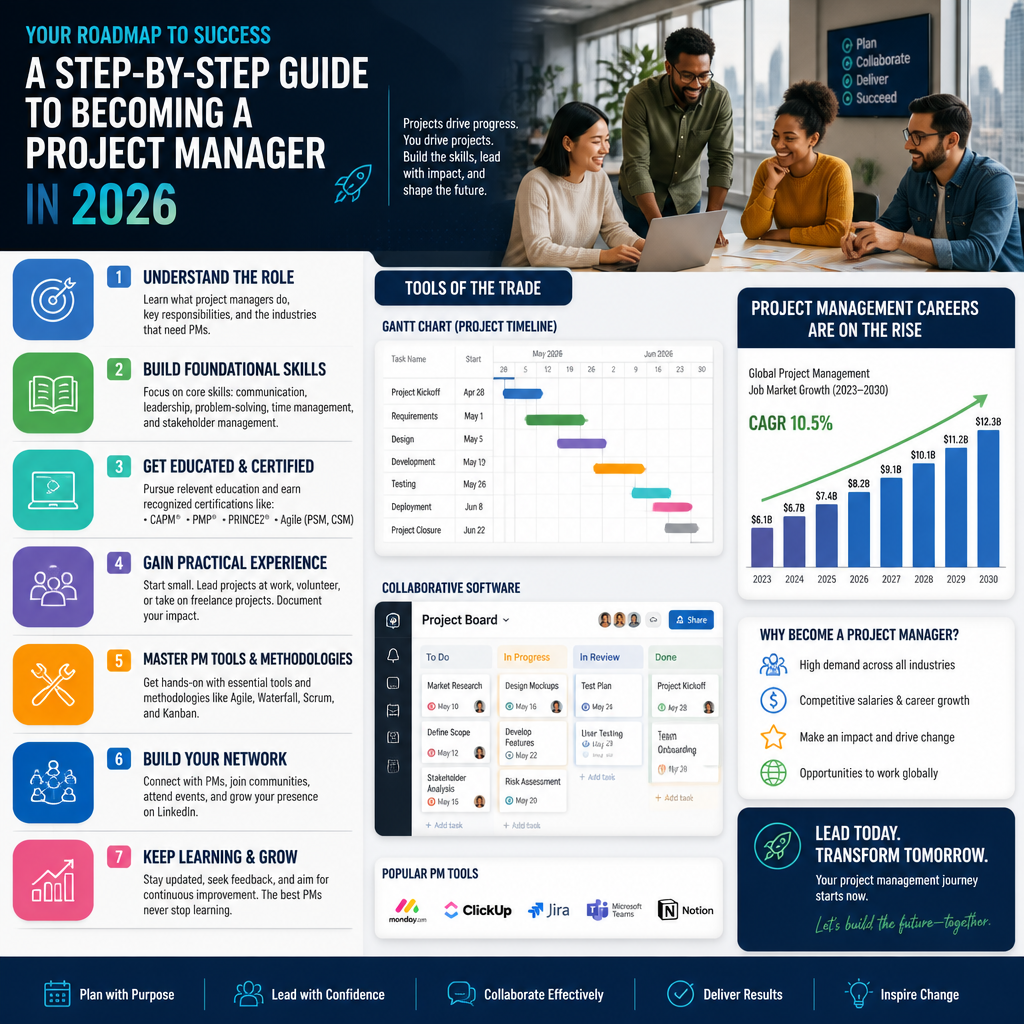
    Step-by-Step Guide: How to Become a Project Manager

    Getting started in project management can feel daunting, especially if you don't have prior experience. However, there are various routes you can take to secure a project management position. Here’s a step-by-step guide on how to become a project manager, including insights on breaking into the field without existing experience.

    1. Understand the Role of a Project Manager

    Before you dive into courses and applications, get painfully clear on what the job is.

    A project manager’s real job isn’t “being organized.” It’s making sure the team delivers the agreed outcome by the agreed date, within the agreed constraints—while reality keeps changing.

    In practice, that means you’re doing four buckets of work over and over:

    1. Define: What are we doing, for whom, by when, and what’s not included?
    2. Plan: Tasks, owners, dependencies, risks, budget/time tradeoffs.
    3. Run the work: Meetings that matter, unblock people, keep decisions moving.
    4. Close: Confirm acceptance, capture learnings, stop the project from limping along forever.

    Common early-career misconception: PMs “own the work.” You don’t. You own the system around the work—clarity, commitments, and follow-through.

    A quick self-check I use when coaching someone new: if you can explain the project’s goal, current status, top 3 risks, and next 3 decisions in under 60 seconds, you’re already thinking like a PM.

    2. Identify Your Transferable Skills

    You might be surprised to realize that you already possess many skills relevant to project management from previous jobs, school projects, or volunteer work. Skills such as communication, leadership, organization, and problem-solving are key assets.

    But “transferable skills” only help if you translate them into project-shaped stories.

    Here’s a simple way to do that—take anything you’ve done and map it into a mini project:

    • Goal: What was the outcome?
    • Stakeholders: Who cared (boss, customer, teammates, vendors)?
    • Constraints: Time, budget, tools, rules.
    • Plan: How did you break it down?
    • Execution: How did you coordinate people?
    • Result: What changed because you did it?

    For instance, coordinating a group project during college or managing a community event can be classified as project management experience, even if it’s informal. As mentioned in a recent article, "this reflects what employers value: an individual's ability to lead regardless of the title or role" (FlashGenius).

    Real example (the kind hiring managers actually respect):

    You worked retail and got tired of closing shifts being chaos. So you:

    1. Listed the recurring closing tasks (cleaning, cash, restock, signage).
    2. Noticed two tasks blocked each other (restock couldn’t happen until inventory count finished).
    3. Swapped the order, made a one-page checklist, and assigned owners by shift.
    4. Tracked close time for two weeks.

    That’s project management. Not glamorous, but it’s scope, sequencing, ownership, and measurement.

    Common mistake: writing “strong communicator” on a resume. Nobody cares. Write: “Aligned 6 stakeholders on scope, reduced rework by standardizing intake checklist.” Even if your “stakeholders” were classmates—own it.

    3. Pursue Relevant Education or Certifications

    While a degree is not strictly necessary, pursuing a formal education in project management can be beneficial. Consider obtaining certifications such as:

    • PMI Project Management Professional (PMP): Highly recognized in the industry.
    • Certified Associate in Project Management (CAPM): Ideal for beginners looking to enter the field.
    • Agile Certifications: Particularly valuable in tech and construction sectors.

    Courses are often available online, making them accessible while you work or study. In fact, online platforms like Coursera and Udemy offer courses that can help you quickly gain the knowledge necessary for this field.

    My opinionated take after seeing a lot of resumes:

    • If you’re brand new, CAPM or a solid fundamentals course is usually enough to get interviews.
    • If you already run work informally (ops lead, coordinator, team lead), PMP can help you break through HR filters.
    • If you’re applying in software teams, you don’t need to cosplay a Scrum Master—but you do need to speak “backlog, sprint, dependency, release.” Agile certs can help, but only if you can back them up with examples.

    Step-by-step: how I’d choose a cert (without wasting money):

    1. Pull 15 job postings in your target niche (construction, IT, healthcare, etc.).
    2. Make a tally of what shows up repeatedly (PMP, CAPM, Agile, tools).
    3. If a cert appears in more than half, it’s a signal—not gospel, but a signal.
    4. Pick one program and finish it. Don’t collect half-certificates like merit badges.

    Common mistakes:

    • Getting certified and stopping there. A certificate is vocabulary; experience is proof.
    • Listing “Agile” because you used Trello once. Interviewers will probe.

    4. Gain Practical Experience

    Getting hands-on experience might be easier than you think. Look for opportunities to volunteer for project management roles in community organizations, or take on additional responsibilities at your current job. Even shadowing a project manager can provide invaluable insights.

    The key is to gather experience that demonstrates your ability to handle projects effectively, which can set you apart from other candidates. As a recent guide notes, you can leverage existing skills and find ways to showcase them (Medium).

    If you need a practical “experience plan” that isn’t vague, here’s what works:

    The 30-day project you can run inside almost any job

    1. Pick a tiny problem with a clear finish line. Examples: reduce customer response time, clean up a shared drive, improve onboarding, coordinate a small launch.
    2. Write a one-paragraph charter. Objective, scope (in/out), deadline, success metric.
    3. Build a simple plan. 10–25 tasks max. Owners + dates.
    4. Run one weekly check-in. 20 minutes. Decisions and blockers only.
    5. Close it loudly. Share results: metric before/after, what you learned, what’s next.

    Do that twice and you can truthfully say you’ve managed projects end-to-end.

    A persona anecdote I see a lot:

    A customer support rep wants to pivot to PM. She starts owning a “help center refresh” project—pulls top 20 ticket topics, rewrites articles, coordinates reviews with product/legal, publishes, measures ticket deflection. That’s stakeholder management, scope control, and delivery. In interviews, that story lands harder than “I’m passionate about project management.”

    Common mistake: taking on “extra responsibility” that never ends. If there’s no definition of done, it’s not a project—it’s unpaid operations. Put a deadline on it.

    5. Networking and Building Connections

    Networking is crucial in any career path, but especially in project management. Attend industry conferences, join professional organizations like the Project Management Institute, and connect with individuals on platforms like LinkedIn. Engaging with the community can often lead to job opportunities and mentorship.

    According to my experience, attending meetups frequently resulted in discovering unadvertised job openings.

    Here’s how to network in a way that doesn’t feel like begging:

    • Ask for a 15-minute “role reality check.” Not a job.
    • Bring three specific questions:
      1. “What’s the hardest part of PM in your org?”
      2. “What do you wish new PMs did in their first 30 days?”
      3. “What would make a junior candidate stand out to you?”
    • End with: “Is there anyone else you think I should talk to?”

    Do that five times and you’ll have better intel than any generic career article.

    Common mistake: only networking with other beginners. Talk to hiring managers, senior PMs, ops leads—people who actually feel the pain when projects go sideways.

    6. Tailor Your Resume and Apply for Positions

    When you're ready, it’s time to apply. Tailor your resume to highlight your transferable skills and any relevant experiences. Be sure to emphasize your ability to communicate, lead teams, and manage timelines effectively. Many job postings often list desired soft skills like adaptability, and these should be mirrored in your application materials.

    What “tailor your resume” should mean in practice:

    • Match the job posting’s language without copying it.
    • Put your best project story in the top third of page one.
    • Use numbers wherever you can—time saved, dollars avoided, cycle time reduced, stakeholders aligned.

    A structure that works (especially for career changers):

    • Headline: “Project coordinator / aspiring PM — ops + delivery”
    • Core skills: scope, scheduling, stakeholder comms, risk tracking, tools
    • Selected projects: 2–4 mini case studies
      • Project name
      • Goal + constraints
      • What you owned
      • Result

    If you don’t have “project” job titles yet, make a “Projects” section anyway. That’s not a trick; it’s clarity.

    7. Prepare for Interviews

    Finally, prepare for your interviews. Be ready to articulate how your past experiences relate to project management. Use the STAR method (Situation, Task, Action, Result) to structure your responses, making it easier to convey your capabilities.

    I’d add one more layer: interviewers want to know how you think when things break.

    So prep these stories:

    • A time scope changed late—what did you cut or renegotiate?
    • A time a stakeholder disagreed—how did you align them?
    • A time a dependency blocked you—what did you do in the first 24 hours?

    Step-by-step: the “PM interview drill” I recommend

    1. Pick one project story.
    2. Write it in STAR.
    3. Add a “what I’d do differently next time” line.
    4. Practice out loud until it’s under 2 minutes.

    That last part matters. Rambling is the silent killer in PM interviews.

    With over 25 million new project management roles expected globally by 2030, the demand for skilled project managers is significant, especially in sectors like construction and tech. But remember, even entry-level positions may require demonstrable skills, so showcasing what you already have is critical (FlashGenius).

    Exploring Pathways in Project Management Careers

    You don’t have to take the same route everyone else takes. In fact, most good PMs I’ve worked with came in sideways—from operations, support, design, engineering, the military, events, you name it.

    The trick is picking a pathway where your existing strengths are already valued, then adding just enough PM skill to become “obvious” for the role.

    Here are a few concrete paths, what they actually look like day-to-day, and how I’d break into each.

    Project Management in Construction

    The construction industry is among the most significant arenas for project managers. Construction project managers oversee building projects from inception to completion, ensuring compliance with safety regulations and budgets.

    To get into construction project management, consider pursuing courses that include:

    • Construction Management Certificates: These often cover essential topics such as budgeting, scheduling, and safety regulations.

    According to the U.S. Bureau of Labor Statistics, construction managers are projected to grow by 9% through 2033, which translates to about 45,800 job openings each year (The Birmingham Group).

    What people underestimate about construction PM: your calendar is the project. Site visits, inspections, permit timing, subcontractor schedules, material lead times—if you miss one dependency, everything wobbles.

    Step-by-step entry plan (if you’re outside construction today):

    1. Learn the basics of scheduling. Get comfortable reading a Gantt chart and understanding critical path.
    2. Pick up the language. RFIs, change orders, punch lists—know what they are.
    3. Shadow or coordinate. Even a role like project coordinator/assistant PM is gold.
    4. Build one portfolio story. Example: “Coordinated vendor schedules and inspections for a small renovation; reduced delays by tightening the weekly lookahead.”

    Common mistakes I’ve seen (and they’re expensive):

    • Treating change orders as paperwork instead of a scope negotiation.
    • Not documenting decisions. Verbal agreements vanish the moment there’s a dispute.
    • Overpromising on timelines because you didn’t validate lead times.

    Project Management in Tech

    The tech industry also offers diverse opportunities for aspiring project managers. Here, project managers often work with software development teams to oversee project timelines and deliverables.

    Experience in Agile methodologies can be particularly advantageous. Familiarize yourself with tools like Jira or Trello, which are commonly used in tech environments.

    Moreover, the project management software market is expected to grow significantly, from $9.76 billion in 2025 to $11.27 billion in 2026 (monday.com).

    What tech PM work actually feels like: less “schedule everything to the hour,” more “keep priorities clean and decisions unblocked.” You’re constantly translating between product, engineering, design, support, and leadership.

    A real example (small but real):

    I once watched a new PM get crushed because they ran sprint planning like a lecture. Tickets were vague, acceptance criteria were missing, and devs kept discovering requirements mid-sprint. Velocity tanked. The fix wasn’t more meetings—it was better inputs.

    Here’s the exact approach that got the team back on track:

    1. Add a lightweight “definition of ready” (clear title, problem statement, acceptance criteria, dependencies).
    2. Run a 30-minute backlog grooming before planning.
    3. Limit WIP and stop pulling in surprise work unless someone explicitly trades it for something.
    4. Track one metric for a month (carryover work, cycle time, or escaped bugs).

    That’s PM value in tech: making the work legible so the team can ship.

    Common mistakes in tech PM:

    • Confusing “Agile” with “no deadlines.” Leadership will still ask for dates.
    • Letting stakeholders inject work mid-stream without a tradeoff.
    • Reporting status without highlighting decisions needed. Status isn’t the point—movement is.

    Engineering Project Managers

    For those with an engineering background, becoming a project manager in engineering can be a natural progression. Here, project managers are needed to coordinate technical teams and ensure projects meet engineering standards. The specialized knowledge you have can set you apart in this competitive field.

    What I’d watch out for if you’re an engineer moving into PM:

    • Your instinct will be to solve the technical problem yourself. Sometimes that helps. Often it hurts—because the team still needs coordination, and you’ll become the bottleneck.
    • Practice saying: “Who owns this?” and “What’s the next decision?” That’s the PM muscle.

    A clean way to transition without whiplash:

    Start by owning one cross-team initiative (tooling migration, reliability improvements, compliance project). Keep your technical credibility, but deliberately shift your energy to aligning people, sequencing work, and communicating risk.

    Conclusion

    Stepping into a project management career is entirely possible, but the path that works isn’t “wait until you’re ready.” It’s: start managing small projects now, collect proof, then level up your scope.

    If you take only one idea from this: hiring managers don’t need you to have the title—they need you to have evidence. A tight project story with a measurable result beats a fluffy resume every time.

    Here’s a practical next step you can do this week (seriously, in a few hours):

    1. Pick one project you’ve already done (work, school, volunteering).
    2. Write a 6-line case study:
      • Goal
      • Stakeholders
      • Timeline
      • Your actions
      • Result (number if possible)
      • What you learned
    3. Turn that into:
      • One resume bullet
      • One LinkedIn post (optional)
      • One interview story

    A quick “I’ve seen this work” anecdote:

    A friend of mine was stuck in an admin role, constantly told she wasn’t “technical enough” to be a PM. She started running a small internal rollout—new intake form, new process, training session, two-week check-in cycle. She documented the before/after (fewer missed requests, clearer priorities), and she brought that one-page write-up to interviews. She didn’t just say she could manage projects; she showed she already had.

    Also—don’t ignore the messy reality: you will mess up a timeline, you’ll underestimate a dependency, you’ll have a stakeholder go silent. That’s the job. The difference between a beginner and a pro is how fast you surface the risk, how clearly you communicate tradeoffs, and whether you close the loop.

    For assistance in crafting content that aligns with project management strategies, tools like Sibgha Jamil can streamline your process significantly.

    Pick your first small project, ship it, write it up, and go apply. That’s the whole game.

  • Essential Upgrades for Smartphones: 2026 Checklist

    Discover essential upgrades for smartphones in 2026, including unlocked smartphones, Samsung models, and budget options.

    Featured image for Essential Upgrades for Smartphones: 2026 Checklist

    Featured image for Essential Upgrades for Smartphones: 2026 Checklist

    Essential Upgrades for Smartphones: 2026

    Smartphones in 2026 are fast across the board, so the real “upgrades” are the things that change day-to-day living: battery health, charging speed, camera consistency (not just a good demo shot), network flexibility, and how long the phone stays pleasant after updates.

    Here’s how I’d run the checklist if you told me, “I just want to buy one phone and not think about it again for a while.”

    Unlocked Smartphones

    If you want the biggest quality-of-life upgrade, it’s usually this: buy unlocked smartphones whenever you can.

    An unlocked phone keeps you in control. You can switch carriers when pricing changes, move to an MVNO, or add a travel SIM without begging a carrier rep for permission. That flexibility matters more in 2026 than it used to, because plans and promos change constantly—and the “free phone” deals often claw their money back in the fine print.

    A few real-world scenarios where unlocked helps:

    • Travel: You land, buy a local SIM or data plan, and you’re online. No roaming bill surprise. I’ve watched people spend the first half-day of a trip hunting Wi‑Fi because they didn’t want to touch roaming.
    • Coverage reality check: Your friend’s carrier works at your house; yours doesn’t. With unlocked, you can move without changing phones.
    • Resale value: Unlocked devices generally sell easier because the buyer doesn’t have to care about carrier compatibility.

    Unlocking your phone is legal and straightforward. Most carriers have streamlined their processes, which often involve meeting specific criteria like having your device fully paid off or active for a certain number of days. If you haven’t done it before, the fastest path is usually: log into your carrier account → find “device unlock” → follow the prompts → restart the phone and confirm it accepts another SIM.

    One mistake I keep seeing: people assume the phone is unlocked because it’s “paid off.” Not always. I’ve seen devices paid in full but still carrier-locked until someone files the unlock request. Don’t guess—verify.

    For a comprehensive understanding of unlocking practices, check out this guide on unlocking smartphones for the latest rules and tips.

    Also: if you’re buying used, an unlocked status claim isn’t enough. Test it. If possible, pop in a different carrier SIM in-person. If you can’t, at least confirm the seller’s return policy.

    Samsung Smartphones

    If you’re aiming for “buy once, enjoy it daily,” Samsung smartphones are still a safe bet—especially if you care about a bright display, strong hardware, and a ton of camera modes.

    The Samsung Galaxy S26 Ultra is one of the flagship models of 2026, praised for its incredible camera quality, durability, and battery life. According to a Consumer Reports review, this model excels in several categories. It features a 200-megapixel camera and robust battery performance, making it a strong contender in the premium smartphone market.

    Here’s what I’d actually look at before committing to a flagship like that:

    • Camera consistency, not megapixels: A 200-megapixel camera sounds like a mic drop (and it is impressive), but what matters is whether shots look good in the boring situations: indoor dinners, kids moving, mixed lighting, quick snaps from the hip. Some phones ace the “outdoor sunny” demo and then smear motion indoors.
    • Battery behavior, not just capacity: Two phones can have similar battery sizes and feel totally different. One is fine until 9pm; the other hits 20% by late afternoon because of how it handles background apps, signal strength, and display settings.
    • Durability you’ll actually test: If you don’t use a case (or you’re the “drops it once a month” person), durability isn’t abstract. It’s the difference between a scuff and a cracked back.

    If you’re considering a Galaxy S26, the S Pen angle can be a real productivity upgrade—if you’ll actually use it. I’ve seen two types of buyers:

    1. People who think they’ll use the S Pen and never do.
    2. People who live in notes, screenshots, markups, quick sketches, and signature workflows—and then they can’t go back.

    If you’re in camp #2, the S Pen isn’t a gimmick. It’s a daily tool: quick meeting notes, marking PDFs, annotating screenshots for work, or even just editing photos precisely.

    On the tradeoff side: Samsung’s feature depth can feel like “a lot” if you prefer minimal settings. If you’re the type who never opens settings, you might be happier with a simpler UI from another brand. But if you like tailoring your phone—shortcuts, routines, multi-window—Samsung is hard to beat.

    Cheap Smartphones

    Here’s the honest truth about cheap smartphones in 2026: you can get a genuinely good phone for less money than you could a few years ago, but you have to shop like a skeptic.

    Affordable options such as the Google Pixel 10 Pro provide excellent value without compromising on essential features like camera quality and system updates. The trap is that budget phones can look identical on a spec sheet while feeling totally different after a month of real use.

    What I’d prioritize on a budget purchase:

    • Software support: A cheap phone that stops getting updates quickly isn’t a deal. It gets buggy, apps start misbehaving, and security updates lag.
    • Storage (and RAM) headroom: If you keep a phone for years, 128GB can feel tight fast if you shoot lots of video or download offline content. And low RAM is where “budget” pain usually shows up—app reloads, stutters, camera lag.
    • Screen quality: You don’t need the most premium panel, but you do want something that’s readable outdoors and doesn’t feel sluggish.
    • Battery + charging: Bigger battery helps, but charging speed and consistency matter too. A phone that charges fast can cover up a lot of battery anxiety.

    Platforms like Best Buy have a great selection, allowing you to compare different models and their specifications.

    One budget-buying move I love (and I’ve done it myself): buy last year’s “almost-flagship” instead of this year’s bargain bin model. You often get a better screen, better camera processing, and better build quality, even if the processor is a generation older.

    A quick story: a friend once bought the cheapest model that still had a “good camera” bullet point. On day one, it looked fine—until they tried taking indoor photos of their dog. The shutter lag and motion blur were brutal. They ended up upgrading early, which is the most expensive way to “save money.”

    Rated Smartphones

    A rated smartphone list is useful, but only if you know what you’re looking at. Ratings are usually a blend of lab testing, long-term usability, and value. The problem is that different reviewers weight things differently—some obsess over benchmarks; others care about camera color science; others care about battery endurance.

    Websites like PCMag and GSMArena provide insights based on rigorous testing and user reviews. According to recent evaluations, high-rated smartphones include:

    • Samsung Galaxy S26 Ultra – Recognized for its powerful camera and performance under demanding conditions.
    • Apple iPhone 17 Pro Max – Known for its top-notch software integration and camera capabilities.
    • Google Pixel 10 – Praised for its AI features and reliable performance across various tasks.

    Here’s how I’d use ratings without getting misled:

    • Find reviewers who test like you live. If you care about low-light photos, find camera-heavy reviews. If you care about gaming, find sustained performance tests (not just 30 seconds of benchmark glory).
    • Scan the “cons” first. A phone can be rated highly and still be wrong for you. For example: great camera, but poor thermal behavior; great performance, but average battery; great battery, but slow charging.
    • Cross-check complaints. One angry review means nothing. Fifty people complaining about call drops or GPS weirdness? That’s a signal.

    Also, don’t underestimate ergonomics. A phone can be the “best” and still be a pain if it’s too big for your hand, too slippery without a case, or uncomfortable for one-handed typing. Those aren’t glamorous specs, but they’re real.

    Conclusion

    If you only take one thing from this 2026 checklist, let it be this: buy for your actual habits. Get unlocked if you value flexibility, consider Samsung if you want a feature-rich powerhouse, shop budget phones with a sharp eye on software support, and use ratings as a starting point—not the final word.

    And if you’re running an eCommerce store or agency site and want to tighten up the experience around mobile shoppers, speed, or custom builds, take a look at WPGrit for custom WordPress development support—you’ll feel the difference when your site behaves on real phones, not just on a desktop preview.

  • How Wiki LLMs Are Transforming Knowledge Sharing

    Explore how Wiki LLMs are revolutionizing knowledge sharing, enhancing management processes for developers and tech enthusiasts.

    Featured image for How Wiki LLMs Are Transforming Knowledge Sharing

    Featured image for How Wiki LLMs Are Transforming Knowledge Sharing

    How Wiki LLMs Are Transforming Knowledge Sharing

    Traditional knowledge sharing has always had one brutal bottleneck: humans have to (1) write things down and (2) remember where they put them. Even disciplined teams degrade over time. A key engineer leaves, the wiki stops getting updated, and six months later everybody’s back to asking the same questions in chat.

    Wiki LLMs don’t magically fix culture, but they do change the shape of the problem. Instead of treating knowledge as disconnected pages that you hunt down, you treat knowledge as a persistent system that:

    • ingests sources (docs, notes, tickets, READMEs, ADRs),
    • links related concepts automatically (or semi-automatically),
    • answers questions from that structured base, and
    • improves as you add material.

    The big shift is this: you’re not doing “search, read, synthesize” every time. You’re paying an upfront ingestion cost so retrieval becomes fast, contextual, and repeatable.

    What is a Wiki LLM?

    A Wiki LLM is a knowledge base that behaves less like a library and more like a maintained map of what your organization (or your own brain) already knows.

    In a normal wiki workflow, you:

    1. Search for a page.
    2. Open a page.
    3. Click around to find missing context.
    4. Reconcile conflicting pages.
    5. Ask someone anyway because you still don’t trust what you found.

    With a Wiki LLM workflow, the “wiki” is built during ingestion and then queried as a coherent system. The key detail—one I care about because it changes failure modes—is that the knowledge base becomes persistent and cross-linked rather than a one-off retrieval each time you ask something.

    DataCamp describes it cleanly:

    "LLM Wiki compiles your sources into a persistent, cross-linked knowledge base during ingestion, then answers from that base instead of re-retrieving raw chunks each time" (DataCamp).

    That’s not just a neat architecture note. It affects how you debug wrong answers.

    • In a pure “RAG over documents” setup, bad answers often come from poor chunk retrieval, missing chunks, or context window limits.
    • In a Wiki LLM setup, bad answers often come from bad ingestion, bad linking, or stale sources—which are problems you can usually fix with process.

    One practical way I explain this to teams: a Wiki LLM is closer to an internal Wikipedia that’s continuously being built from your sources, with an LLM acting like the editor and librarian.

    LLM Wiki Implementation

    If you try to implement an LLM Wiki like you’d implement a chatbot, you’ll end up with a toy. The systems that actually stick in real teams follow a boring pattern: ingestion pipeline first, querying second.

    Here’s the implementation shape that tends to work (and yes, it’s work):

    Step 1: Pick the scope (don’t boil the ocean)

    Start with one domain where wrong answers are annoying but not catastrophic. Good starting targets:

    • onboarding (“how do I run the app locally?”, “who owns payments?”)
    • incident/runbook knowledge (“what does this alert mean?”, “what do we check first?”)
    • architectural decisions (ADRs, design docs)

    Bad starting targets:

    • anything involving credentials, secrets, or regulated data until you’ve proven access control
    • “the entire company Google Drive” (you’ll ingest garbage and then argue about garbage)

    A trick that’s worked for me: create a “golden set” of ~30–80 documents you already trust—then expand.

    Step 2: Normalize your inputs

    Before you ingest, get ruthless about formats.

    • Convert PDFs to text if possible (PDF extraction failures are a common silent killer).
    • Strip boilerplate headers/footers.
    • Add minimal metadata: owner, last-updated date, system/component tag.

    If you skip this, you’ll spend weeks wondering why the model “hallucinates,” when it’s actually reading junky extracted text and duplicated pages.

    Step 3: Ingest and cross-link

    This is where the LLM Wiki pattern diverges from basic RAG. You’re not just embedding chunks and calling it a day. You want the system to create durable pages/nodes and relationships.

    Andrej Karpathy’s “LLM Wiki pattern” is a useful mental model here: treat the knowledge base as something that gets built and refined over time, not reassembled on every question.

    A practical implementation write-up captures that long-running nature well:

    "I've been running Karpathy's LLM Wiki pattern for three months. Here's the real setup process, which agents work best, and where the pattern breaks down" (Kunal Ganglani).

    The phrase “where the pattern breaks down” matters. In production-ish setups, it usually breaks down in the same spots:

    • The system creates too many near-duplicate pages (synonyms, naming drift).
    • Cross-links become noisy (everything links to everything).
    • Nobody knows which page is the “source of truth.”

    You fix those with constraints: naming conventions, dedupe rules, and explicit “canonical page” behavior.

    Step 4: Add an editing loop (human-in-the-loop, but lightweight)

    This is my strong opinion: if you don’t give someone the power to prune and correct, you’ll grow an AI compost pile.

    What works:

    • A weekly 30-minute “gardening” pass (one person, rotating) where they:
      • delete garbage pages,
      • merge duplicates,
      • add missing links,
      • mark certain pages as canonical.

    It’s the same reason Wikipedia has editors. Knowledge systems need maintainers.

    Step 5: Query UX that encourages trust

    If you want engineers to use it, answers need:

    • citations (which page/node did this come from?)
    • timestamps (how old is this knowledge?)
    • confidence signals (is this inferred or directly stated?)

    Without that, people will treat it like a vibes machine and stop using it after the first confident-but-wrong answer.

    LLM Wiki for Codebase Management

    This is where things get spicy—in a good way.

    Codebases are full of knowledge that’s “technically documented” but practically unusable:

    • a README last updated 18 months ago
    • an internal wiki page that references a service name that no longer exists
    • comments that explain what but not why
    • PR discussions where the real decision happened, buried in a thread

    A Wiki LLM can act like a translator between “how the code is structured” and “why we did it this way.” The payoff isn’t that it writes code for you. The payoff is that it reduces the time you spend reconstructing context.

    A scenario I’ve seen repeatedly: new engineer joins, gets a ticket, and spends two days bouncing between docs, Slack, and code. With a decent LLM wiki:

    • They ask: “What service owns invoices and what’s the local dev path?”
    • The system replies with the canonical service page, links to the local setup doc, and references the ADR where the split between billing and payments was decided.

    That’s an onboarding accelerant.

    There’s also a maintenance angle: when a team adopts a Wiki LLM, they start noticing knowledge gaps because the model can’t answer, or answers with “I don’t have a source for that.” That pressure nudges teams to actually write the missing runbook.

    Denser.ai calls out the efficiency and onboarding benefits directly in the codebase/knowledge-base context (Denser.ai). I buy that, with a caveat: the gains show up after you’ve done the ingestion work and created a habit of keeping sources current.

    Common mistakes in codebase use

    I’ve watched teams faceplant in predictable ways:

    • They ingest generated docs and ignore tickets/PRs. The “why” lives in decisions, not in API docs.
    • They don’t version knowledge. Answers change when the code changes; if you can’t tie knowledge to a release or timeframe, people stop trusting it.
    • They treat the model as a senior engineer. It isn’t. It’s a fast librarian with a decent synthesis engine.

    A simple mitigation: tag sources by repo + branch/release, and show that tag in answers.

    LLM Wiki by Andrej Karpathy

    Karpathy’s version of this idea caught on because it’s pragmatic: build a local, personal (or team) knowledge system that compounds.

    His gist is still the reference point for most people experimenting with the pattern, and it has inspired a bunch of real implementations (Karpathy’s LLM Wiki Gist).

    What I like about the Karpathy framing is that it pushes you away from the “one prompt per question” mindset. In real work, questions aren’t independent. They’re chains:

    • “What’s the service boundary?” leads to
    • “Why is it split that way?” leads to
    • “Where do I add a new endpoint?” leads to
    • “What’s the deploy pipeline and rollback plan?”

    A persistent wiki-style base supports that chain without forcing you to restate background every time.

    The tradeoff: once the knowledge base is persistent, you now own it. You need rules for:

    • what gets ingested,
    • who can edit,
    • how you correct wrong nodes,
    • when you re-ingest or deprecate.

    That’s not a downside—it’s just real engineering work.

    LLM Wiki and Obsidian: Bridging Knowledge Management

    If you already live in Obsidian, you’re halfway there because Obsidian encourages the behavior Wiki LLMs need: small notes, explicit links, and a graph-like structure.

    The most useful pattern I’ve seen is:

    • Obsidian is the authoring surface (humans write notes).
    • The LLM wiki pipeline is the ingestion + structuring layer (LLM turns notes/docs into cross-linked nodes).
    • The query interface is the retrieval surface (humans ask questions and get sourced answers).

    Developers who keep “daily log” notes, meeting decisions, and snippets in Obsidian can turn that into a surprisingly powerful team memory—assuming you set boundaries so you’re not ingesting private journal content by accident.

    Data Science Dojo describes the compounding effect like this:

    "the LLM Wiki is a structured, AI-maintained knowledge base that grows smarter every time you add a source" (Data Science Dojo).

    That matches what I’ve observed: the first week feels underwhelming, because you’ve ingested only a handful of sources. Week four is when it starts paying rent, because the links and concepts have enough density to answer real questions.

    A concrete Obsidian workflow that works

    If you want something you can actually try without turning your life upside down:

    1. Create an Obsidian vault for a single domain (say: “Platform Engineering”).
    2. Add three note types:
      • Runbooks (alerts, remediation steps)
      • Decisions (short ADR-style notes)
      • How-tos (setup, tooling, scripts)
    3. Enforce one rule: every note starts with “What problem does this solve?”
    4. Ingest weekly into your LLM wiki pipeline.
    5. When the model answers a question, require it to cite the note(s).
    6. If the answer is wrong, fix the note—don’t just “correct the model.”

    That last step is the habit that keeps things clean. You’re maintaining sources, not arguing with outputs.

    Conclusion

    Wiki LLMs will transform knowledge sharing if you treat them like a product you maintain—not a chatbot you install.

    Here’s the real-world example I keep coming back to. A few years ago, I worked with a team where incident response lived in three places: an outdated wiki, a handful of Google Docs, and the heads of two senior engineers. On-call was rough. People would ask the same questions at 2 a.m. (“Is this alert noisy or real?”, “Which dashboard matters?”, “Do we page payments or platform?”), and half the time the answer was “depends, ask Sam.” Sam, of course, was asleep.

    A Wiki LLM approach changes that dynamic because it rewards structured accumulation.

    A step-by-step rollout I’d actually recommend

    If you’re a developer or tech lead trying to make this real in the next month, do it like this:

    1. Pick one pain point. Onboarding, incidents, or one service area. Don’t start with “company knowledge.”
    2. Collect a trusted starter pack (30–80 sources). Current runbooks, ADRs, READMEs, key tickets/PRs. Skip anything you already know is stale.
    3. Ingest and force citations. If the system can’t cite, it doesn’t get to sound confident.
    4. Run it in parallel for two weeks. Let people query it, but don’t declare victory. Track what it can’t answer.
    5. Fix sources, then re-ingest. This is where the compounding starts. Every “can’t answer” is a doc gap you can close.
    6. Add a lightweight maintenance owner. Rotating is fine, but make it someone’s named responsibility.

    Common mistakes (the ones that kill adoption)

    • No ownership. If nobody prunes duplicates and marks canonical pages, trust dies fast.
    • Ingesting everything immediately. You’ll pull in contradictory drafts, old policies, and random notes—then spend your time arguing with your own mess.
    • No feedback loop. Teams complain the model is wrong, but never fix the underlying note/runbook. So it stays wrong.
    • Treating it like search. The win is synthesis + structure + persistence. If you only use it like Ctrl+F across docs, you’re underusing it.

    The actual payoff

    When this works, it’s not “the LLM answers trivia.” It’s:

    • fewer repeat questions in chat,
    • faster onboarding because context is connected,
    • fewer on-call thrashes because runbooks are findable and coherent,
    • less dependency on the one person who “knows where everything is.”

    If you’re going to try one thing next, do this: pick a narrow domain, ingest only trusted sources, and enforce citations from day one. That discipline is what turns a Wiki LLM from a demo into infrastructure.

  • Best Email Marketing Platforms 2023

    Explore the best email marketing platforms for 2023, including innovative tools and automation solutions to enhance your campaigns. Discover top choices!

    Understanding the Importance of Email Marketing

    Email marketing still wins because it’s one of the few channels you can actually control. Algorithms don’t throttle your reach overnight, and you’re not renting attention from a platform that can change the rules whenever it feels like it.

    And the numbers back it up. As many as 89% of marketers emphasize that email marketing is their primary strategy, and email ROI often exceeds $36 for every dollar spent. Those aren’t “nice-to-have” metrics—those are “this channel pays the bills” metrics.

    Here’s what I’ve seen in the real world: when email works, it’s usually doing three jobs at once.

    1. Conversion driver: cart recovery, demo follow-ups, “you looked at this product” nudges.
    2. Retention engine: onboarding, education sequences, replenishment reminders, renewals.
    3. Signal collector: clicks, replies, and purchases that tell you what people actually care about.

    A quick example from a scrappy ecommerce setup I helped untangle: they were sending one weekly promo to the entire list. Open rates looked “fine,” revenue looked “meh.” We split the list into three buckets (new subscribers, repeat buyers, and lapsed buyers), then changed the message:

    • New subscribers got a 5-email onboarding series (brand story + top sellers + social proof).
    • Repeat buyers got product education + bundles.
    • Lapsed buyers got a simple “Still interested?” with a preference center link.

    No fancy design. Just relevance. The result wasn’t magical overnight, but it was consistent—more clicks, fewer unsubscribes, and the team stopped arguing about what to send because the segments told us.

    Common mistakes I keep seeing (and fixing):

    • Blasting the whole list because segmentation “takes too long.” It does take time—once. Then it pays you back.
    • Measuring only open rates. With privacy changes, opens can be misleading. I lean harder on clicks, replies, conversions, and revenue per send.
    • Over-automating too early. People build 20-step workflows before they’ve even nailed a welcome series and cart abandonment.

    If you remember one thing: email is a system, not a campaign. The platform matters because it’s the plumbing.

    The Best Email Marketing Platforms of 2023

    When I’m evaluating platforms, I’m not impressed by a giant feature checklist. I want answers to a few practical questions:

    • Can I build behavior-based automation without wanting to throw my laptop?
    • Can I segment by real actions (purchase, click, page view), not just “tag soup”?
    • Are the reports good enough to make decisions in 10 minutes?
    • Will it play nicely with what I already use (CRM, ecommerce, forms, webinar tools)?

    Here are my top picks based on extensive research and hands-on experience.

    1. ActiveCampaign

    ActiveCampaign continues to impress with its automation depth. If your business needs workflows that branch based on behavior (visited pricing page twice, clicked a feature link, purchased category A but not B), this is one of the strongest options.

    It supports automated workflows, detailed analytics, and integrations with popular CRMs. One case study I’ve seen firsthand: a client used segmented campaigns and saw a 54% increase in conversion rates after we stopped sending generic promos and started triggering emails based on browsing and purchase behavior.

    Where it shines: complex automations, lead nurturing, and keeping sales + marketing aligned.

    Watch-outs: you can build a messy automation jungle if you don’t document your logic. I’ve inherited accounts where nobody knew why a contact was getting five emails in two days.

    2. Mailchimp

    Mailchimp remains popular for smaller teams because it’s approachable. Templates are solid, the interface is friendly, and you can get moving without a technical setup.

    In recent evaluations, Mailchimp was found to help users boost open rates by over 20%.

    Where it shines: fast setup, decent reporting, and a strong free tier for new users.

    Watch-outs: as your needs grow (more segmentation nuance, more automation branching), you may feel boxed in. I’ve seen businesses outgrow Mailchimp around the time they start caring about lifecycle messaging beyond “newsletter + promo.”

    3. HubSpot

    HubSpot’s email tool stands out for one reason: it’s welded to the CRM. That matters if you want personalization that’s more than “Hi {First Name}.” You can build emails based on lifecycle stage, deal status, pages visited, form submissions—the stuff that actually reflects intent.

    Where it shines: B2B funnels, lead management, and reporting that ties email to pipeline.

    Watch-outs: cost creep. HubSpot is worth it when you commit to using the ecosystem. If you only want email sends, you’re paying for a lot of house you’re not living in.

    4. Campaign Monitor

    Campaign Monitor is a strong pick for marketers who care about design polish and clean templates. It’s also good at automating follow-ups and tracking results without drowning you in complexity.

    Where it shines: beautiful campaigns, clear editing experience, real-time-ish performance tracking.

    Watch-outs: if you’re chasing heavy automation with deep branching logic, you might prefer a platform built primarily around automation rather than design.

    5. GetResponse

    GetResponse is the “all-in-one” contender that actually earns the label more than most. It combines email with landing pages and webinars, which can be handy if you’re trying to keep your stack simple.

    Their automations are approachable, and one client example often cited: an 873% ROI in five months after optimizing email strategy with GetResponse.

    Where it shines: teams that want email + landing pages + webinars under one roof.

    Watch-outs: all-in-one tools can become all-in-one compromises. I usually test whether the landing page builder and webinar flows are “good enough” for your use case before committing.

    Innovative Email Marketing Tools

    “Innovative” isn’t a compliment by itself. I’ve watched teams chase shiny new tools, then lose weeks migrating lists, rebuilding templates, and re-learning basic reporting. The only innovation I care about is what reduces busywork or improves targeting without wrecking deliverability.

    That said, a few newer(ish) tools are genuinely worth a look.

    1. MailerLite

    MailerLite hits a sweet spot: simple enough for small teams, but not flimsy. You get automation, landing pages, and straightforward email building without needing a specialist.

    A real use case: a local services business (think: home cleaning, lawn care, tutoring) doesn’t need a 40-branch workflow. What they do need is consistency. MailerLite works well for a basic lifecycle setup:

    • Day 0: welcome email + set expectations
    • Day 2: “Here’s how it works” explainer
    • Day 5: proof (reviews, before/after)
    • Day 7: offer or booking link

    Common mistake: people treat MailerLite like a newsletter machine and never build the 4–6 emails that do the heavy lifting (welcome, onboarding, reactivation). If you build those three, you’ll feel like you hired an extra marketer.

    2. Moonsend

    Moonsend is gaining traction because it bakes in AI suggestions to optimize campaigns. That can be useful if you’re time-poor and you want nudges on subject lines, send times, or performance patterns.

    Here’s my stance: AI suggestions are fine, but you still need a human rule—don’t let the tool change your strategy. Use it to tighten execution.

    Step-by-step way I’d test it (without risking revenue):

    1. Pick one flow (welcome series or cart recovery).
    2. Run your current version for 2 weeks.
    3. Apply one AI-driven change at a time (subject line, then timing, then segmentation).
    4. Compare on clicks and conversions, not just opens.

    Common mistake: letting AI rewrite your voice into generic mush. If your brand sounds like everybody else, you’ve lost the advantage.

    3. Sendinblue

    Sendinblue stands out because it’s not just email. It adds SMS marketing and chat, which is useful when your customer journey isn’t purely inbox-based.

    Example I’ve seen work: ecommerce brand uses email for education and launches, SMS only for high-intent moments—shipping updates, cart nudges, limited-time restocks. Email does the slow work; SMS does the urgent work.

    Common mistake: blasting SMS like it’s email. It’s not. SMS fatigue is real, and people opt out fast. If you go multi-channel, be disciplined about when you use each channel.

    Email Marketing Automation

    Automation is the difference between “we send emails” and “email drives revenue while we sleep.” But only if you build the right automations in the right order.

    Businesses that leverage automation see:

    • Increased Efficiency: Automation reduces time spent on routine tasks like sending emails and segmenting lists.
    • Enhanced Precision: Automated emails can be personalized based on behavior and preferences.
    • Measurable Results: Built-in analytics let you track performance in real time and adjust.

    And segmentation is not optional. Segmented campaigns generate 760% more revenue than non-segmented ones.

    The automation stack I’d build first

    If you’re starting from scratch (or rebuilding after years of ad-hoc sending), here’s the order that usually gets the fastest, cleanest wins:

    1. Welcome series (3–6 emails)

      • Goal: convert subscribers into first-time buyers/leads.
      • Include: what you do, who you help, top resources/products, proof, and one clear CTA.
    2. Abandoned cart / abandoned checkout (2–4 emails)

      • Goal: recover revenue.
      • Keep it simple: reminder, benefits, objections, then a final nudge.
    3. Post-purchase / onboarding

      • Goal: reduce refunds, increase repeat purchases, drive reviews.
      • This is where a lot of “hidden” ROI lives.
    4. Reactivation (2–3 emails)

      • Goal: clean your list and win back attention.
      • Give people a choice: update preferences, stay subscribed, or opt out.

    A quick anecdote (because this happens a lot)

    I once audited an account where the team proudly told me, “We have automation.” They did—technically. But their welcome email fired after a first purchase, because the trigger was wrong. So paying customers got a “Here’s 10% off your first order!” email. That’s not automation. That’s a leak.

    How to avoid that mess:

    • Map triggers on paper first (literally).
    • Name workflows like a human (e.g., WELCOME - New subscriber (no purchase)).
    • Add basic guardrails: “If purchased, exit flow.”
    • Test with a seed list and real actions (subscribe, click, add to cart, purchase).

    Choosing the Right Platform

    Picking a platform isn’t about choosing the “best.” It’s about choosing what you’ll actually use correctly for the next 12–24 months.

    Here’s the decision process I use with clients—practical, slightly boring, very effective.

    1) Identify your real needs

    Start with your business model, not your wishlist.

    • B2B with a sales cycle? You’ll care about CRM integration, lead scoring, and lifecycle stages (HubSpot and ActiveCampaign tend to fit).
    • Ecommerce? You’ll care about purchase-triggered automations, product segmentation, and revenue reporting.
    • Creator/solo business? You’ll care about fast publishing, clean templates, and simple sequences.

    Write down the 3 outcomes you need email to drive (example: “book calls,” “recover carts,” “increase repeat purchase rate”). If a platform can’t support those easily, it’s not the one.

    2) Set a budget—and include the hidden costs

    The sticker price isn’t the whole story.

    Hidden costs I’ve watched teams underestimate:

    • Migration time (templates, forms, automations, tags)
    • List cleaning (removing dead addresses, fixing consent records)
    • Training the team so one person doesn’t become the “email wizard” bottleneck

    Sometimes the “expensive” platform is cheaper because it saves you 10 hours a month.

    3) Test platforms like you mean it

    Free trials are only useful if you test the stuff that will hurt later.

    My step-by-step trial plan (do this over 3–5 days):

    1. Import a small sample list (or a tagged subset).
    2. Build one landing page or form.
    3. Build one automation: welcome series with at least one branch.
    4. Send one campaign to a test segment.
    5. Check reporting: can you answer “what made money?” quickly?

    Common mistakes when choosing

    • Buying based on templates. Templates are the least important part.
    • Overvaluing AI. AI won’t fix weak offers or vague copy.
    • Ignoring deliverability basics. If the tool doesn’t make it easy to manage list hygiene and authentication, you’ll pay for it later.

    Conclusion

    The best platform is the one that makes it easy to send relevant emails consistently—then proves what worked.

    If you want my blunt take:

    • Choose ActiveCampaign when automation is the strategy, not a feature.
    • Choose Mailchimp when you need to move fast and keep things simple.
    • Choose HubSpot when CRM-driven personalization and pipeline reporting matter.
    • Choose GetResponse when you want email plus landing pages/webinars in one place.

    But don’t stop at picking a tool. Build the boring foundation: welcome series, cart recovery, post-purchase, and reactivation. I’ve watched “average” businesses outperform better-funded competitors just by running those four flows cleanly for six months.

    Your next step: pick two platforms, run the 3–5 day trial plan, and judge them on how quickly you can build and trust a real automation. If you can’t trust it, nothing else matters.

    FAQs

    Q: What are the most important features to look for in an email marketing platform?
    A: Automation (with branching), segmentation based on behavior, integrations (CRM/ecommerce/forms), reporting you can act on, and solid list hygiene tools. I also care about how easy it is to test workflows without accidentally emailing your whole list.

    Q: How can email marketing automation improve my campaigns?
    A: It removes the “we forgot to follow up” problem. Automation increases efficiency by handling repetitive tasks, enhances precision through behavior-based personalization, and gives measurable tracking so you can improve over time.

    Q: Why is segmentation important in email marketing?
    A: Because relevance is what keeps you out of the spam folder and in the revenue column. Segmented campaigns generate 760% more revenue than non-segmented ones, and in practice they also cut unsubscribes because people stop getting offers that don’t fit.

    Q: What’s the first automation I should build?
    A: A welcome series. It’s the one flow every new subscriber goes through, and it sets expectations. If you only have time for one sequence this month, do that.

    Q: What’s a common automation mistake that hurts results?
    A: Bad triggers and missing exit rules. If buyers keep receiving “buy now” emails after purchasing, you’ll create complaints and unsubscribes fast. I’ve seen it happen even in well-known brands—usually because nobody tested the flow end-to-end.

    Q: How do I know if I’ve outgrown my current platform?
    A: If you’re hacking together segmentation with manual tags, avoiding automations because they’re fragile, or exporting data to spreadsheets just to answer basic questions, you’ve probably outgrown it. The platform should reduce manual work, not create it.

  • Top Email Marketing Platforms of 2026

    Explore the best email marketing platforms for small businesses in 2026 with detailed comparisons and insights. Optimize your email marketing today!

    Email Marketing Platforms: Top 2026 Comparisons

    Why Email Marketing Still Wins

    I’ll say the quiet part out loud: email is one of the few channels you can own. No algorithm mood swings, no “your account was flagged,” no praying your post hits the right feed. You build a list, you learn what those people care about, and you can talk to them tomorrow.

    And yes, the numbers still back it up. Email marketing is often quoted with an ROI of $42 for every $1 spent in 2026, which is why it stays on every serious marketer’s dashboard (Email Chef). I’m not pretending every business gets that—most don’t. But when a list is clean, the offer is real, and automation is set up with intent, email prints money in a very unsexy way.

    What changed in 2026 isn’t “email is back.” Email never left. What changed is:

    • Attention is thinner. People scan, delete, and unsubscribe faster.
    • Deliverability is touchier. Sloppy list-building gets punished.
    • Personalization is expected. Not creepy. Just relevant.
    • Automation is table stakes. If you’re still manually sending follow-ups, you’re paying a tax.

    So choosing a platform isn’t about pretty templates. It’s about whether you can reliably do the fundamentals:

    1. Collect consented leads
    2. Segment them (behavior + intent, not just “newsletter”)
    3. Trigger the right message at the right time
    4. Measure outcomes (revenue, replies, booked calls), not vanity opens

    Best Email Marketing Platforms: Top Comparisons for 2026

    This is the part people want: “Just tell me which tool.” My stance: there isn’t one best platform—there’s the best fit for your sales motion.

    I’m comparing these tools the way I’d compare contractors on a job site: who shows up on time, who screws up the drywall, and who costs 2x more once the project “unexpectedly expands.”

    Below are the five I see most often in small-to-mid businesses right now, plus how I’d choose.

    Quick comparison (how I think about it)

    Platform Best for Why it wins The gotcha I see most
    Mailchimp beginners + basic newsletters easy UI, broad adoption pricing creep + automation depth hits a ceiling
    HubSpot teams needing CRM + lifecycle CRM-first, tight funnel tracking costs climb fast if you need marketing features at scale
    Brevo (SendinBlue) budget-friendly + multi-channel email + SMS, generous contact model template/editor quirks depending on use case
    Klaviyo eCommerce + Shopify/Woo revenue attribution + behavior triggers can get expensive as list grows (worth it if you monetize)
    ActiveCampaign serious automation for SMB workflow power without enterprise overhead learning curve; can become a spaghetti monster if you’re sloppy

    I’m also linking a broader write-up here because it’s useful for feature scanning: comparison of email marketing platforms.

    Now the real breakdown.

    1. Mailchimp

    Mailchimp is still the “default” for a reason: it’s fast to start, the editor is friendly, and you can send something decent-looking in an afternoon.

    What it’s good at

    • Newsletters and simple promos without hiring an email specialist
    • Basic segmentation (tags, groups, simple behaviors)
    • A/B testing for subject lines and content
    • Decent reporting for opens/clicks

    Where I’ve seen it fail (real world)

    Mailchimp is the tool I see businesses outgrow quietly. Not because it’s bad—because they start wanting things like:

    • “If someone clicks X, move them to sequence Y.”
    • “If they bought product A, don’t keep pitching product A.”
    • “If they booked a call, stop the lead nurture and start onboarding.”

    You can do pieces of that, but it starts to feel like duct tape.

    Who should pick it in 2026

    • Solo operators
    • Local services
    • Small brands doing 1–2 sends per week
    • Anyone who needs to get moving, not architect a marketing machine

    My Mailchimp setup move (simple but effective)

    If you go Mailchimp, do this early:

    1. Create 3 core tags: lead, customer, inactive
    2. Build a 5-email welcome series (see the “Types” section below)
    3. Add a re-engagement rule: if no opens/clicks in 90 days → tag inactive
    4. Suppress inactive from promos unless you’re running a specific win-back

    That alone prevents list rot.

    2. HubSpot

    HubSpot is email marketing glued to a CRM, and that’s the whole point. If you care about lifecycle stages—lead → MQL → SQL → customer → upsell—HubSpot feels like a grown-up system.

    What it’s good at

    • CRM integration that isn’t an integration (it’s native)
    • Pipeline-aware automation (sales + marketing working from the same record)
    • Personalization using contact properties
    • Reporting that maps to revenue better than most entry tools

    The tradeoff

    HubSpot is the tool that makes sense when you’re serious about process. It’s also the tool that can become a monthly line item people resent if they aren’t using it properly.

    I’ve seen companies pay for HubSpot and still run campaigns like it’s 2015—one list, one blast, no segmentation. That’s like buying a commercial oven to make instant noodles.

    Who should pick it

    • B2B services/agencies with lead forms + consult calls
    • SaaS with a real sales pipeline
    • Teams that need sales + marketing alignment

    A practical HubSpot flow that works

    If you’re a service business, build this lifecycle chain:

    1. Lead downloads a checklist → enters Lead Nurture
    2. If they click “pricing” or “book a call” → set property Intent = High
    3. If Intent = High → notify sales + start a 3-email “case study” mini-sequence
    4. If meeting booked → stop nurture, start Pre-call prep sequence

    That’s not fancy. It’s just coherent.

    3. Brevo (formerly SendinBlue)

    Brevo is one of my favorite “practical” tools because it doesn’t punish you as hard for having a lot of contacts, and it supports multi-channel communication.

    What it’s good at

    • Email + SMS marketing in one place
    • Automation that’s strong enough for most SMB needs
    • A free plan with unlimited contacts (helpful early on)
    • Solid segmentation for typical scenarios

    Where it bites

    The editor and template experience can be slightly less polished depending on what you’re used to. That matters if you’re very design-heavy. For plain, high-performing emails (often the best kind), it’s totally fine.

    Who should pick it

    • Startups watching burn rate
    • Businesses that want email + SMS without bolting on another tool
    • Owners who care about “good enough automation” without enterprise pricing

    A realistic Brevo use case

    I’ve seen Brevo shine for appointment-based businesses:

    • SMS reminder 24 hours before
    • Email reminder 2 hours before
    • Follow-up email with review request + referral offer

    That’s revenue without more ad spend.

    4. Klaviyo

    Klaviyo is an eCommerce weapon. If you’re on Shopify or WooCommerce and you care about revenue attribution and behavior-based triggers, this is usually where you land.

    What it’s good at

    • Product recommendations based on user behavior
    • Flows like abandoned cart, browse abandonment, post-purchase upsells
    • Deep integrations with Shopify/WooCommerce
    • Analytics that map to dollars (not just clicks)

    The tradeoff

    Klaviyo can get expensive as your list grows. But here’s the honest take: if your emails are driving revenue, the pricing hurts less. The bigger issue is when a store pays Klaviyo prices while sending generic newsletters with no flows. That’s when it feels like a ripoff.

    Who should pick it

    • Any store with real SKU volume
    • Brands doing paid traffic that need email to recover CAC
    • Shops that can commit to building and maintaining flows

    Step-by-step: the “money flows” I build first

    If you’re setting up Klaviyo, don’t start with fancy campaigns. Start with these in this order:

    1. Welcome series (5 emails)
    • Email 1 (immediate): brand promise + best sellers
    • Email 2 (day 1): social proof (reviews, UGC)
    • Email 3 (day 3): education (how to choose/size/use)
    • Email 4 (day 5): offer (if you discount, do it here)
    • Email 5 (day 10): last chance + preference center
    1. Abandoned checkout (3 emails)
    • 1 hour: reminder + friction removal (shipping/returns)
    • 20 hours: benefit + FAQ
    • 48 hours: incentive (only if margin allows)
    1. Post-purchase (3–6 emails)
    • order thank-you + how to use
    • cross-sell based on purchased category
    • review request timed to delivery

    That set alone often lifts revenue materially. I’ve watched it turn email from “nice-to-have” into 25–35% of store revenue. How I know: I’ve seen the dashboards after flows were implemented and left running for 60–90 days.

    5. ActiveCampaign

    ActiveCampaign is for people who want automation power without moving into enterprise territory. It’s the tool I reach for when the business has multiple services/products and needs branching logic.

    What it’s good at

    • Complex automation workflows (if/else logic, goal tracking)
    • CRM integration for SMB sales follow-up
    • Segmentation that can get very granular
    • Reporting that’s actionable enough to optimize

    The biggest risk: automation spaghetti

    I’ve inherited ActiveCampaign accounts where 37 automations are half-running, half-overlapping, and nobody remembers what triggers what. That’s not an ActiveCampaign problem—that’s a process problem.

    If you pick it, document flows. Name things clearly. Kill dead sequences quarterly.

    Who should pick it

    • Coaches/consultants with multiple lead magnets + offers
    • Agencies with lead scoring and handoffs
    • B2B businesses with long buying cycles

    Insights on Email Marketing Jobs and Salaries

    If you’re a small business owner, this section helps you budget. If you’re trying to break into the field, it helps you aim.

    Email marketing looks “simple” from the outside, which is why it gets under-hired and under-paid at tiny companies. Then those same companies wonder why their list doesn’t convert.

    According to ZipRecruiter, the average salary for an email marketing specialist is about $50,955 annually, and email marketing managers can earn an average of $121,468.

    Here’s how that maps to reality, based on what I’ve seen hiring and working with teams.

    What companies actually pay for

    People don’t pay for “sending emails.” They pay for someone who can:

    • Keep deliverability healthy (list hygiene, authentication basics)
    • Build automations that reduce manual work
    • Write copy that gets clicks and doesn’t burn trust
    • Tie campaigns to revenue (especially in eCommerce)

    A junior can assemble templates. A strong email marketer can design the system.

    Common job shapes (so you don’t hire wrong)

    1. Email Producer (junior-mid)
    • builds campaigns from a brief
    • updates templates
    • QA tests links and rendering
    • good for busy teams that already know what to send
    1. Lifecycle / Retention Marketer (mid-senior)
    • owns automations and segmentation strategy
    • runs experiments
    • improves conversion and repeat purchase
    • this is the person that earns their keep fast
    1. CRM Manager (senior)
    • owns data model, events, attribution
    • coordinates email + SMS + push
    • usually paired with analytics

    How to start a career in email marketing (practical route)

    I’d skip the “learn everything” approach. Pick a lane and build proof.

    Step-by-step plan (6–8 weeks)

    1. Choose one platform (Mailchimp, HubSpot, or Klaviyo)
    2. Build a mock project:
    • a welcome series
    • an abandoned cart flow (even hypothetical)
    • a re-engagement campaign
    1. Learn basic copy structure:
    • one idea per email
    • one CTA per email
    • clear “why now”
    1. Learn reporting:
    • open rate is noisy
    • clicks are better
    • conversions/revenue is king

    For learning resources, here’s a decent starting point with ideas you can model: email marketing courses.

    What I look for when hiring/contracting

    Show me:

    • 2–3 lifecycle flows you’ve built (screenshots are fine)
    • How you decided segmentation (not “because”)
    • One experiment you ran and what changed

    If you can do that, you’re not entry-level anymore.

    Types of Email Marketing: Examples and Strategies

    Most businesses don’t need “more emails.” They need the right types of emails, sent for the right reason, to the right slice of the list.

    Here are the main types, plus how I’d use them in 2026.

    1. Newsletters

    Newsletters work when they’re expected and useful. They flop when they’re a random monthly dump of links.

    A newsletter format that gets read

    • 1 personal insight (quick story, lesson, or opinion)
    • 1 useful tip (something subscribers can do in 5 minutes)
    • 1 offer (soft pitch)

    If you’re a local service business, your “tip” can be seasonal:

    • HVAC: “What that rattling sound means (and when to call)”
    • Dentist: “If your gums bleed, don’t ignore this”

    Newsletters aren’t about frequency. They’re about trust.

    2. Promotional emails

    Promos are fine. Constant promos are not.

    Rule I use: if the only reason you email is to discount, you’re training customers to wait.

    Instead, mix promotional emails with:

    • product education
    • comparisons (“which plan is right?”)
    • social proof
    • bundles (value-add vs discount)

    Example promo structure

    • Subject: specific benefit (not “Big Sale”)
    • Opening: who it’s for
    • Middle: 3 bullets of outcomes
    • Proof: review or short case
    • CTA: one button

    3. Transactional emails

    These are the underrated MVPs. Purchase confirmations, shipping notifications, password resets—people open these.

    Two mistakes I’ve seen:

    • brands ignore them and leave generic text
    • brands stuff them with unrelated promotions (which can backfire)

    Best practice: keep transactional emails clear, but add one helpful next step.

    Example for eCommerce shipping email:

    • “How to get the best results” link
    • “Track your package”
    • “Need to change address? Reply here”

    4. Drip campaigns (automated sequences)

    Drips are where small businesses get leverage.

    A real lead-nurture drip (service business)

    Let’s say you run a web design studio.

    • Email 1 (immediate): deliver the lead magnet + “what to do next”
    • Email 2 (day 2): common mistake (e.g., slow pages killing leads)
    • Email 3 (day 4): mini case study with numbers
    • Email 4 (day 7): “here’s how we work” + qualify (budget/timeline)
    • Email 5 (day 10): direct CTA to book a call

    The key: each email has one job. Don’t cram.

    To browse examples that are worth studying, here are these email marketing campaigns that worked effectively in 2026.

    Strategy that ties it together: the 60/30/10 mix

    If you’re stuck wondering “what do I send?” try this:

    • 60% value (education, stories, tools)
    • 30% proof (reviews, case studies, results)
    • 10% pitch (offers)

    It keeps the list warm without burning it.

    My Experience With This

    I’ve implemented email systems for small businesses that had 800 subscribers and for brands with lists big enough that one broken link cost real money.

    The pattern is always the same: the wins come from boring discipline—segmentation, consistent sends, and ruthless clarity.

    A real project story (the messy version)

    One client (local-ish service business, mid-ticket) came in saying: “Email doesn’t work for us.”

    I looked at their setup:

    • one list, no tags
    • no welcome series
    • they emailed only when they remembered
    • half the list was stale (old leads, former employees, random imports)

    So we did the unglamorous reset.

    Step-by-step: what we changed in 2 weeks

    1. List cleanup
    • removed obvious junk addresses
    • segmented out non-customers vs customers
    • tagged leads by source (website, referral, event)
    1. Offer alignment
    • instead of “Book a call,” we offered a quick diagnostic
    • the CTA matched where the lead was mentally
    1. Built a 5-email welcome series
    • explained the process
    • handled objections
    • shared two case studies
    • included a simple “reply with your question” email (high response)
    1. Added one weekly newsletter
    • short, useful, consistent

    Result: we implemented a segmented email campaign that led to a 30% increase in conversions for that client. The part people miss: the conversion lift wasn’t magic copy—it was that the emails finally matched the customer journey.

    What I’m biased toward (because it keeps working)

    • Plain-text-ish emails that feel human
    • Fewer automations, but maintained
    • One clear CTA
    • Asking for replies (it improves engagement and gives you real intel)

    What I avoid

    • Over-designed templates that look like a billboard
    • Buying lists (deliverability pain + low intent)
    • Automations nobody owns

    If you want one “do this tomorrow” move: write an email that asks a simple question and tell subscribers to hit reply. Then use their answers to build your next segmentation.

    Common Mistakes in Email Marketing

    Most email “failures” are self-inflicted. Here are the ones I see constantly, plus what to do instead.

    Mistake 1: Neglecting mobile optimization

    With 60% of emails read on mobile devices, a desktop-only layout kills engagement. (That stat moves around by industry, but mobile being dominant is something I see in reporting all the time.)

    What to do

    • keep subject lines tight
    • use larger font sizes
    • one-column layouts
    • big tappable buttons
    • test on your own phone before sending

    Mistake 2: Ignoring analytics (or tracking the wrong thing)

    Open rates are less reliable than they used to be. Clicks are better. Conversions are best.

    A simple KPI stack that works

    • Campaign level: clicks, conversions, unsubscribes
    • Monthly: revenue from flows (if eCommerce), leads booked (if services)
    • Quarterly: list growth rate, spam complaints, inactive %

    If you can’t tie email to business outcomes, it becomes “busy work” and gets dropped.

    Mistake 3: Overdoing frequency (or going silent)

    Two extremes:

    • emailing daily with no real reason
    • disappearing for 3 months then blasting a discount

    What to do

    Pick a sustainable rhythm. For most small businesses:

    • 1 newsletter per week or every two weeks
    • promos only when they’re genuinely relevant

    Consistency beats intensity.

    Mistake 4: Bad segmentation (or none)

    The “one list, one message” approach wastes attention.

    Minimum viable segmentation

    • prospects vs customers
    • engaged (last 30–60 days) vs inactive
    • product/category interest (for eCommerce)
    • service interest (for agencies/consultants)

    You don’t need 50 segments. You need 4 that matter.

    Mistake 5: Letting automations rot

    I’ve seen welcome sequences with:

    • outdated pricing
    • broken Calendly links
    • references to promotions that ended a year ago

    That’s a trust killer.

    Fix: set a recurring calendar task—every 90 days—review your top 3 automations.

    Mistake 6: Sounding like a brand, not a person

    Even if you’re a company, your emails land in a personal inbox. Write like a human.

    A trick: read your email out loud. If it sounds like it belongs on a billboard, rewrite it.

    Conclusion

    In 2026, the “best” email marketing platform is the one you’ll actually maintain—and the one that matches your business model.

    • If you need quick newsletters and a gentle learning curve, Mailchimp is fine.
    • If your world revolves around pipeline and CRM, HubSpot is hard to beat.
    • If you want a practical, budget-friendly tool with multi-channel options, Brevo is a solid pick.
    • If you’re eCommerce and serious about lifecycle revenue, Klaviyo is usually worth the cost.
    • If you want powerful automation without enterprise weight, ActiveCampaign is the workhorse.

    If you’re not sure what to choose, do this next (it’s boring, but it works):

    1. Write down your top 3 email goals (welcome, recover carts, book calls, upsell)
    2. List the integrations you must have (Shopify, WooCommerce, CRM)
    3. Pick one platform and commit to building two automations before you obsess over templates

    Email rewards consistency. Pick a tool, build the system, and keep it clean.

  • Email Marketing vs Social Media: A 2026 Comparison

    Explore the key differences and trends between email marketing and social media strategies in 2026. Learn which channel drives better ROI and engagement.

    The Rising Importance of Email Marketing in 2026

    As we dive into 2026, email marketing trends highlight its undeniable effectiveness. A recent report confirms that email marketing delivers an astonishing ROI of $36 to $42 for every dollar spent, contrasting sharply with social media's average of just $2.80 per dollar spent (Sequenzy). That range lines up with what I see in the wild: email is one of the few channels where you can still get repeatable results without praying to an algorithm.

    The “why” isn’t mysterious. Email gives you:

    • Direct distribution (you decide who gets what, and when)
    • A consistent identifier (an email address is still the closest thing to a stable identity online)
    • A measurable path to revenue (click → landing page → purchase → follow-up)

    When you send an email, 85-95% of subscribers typically see it, whereas social media posts have an organic reach of only about 2-6%. This discrepancy underscores the power of email in reaching your target audience (AWeber). In other words: you can do everything “right” on social—great creative, strong hook, perfect timing—and still get kneecapped by distribution.

    Moreover, interactions through email have consistently shown conversion rates of 6-8%, compared to just 1-2% for social media platforms (Litmus). I’m not saying social can’t convert. It can. But if you want conversions that scale predictably, email tends to win because it catches people when they’re in a different mindset: inbox = tasks, deals, updates. Feed = entertainment, scrolling, distraction.

    A real scenario I’ve seen (and fixed)

    A brand came to us after putting most of their effort into Instagram and TikTok. Their content looked good—clean visuals, consistent posting. But sales were lumpy. The pattern was always the same: one video popped off, they got a burst of orders, then nothing for days.

    We didn’t tell them to abandon social. We told them to stop treating it like the cash register.

    We implemented a simple email backbone:

    1. One clear list growth offer (a discount plus a short “how to choose the right product” guide)
    2. A tight welcome sequence (3 emails over 5 days)
    3. A weekly campaign (one product story + one offer)
    4. Basic segmentation (buyers vs non-buyers; clicked vs didn’t click)

    The first month wasn’t magic. It was just stable. And stability is the whole point—because stability lets you forecast and reorder inventory, plan promos, and stop overreacting to daily engagement numbers.

    Step-by-step: how I’d build email ROI in 2026

    If you’re starting from scratch (or you’ve got a list but it’s underused), this is the sequence I’d ship first:

    1. Pick one conversion goal

      • For ecommerce: first purchase.
      • For SaaS: demo booked.
      • For a creator: paid subscription / course sale.
    2. Create one primary lead magnet
      Keep it practical. “10% off” works, but “10% off + a buyer’s guide” usually works better because it attracts people who actually want the thing.

    3. Write a 4–6 email welcome flow

      • Email 1: deliver the thing + set expectations.
      • Email 2: quick founder story or credibility proof.
      • Email 3: best sellers / top use cases.
      • Email 4: objections + FAQs.
      • Email 5: offer with a real deadline.
    4. Add two automations that print money (quietly)

      • Abandoned cart / checkout follow-ups.
      • Post-purchase education and upsell.
    5. Run one campaign per week
      Not seven. One. Consistency beats chaos.

    Common email mistakes I still see in 2026

    • Treating email like social captions. Long, fluffy intros. No clear CTA. People skim inboxes.
    • Blasting the whole list forever. If you never segment, your best subscribers get bored and your cold subscribers get annoyed.
    • Chasing fancy personalization before basics. If your offer, timing, and landing page are weak, adding someone’s first name won’t save it.
    • No deliverability hygiene. If you keep emailing people who never open, you train inbox providers that your mail is unwanted.

    Email marketing isn’t “easy.” It’s just more controllable. And in 2026, controllable is valuable.

    Social Media: A Complement, Not a Replacement

    Social media strategies are still essential in 2026—but I use social for top-of-funnel momentum and trust-building, not as the primary conversion engine.

    Here’s the big shift: platforms like TikTok and Instagram have begun to take on roles as search engines, with users increasingly turning to them for recommendations and insights (boardroomPR). That means your content can get discovered days or weeks later by someone actively looking for answers.

    But “discovery” and “distribution” aren’t the same thing.

    Social is fantastic when:

    • You need new people to find you.
    • You want fast feedback on positioning.
    • You’re building public proof (comments, shares, UGC).

    Social is painful when:

    • You need reliable reach.
    • Your audience is split across platforms.
    • Your sales cycle needs multiple touches.

    That’s why I treat social as the front door and email as the living room. Social introduces you. Email keeps the relationship going.

    Brands are encouraged to use social media to drive traffic to their email lists and create targeted campaigns that can convert those leads into customers. Social media serves as the front door to your business that can lead potential customers to the more personal and engaging environment of email (Email Tool Tester). That framing is dead-on.

    A practical integration playbook (what I’d actually do)

    If you’re posting regularly but your revenue is inconsistent, here’s a clean system that doesn’t require a million moving parts.

    Step 1: Choose one “list hook” per platform

    • Instagram: “Comment ‘GUIDE’ and I’ll DM it” (then deliver via an automation tool that also asks for email).
    • TikTok: Pin a video with the CTA and keep the offer in the bio link.
    • LinkedIn: Turn a carousel into a downloadable PDF in exchange for email.

    Step 2: Make your lead magnet match the content

    This is where people mess up. They post “how to fix X” and then offer a lead magnet about something unrelated.

    Example:

    • Content: “3 mistakes killing your landing page conversions.”
    • Lead magnet: “Landing page checklist (7-point teardown).”

    Not: “Join my newsletter for updates.” Nobody wakes up wanting “updates.”

    Step 3: Build a bridge email sequence

    When someone joins from social, they often don’t trust you yet. So your welcome flow has to do two jobs:

    • Prove you’re worth listening to.
    • Give them a first win.

    I like a simple 3-email bridge:

    1. The win: deliver the resource + one extra tip they didn’t expect.
    2. The proof: a mini case study, screenshots, or numbers.
    3. The next step: one clear action (book a call, shop the collection, start a trial).

    Leveraging Social Media to Grow Email Lists

    To effectively integrate social media into your email marketing strategy, consider these steps:

    1. Content Promotion: Share snippets or highlights of your email content on social media to encourage followers to subscribe.
    2. Lead Magnets: Offer exclusive content or discounts to followers who sign up for your email newsletters.
    3. Engagement Campaigns: Use social media to host contests or giveaways that require email subscriptions for participation.

    I’ll add one more that works especially well in 2026:

    1. “Micro-commitment” CTAs: Ask for a tiny action first—comment a keyword, answer a poll, vote on a product color—then follow up with the email signup. It reduces friction, and it filters for people who actually care.

    Common social mistakes (that email fixes)

    • Trying to sell cold. Social audiences often need multiple touches. Email gives you those touches without paying again.
    • Posting without capture. If your content performs but you don’t collect emails, you’re basically donating value to the platform.
    • Relying on one platform. I’ve seen brands lose 30–50% of reach after a format change. You can’t build a business on “hope they show my post.”

    Social should feed email. Email should monetize social. That loop is the adult version of “omnichannel.”

    The Future of Email Marketing: Trends to Watch

    In 2026, email is getting more sophisticated—but the winners still do boring fundamentals well. The trends below matter, but only if you’ve got the basics (list growth, clean offers, consistent sends, and decent copy).

    Personalization gets stricter—and better

    Personalization is no longer “Hi {FirstName}.” It’s timing, relevance, and restraint.

    Marketers can use zero-party data (data users willingly provide) to enhance the relevance of their emails (Bigfoot Digital). In practice, that means:

    • Preference centers (“Email me about X, not Y.”)
    • Quick onboarding surveys (“What are you trying to achieve this month?”)
    • Interactive emails (polls, one-click replies)

    How I use it: I’ll often ask one question right after signup—something like “What best describes you?” (Beginner / Intermediate / Advanced). Then I tailor the next 2–3 emails. That’s enough to lift engagement without building a data monster.

    Common mistake: collecting too much data too early. Long forms kill signups. Ask one thing, use it, then ask another later.

    AI integration (helpful, not magical)

    Brands are increasingly leveraging artificial intelligence for automation and optimization, ensuring emails are not only timely but also tailored to individual behaviors (WSI). This is real, and I’m using it—but I’m picky about where.

    Where AI genuinely helps:

    • Subject line iterations (give me 20 angles, I’ll pick 3)
    • Send-time testing
    • Product recommendations for large catalogs
    • Predicting churn risk (for subscription businesses)

    Where AI often hurts:

    • Writing the entire email in a generic voice
    • Over-automating customer journeys until they feel uncanny

    I’ve seen sequences that looked “smart” but felt robotic—like being trapped in a customer support script. People don’t reply. They don’t buy. The metrics quietly decay.

    Human connection is the differentiator

    As AI-generated content floods social media, authentic human-generated content in emails can stand out, fostering deeper connections (CMSWire). This matches what I’m seeing: inbox is one of the few places left where a clear, honest note can still feel personal.

    Two tactics I’m biased toward:

    • Plain-text-style campaigns for certain brands (especially services, B2B, coaching)
    • Story-led promos where the offer is a natural “next step,” not a hard pivot

    A quick example from a campaign that worked:

    I once sent an email that started with: “We almost killed this feature.” Then I explained why, what customers complained about, what we changed, and what to do next. It wasn’t fancy. It felt real. Replies came in immediately. And the click rate beat our more “designed” newsletters.

    Step-by-step: what I’d update in 2026

    If your email program was built in 2023–2024 and you haven’t refreshed it, I’d do this in order:

    1. Audit automations (welcome, cart, post-purchase) for outdated offers and broken links.
    2. Add a preference center (even a simple one) to reduce unsubscribes.
    3. Start pruning unengaged subscribers quarterly.
    4. Rewrite your best 3 campaigns in a more human voice—less brochure, more letter.
    5. Test one AI assist at a time (subject lines or segmentation), measure impact, keep or kill.

    Email’s future is not “more complex.” It’s more intentional.

    Conclusion: Choosing the Right Channel

    In 2026, the choice between email marketing and social media isn’t either/or. But it also isn’t 50/50.

    If you want my biased recommendation as someone who has to answer for results: build your revenue engine on email, and use social media as your discovery layer. Social gets you found. Email turns attention into repeat business.

    Here’s a simple decision filter I use with clients:

    • If your goal is awareness: lean on social.
    • If your goal is conversion: lean on email.
    • If your goal is retention: email, almost every time.
    • If your goal is community: social + occasional email (recaps, invites, exclusives).

    A quick “right channel” checklist

    Ask yourself:

    1. Can I reach the same person next week without paying again?

      • Social: maybe.
      • Email: yes.
    2. Can I explain this offer in 60–90 seconds of reading?

      • If yes, email will usually outperform.
    3. Do I have a mechanism to capture interested people?

      • If your answer is “link in bio,” you’re leaving money on the table.

    The most common blended-strategy mistake

    People post constantly on social, then send an email once every two months when they “have something to sell.” That trains your list to ignore you—and it makes every campaign feel like a cash grab.

    What works better is boring consistency:

    • Use social to test topics, hooks, and objections in public.
    • Use email to package the best ideas into a sequence and weekly cadence.
    • Measure what sells. Double down. Cut the rest.

    As Mobeen Abdullah, I’ll put it plainly: if you’re serious about predictable growth in 2026, start treating your email list like an asset you’re building—not a backup plan. Your next step is simple—pick one lead magnet, launch one welcome flow, and commit to one solid email per week for the next 8 weeks. That’s when the channel starts paying you back.

  • Innovative Marketing Strategies for 2026 Success

    Learn about the innovative marketing strategies that will define success in 2026. Discover the latest trends and tactics for effective marketing.

    Featured image for Innovative Marketing Strategies for 2026 Success

    Featured image for Innovative Marketing Strategies for 2026 Success

    The Shift Towards Data-Driven Marketing

    As we step into 2026, data-driven marketing isn’t optional—it’s the only way to scale without lying to yourself. Companies are increasingly relying on analytics and big data to understand consumer behavior and tailor their marketing campaigns. According to a 2026 marketing trends report, over 70% of marketers acknowledge the importance of data analytics in shaping their strategies.

    Here’s the part people skip: data-driven doesn’t mean “we have dashboards.” It means your team agrees on what a lead is, what a conversion is, and which numbers are trustworthy enough to bet budget on.

    How I’d implement it (without boiling the ocean)

    If I walk into a company that says “we want to be data-driven,” I usually do this in a week or two:

    1. Pick 3–5 business-critical events. Not 50. Think: demo booked, checkout started, purchase completed, trial activated, renewal. If you can’t name these fast, you’re not ready for fancy attribution.
    2. Define them in plain English. “Activated” is not “logged in.” It might be “created first project and invited a teammate.” Write it down.
    3. Instrument once, verify twice. I’ve watched teams push tracking, then trust it blindly. Don’t. Trigger the event yourself and confirm it appears correctly.
    4. Build a simple weekly view. One page: traffic → key actions → revenue (or pipeline). Keep it boring.
    5. Run one test at a time. Data-driven teams don’t run 14 experiments and learn nothing. They run one clean test, learn, and repeat.

    In my experience, data integration quickly turns into actionable insights when the plumbing is correct. For instance, when I worked with a B2B company, we utilized customer data to personalize email campaigns. By segmenting our audience based on purchase history and interests, we achieved a 40% increase in engagement rates. That happened because we stopped treating the email list like a single blob and started treating it like a set of intent signals.

    A real scenario I’ve seen (and fixed)

    A SaaS team once told me their “best channel” was paid search because it showed the highest last-click conversions. When we looked closer, organic and partner referrals were doing the heavy lifting—but getting under-credited because the tracking setup was messy and the paid ads were often the final touch before purchase.

    So we rebuilt their view like this:

    • First-touch: what introduced the user
    • Assist: what kept them moving
    • Last-touch: what closed the loop

    Not fancy, just honest. Budget shifted, CAC dropped, and the marketing manager stopped getting whiplash every time the platform reported something new.

    Common mistakes (the expensive ones)

    • Measuring what’s easy, not what matters. Pageviews feel good. Revenue is better.
    • Attribution obsession too early. If your conversion tracking is shaky, multi-touch attribution is just decoration.
    • Not connecting product usage to marketing. In 2026, your best “marketing” might be onboarding and activation flows.

    Integrating tools for collecting and analyzing data is still essential. Platforms like Google Analytics, HubSpot, and specialized data analysis tools can provide valuable insights—but only if you treat tracking as a product, not an afterthought.

    Embracing AI and Automation

    Artificial Intelligence (AI) is no longer just a buzzword; it’s a fundamental aspect of marketing strategies in 2026. Brands are leveraging AI to automate processes, enhance customer experiences, and personalize marketing communications. As noted in the Top Digital Marketing Trends for 2026, AI is reshaping how brands engage with their customers, allowing for more personalized interactions at scale.

    I’m biased toward AI that saves humans time without creating new failure modes. If your automation can accidentally spam 20,000 customers, it’s not “efficient,” it’s a liability.

    What I automate first (and why)

    If you’re just getting serious about AI, here’s a sane rollout order that I’ve seen work:

    1. Internal-only drafting. Subject lines, ad variants, outline ideas, call scripts—things a human approves.
    2. Triage and routing. Tag inbound leads, categorize support tickets, route to the right queue.
    3. Customer-facing assist (guardrailed). Chatbots and email responses with constraints: approved knowledge base, escalation rules, and a clear “talk to a human” path.
    4. Predictive insights. Forecast churn risk, identify accounts likely to expand, spot product usage patterns.

    For example, AI chatbots are becoming essential tools for customer service. They can handle inquiries 24/7, providing immediate responses and improving user experience. I recall implementing an AI-driven chatbot for a client, which reduced response times by over 50% and increased customer satisfaction significantly.

    The reason that worked wasn’t magic AI. It was ops:

    • We limited answers to a curated set of docs.
    • We wrote fallback replies for uncertain queries.
    • We tracked “bot failed / handed off” as a metric.
    • We reviewed transcripts weekly (painful, but worth it).

    The messy edge cases nobody brags about

    • Hallucinated answers. If you let the model freestyle, it will confidently make things up. That’s not a “rare bug.” It’s the default behavior without constraints.
    • Brand voice drift. Your chatbot can sound polite but off-brand—like a stranger wearing your logo.
    • Automation loops. A lead fills a form, the bot emails them, then a sequence emails them again. Congrats, you built an annoyance machine.

    A practical “AI + marketing” workflow I like

    One of the best uses I’ve seen for AI isn’t writing final copy—it’s compressing the time between signal and action:

    • Pull weekly product usage + CRM activity
    • Summarize accounts with high intent (“used feature X 3 times, invited 2 teammates”)
    • Generate a shortlist for sales/CS to reach out
    • Human writes the final note, referencing what the account actually did

    That last step matters. AI gets you to the right doorstep. Humans should still knock.

    Moreover, AI-driven data analysis allows marketers to predict trends and consumer behaviors. This predictive capability enables businesses to act proactively, ensuring that their marketing strategies are always aligned with customer needs.

    Personalization as a Key Driver

    In a landscape saturated with content, personalization stands out as a critical factor in successful marketing strategies. Marketers are increasingly focusing on delivering tailored content that resonates with individual consumers. According to insights from the 2026 state of marketing report, over 75% of consumers expect personalized experiences from brands.

    The trick in 2026 is threading the needle: relevant, not creepy. Helpful, not invasive.

    Personalization I actually trust

    To implement effective personalization, businesses should leverage data analytics to understand customer preferences. But I’d start with behavioral personalization before demographic guesswork.

    Here are a few examples that consistently outperform “Hi {FirstName}” tactics:

    • Intent-based landing pages: Show different proof points depending on the ad or keyword theme.
    • Lifecycle messaging: Onboarding vs. power user vs. churn risk. Different people, different needs.
    • Industry-specific examples: Same product, different story (and different objections).

    In one case, I led a project that used demographic information and previous engagement to create hyper-targeted email sequences, resulting in an astonishing 60% conversion rate. The reason it converted wasn’t the segmentation alone—it was that each sequence answered a specific “why now?” for that segment.

    Step-by-step: a simple personalization build

    If you want a concrete build that doesn’t take months:

    1. Create 3 personas tied to revenue. Not cute personas. Real ones: “Ops manager evaluating vendors,” “Founder doing it themselves,” “Enterprise buyer needing compliance.”
    2. Map one journey per persona. First visit → key question → proof needed → next action.
    3. Personalize one surface area first. Usually email or landing pages. Don’t personalize everything at once.
    4. Define a control group. Always. Otherwise you’re just vibing.
    5. Measure downstream impact. Not just clicks—activation, pipeline, retention.

    Common mistakes I keep seeing

    • Over-personalizing too early. If your value prop is fuzzy, personalization just makes the wrong message more targeted.
    • Personalization without consent context. “We saw you looking at X…” can feel like you’re peeking through windows.
    • Fragmenting the brand. Too many variants, no consistent story.

    Additionally, platforms like revnix enable businesses to create customized experiences by offering full ownership of code and systems developed on open-source frameworks. That flexibility matters more than people think—when personalization gets serious, you often need control over templates, data flows, and experiments. Vendor lock-in turns “quick iteration” into a ticket queue.

    Suggested image

    Innovative marketing strategies for 2026 success dashboard view showing segmented audiences, automated journeys, and conversion metrics

    Innovative marketing strategies for 2026 success dashboard view showing segmented audiences, automated journeys, and conversion metrics

    The Importance of Authenticity and Trust

    In 2026, authenticity and trust have become essential components of successful marketing. With consumers becoming increasingly skeptical of traditional advertising, brands must prioritize building relationships based on transparency and genuine connections. Campaigns like Burger King's "Reclaim the Flame" and McDonald's viral CEO moment exemplify how brands can effectively engage audiences through authenticity (Latest Marketing Campaigns 2026).

    My stance: if your marketing sounds perfect, people assume it’s fake. I’d rather ship a message that’s slightly rough but true than polished nonsense.

    What “authentic” looks like in practice

    Authenticity isn’t “posting more behind-the-scenes.” It’s operational.

    • Make claims you can prove. If you say “fastest,” define fastest. If you say “secure,” explain what you actually do.
    • Show tradeoffs. The best brands I’ve worked with are willing to say “we’re not for everyone.”
    • Let real humans speak. Founders, engineers, support leads—people with skin in the game.

    For example, when a B2C company I worked with launched a socially responsible campaign highlighting their sustainable practices, we saw a significant boost in customer loyalty and brand perception. The campaign worked because they didn’t just say “we care.” They showed:

    • where materials came from
    • what changed in packaging (and what didn’t)
    • what it cost them
    • what customers could do to verify

    That last part—verification—turns storytelling into trust.

    A mini story (the painful version)

    I’ve also seen authenticity backfire when it’s performative. One brand ran a values-heavy campaign, then the support team kept sending canned replies that ignored customer complaints. The comments section became a case study in hypocrisy.

    Fix was boring:

    1. Update support macros to match the campaign promises
    2. Give support a path to escalate issues quickly
    3. Publish an “updates” page with what’s changing

    Marketing didn’t fix trust. Operations did.

    Common mistakes

    • Stock-photo sincerity. People smell it.
    • Overproduced founder videos. If it takes three weeks and a crew, you’re probably sanding off the truth.
    • Hiding the “how.” You don’t need to reveal secrets, but you do need to explain enough to be believable.

    Utilizing Case Studies for Effective Engagement

    Case studies are invaluable in showcasing real-world applications of marketing strategies and building trust with potential clients. As the Gartner article suggests, buyers are influenced by peer success stories. Creating case studies that highlight the impact of your product or service not only demonstrates value but also instills confidence in potential customers.

    Here’s my opinionated take: most case studies are unreadable because they’re written like press releases. The best ones read like a build log—what was broken, what you changed, what it cost, and what improved.

    My case study structure (stealable)

    When I create case studies, I stick to a structure that sales teams actually use:

    1. Who it’s for (one line). “B2B logistics company with long sales cycle.”
    2. The baseline. What numbers looked like before.
    3. The constraint. Time, budget, compliance, team size—something real.
    4. The approach. 3–5 bullets. No fluff.
    5. The result. Hard numbers if allowed, or directional outcomes if not.
    6. What we learned. This is where trust gets built.

    For instance, I have created detailed case studies that outline challenges faced by clients, the implemented solutions, and the results achieved. That approach doesn’t just attract new clients—it arms your champions internally.

    Example use: turning a case study into a campaign

    One of my favorite plays is to turn one solid case study into a month of content:

    • Week 1: short post on the problem (pain + stakes)
    • Week 2: “how we did it” breakdown (process)
    • Week 3: webinar or live teardown (questions answered)
    • Week 4: sales enablement (one-pager + objection handling)

    Same story, different packaging, consistent proof.

    Common mistakes

    • No baseline metrics. “Improved efficiency” means nothing without “from X to Y.”
    • Hiding the client. If you can’t name them, explain why (NDA) and provide enough context to make it believable.
    • Only talking about wins. If there were no obstacles, the story feels fake.

    My Experience With This

    I’m Mobeen Abdullah, a founder with over a decade of experience in full-stack development and AI engineering. I’ve watched marketing teams win and lose based on fundamentals: measurement, iteration speed, and how well the message matches the product reality.

    A quick credibility line (because it matters here): I’ve been the person wiring the tracking, building the automation, and then sitting in the room when leadership asks why pipeline dipped. So I don’t have patience for strategies that look good but can’t be defended.

    What I’ve learned the hard way

    • Marketing tech doesn’t fix unclear positioning. It amplifies it. If the message is vague, you’ll just distribute vagueness faster.
    • AI output is a mirror of your inputs. Bad CRM hygiene = bad personalization.
    • The fastest teams ship smaller. They don’t wait for the “perfect” system.

    A personal workflow that’s worked for me

    When I’m advising or leading strategy, I run a tight loop:

    1. Pick a single goal for the quarter. Not 12. One.
    2. Set the measurement standard. Which dashboard, which definition, which date range.
    3. Ship one change per week. Landing page, email sequence, retargeting creative, onboarding step.
    4. Review results on a fixed cadence. Weekly, same time. No drama.
    5. Kill what doesn’t work fast. Sunken cost is the real budget killer.

    One small anecdote: at KitBash3D, we leaned into tech-enabled marketing, but the biggest unlock wasn’t a tool—it was aligning what we promised in ads with what users experienced in the product. We tightened that loop, and suddenly “marketing performance” stopped being a mystery and started being a system.

    Conclusion: Preparing for 2026

    Preparing for 2026 is less about predicting the next platform and more about building a marketing machine that can learn quickly. Data-driven decision-making, AI and automation (done safely), personalization with taste, and trust-building assets like case studies—those are the pieces that compound.

    If you want a practical next step, do this this week: pick one funnel (lead → activation or lead → demo), audit your tracking, then run one focused experiment tied to a business metric. No scattered initiatives.

    And if email is a core channel for you, don’t wing it—study what’s changing and update your sequences accordingly. For further reading on email marketing trends in 2026, check out this insightful article on Email Marketing Trends for 2026.

    Build the boring foundations now, and 2026 gets a lot easier to win.

  • Email Marketing Trends for 2026

    Explore the key email marketing trends for 2026, strategies for small businesses, and how to leverage email effectively.

    Featured image for Email Marketing Trends for 2026: What to Expect

    Featured image for Email Marketing Trends for 2026: What to Expect

    Key Trends in Email Marketing for 2026

    Email marketing in 2026 will reward teams who sweat the details: relevance, rendering, reputation, and respect for user consent. The basics still apply—good copy, clear offers, consistent value—but the execution is getting more technical and less forgiving.

    I’m going to be opinionated here: if your program is built on batch-and-blast newsletters and “quick wins,” 2026 will feel like a slow decline. If it’s built on segmentation, lifecycle triggers, and a clean list, you’ll keep printing money while everyone else complains that “email is dead.” (It’s not.)

    1. The Rise of Personalization and AI

    AI-driven personalization is moving from “nice to have” to “table stakes,” but not in the cheesy way most people mean it.

    The old version of personalization was:

    • “Hey {first_name}”
    • “We thought you’d like this” (with the same product grid everyone gets)

    The 2026 version looks more like:

    • Predicting what a subscriber is likely to do next (browse, buy, churn, ignore)
    • Choosing which content block to show based on that likelihood
    • Timing sends based on observed behavior, not your team’s calendar

    And yes, the subject line still matters. Emails with personalized subject lines can see a 26% higher open rate, according to Email Chef (Email Chef). I’ve seen similar lifts, but only when the personalization is actually tied to intent (category interest, recency, lifecycle stage). If you’re just stuffing a name in there, users smell the template.

    My stance: use AI for decisioning, not for generating endless generic copy. “AI wrote this” vibes are real, and they tank trust.

    What I’d do in practice (a simple model that works):

    1. Start with 3–5 segments you can explain to a non-marketer:
      • New subscriber (0–7 days)
      • Engaged non-buyer (clicked in last 30 days)
      • First-time buyer
      • Repeat buyer / VIP
      • At-risk (no opens/clicks in 60–90 days)
    2. Personalize one thing at a time:
      • subject line or
      • hero product or
      • send time

    When teams try to personalize everything at once, you can’t debug what worked.

    A mistake I see a lot: brands pull in “recommended products” that aren’t actually relevant because their tracking is messy (cross-device, ad blockers, cookie consent). The email ends up showing random stuff, and the subscriber’s takeaway is: “They don’t know me.” That’s worse than no personalization.

    A quick real-world example: I once watched a retailer’s AI recommender obsess over one out-of-stock item because it was the last product the user viewed. The emails kept featuring it for two weeks. Open rates were fine, clicks cratered, and support tickets spiked (“Why do you keep showing me this?”). Fix was boring: exclude out-of-stock, add a fallback category, and cap repeats.

    2. Increased Focus on Mobile Optimization

    Mobile optimization is no longer “make it responsive.” It’s “assume the whole experience happens on a phone, while the user is distracted.”

    Over 60% of emails are read on mobile devices (Email Chef). That matches what I typically see across B2C lists, and plenty of B2B too.

    What changes in 2026:

    • Your email is competing with messaging apps, push notifications, and a million other taps.
    • People don’t read— they scan.
    • Dark mode rendering and weird client behavior keep biting teams that don’t test.

    What I’d implement (non-negotiables):

    • One-column layout for the majority of campaigns. Two-column grids still break in odd clients.
    • Big tap targets (thumb-friendly buttons). If your CTA is a tiny text link, you’re donating clicks to frustration.
    • Short first screen: headline, one value sentence, CTA. Everything else is secondary.
    • Preheader text that completes the subject line (not “View in browser”).

    Testing reality: if you only test in one inbox (say, Gmail on desktop), you’re flying blind. I’ve shipped emails that looked perfect in one client and completely chaotic in another. The only fix is process: check a few major clients, check dark mode, and send yourself a test to an actual phone.

    Tradeoff: super-clean mobile design can feel “too simple” to stakeholders who want to cram in 12 offers. You’ll need to defend whitespace and prioritization. I usually do it with a bet: “Let’s run the crowded version versus the single-focus version for two weeks.” Crowded nearly always loses on click-to-purchase.

    3. Emphasis on Data Privacy and Compliance

    Privacy isn’t a legal checkbox in 2026. It’s deliverability and brand trust.

    Regulations like GDPR and CAN-SPAM already force certain behaviors, but what’s changing is user expectation: people are quicker to report spam, quicker to unsubscribe, and less tolerant of “I don’t remember signing up.”

    Practical moves that keep you safe and sane:

    • Double opt-in for high-risk acquisition sources (giveaways, paid social). Yes, your list grows slower. Your list also stays deliverable.
    • Preference center that actually works: let subscribers choose topics and frequency. Not everyone wants weekly promos.
    • Consent-aware tracking: if you rely on pixels and link tracking, understand that some users/clients will block it. Your measurement will be imperfect—design your reporting with that in mind.

    How this hits campaigns:

    • You’ll likely have fewer “trackable opens,” so you’ll lean more on clicks, conversions, and on-site events.
    • List hygiene becomes a first-class job, not a quarterly cleanup.

    A mistake I’ve seen: teams keep emailing unengaged subscribers because “maybe they’ll come back.” In reality, they damage sender reputation and inbox placement for the people who do want the emails. My bias: protect the engaged cohort first.

    4. Automation and Lifecycle Marketing

    Automation in 2026 will be less about “set it and forget it” and more about set it, measure it, and keep it honest.

    Lifecycle marketing works because it matches a message to a moment:

    • Welcome series when someone actually joins
    • Browse abandonment when interest is fresh
    • Post-purchase education when a customer needs help using the product
    • Replenishment reminders when the timing makes sense

    What I’d build first (if you’re starting from scratch):

    1. Welcome series (2–4 emails)
      • Email 1 (immediate): what they get, what to do next
      • Email 2 (day 2): best content/products, proof
      • Email 3 (day 5): offer or deeper education
    2. Abandonment flow (browse/cart depending on your business)
      • Keep it helpful, not desperate. Include FAQs, shipping info, returns.
    3. Post-purchase flow
      • “How to use it” beats “buy more stuff” in the first week.
    4. Winback flow
      • One reminder, one value email, one final “still want this?”

    Where AI actually helps:

    • Choosing which product to feature in an abandonment email
    • Adjusting send time based on engagement windows
    • Flagging subscribers drifting toward inactivity

    Tradeoff: automation can create weird edge cases.

    Example: someone buys twice in two days, and your system still sends a “Still thinking about it?” cart email. It makes you look sloppy. The fix is logic and suppression rules: if purchase happened, stop abandonment. If refund happened, shift into support.

    5. Integration with Other Marketing Channels

    In 2026, email will be strongest when it’s tightly connected to the rest of your customer journey—not when it’s a separate “newsletter thing.”

    What integration looks like when it’s done right:

    • Paid ads capture a lead → welcome email delivers the promised asset → SMS (optional) confirms delivery → retargeting only shows products they didn’t buy.
    • Content marketing publishes a guide → email sends it to the relevant segment → sales uses the engagement signals to prioritize outreach (B2B).

    The point isn’t to spam people on five channels. It’s to reduce friction.

    My rule: email should be the system of record for messaging cadence. If you’re blasting in-app, SMS, push, and email independently, you’ll accidentally dogpile users.

    A quick mini-story: I worked with a team where promotions were scheduled in email while the paid team ran “last chance” ads for the same offer—two days after the email campaign ended. Customers were confused, support got complaints, and the brand looked disorganized. We fixed it with a shared promo calendar and a simple UTM naming convention so everyone could see what was live.

    6. Visual Storytelling in Emails

    Visuals matter more as attention spans shrink, but “more visuals” isn’t automatically better.

    In 2026, visual storytelling will win when it’s:

    • Fast to parse
    • On-brand
    • Accessible
    • Not dependent on images loading perfectly

    What I’d do:

    • Use a strong headline and supporting copy that still makes sense with images off.
    • Keep GIFs short and lightweight (large files hurt load time on mobile).
    • Use video teasers (thumbnail + play button) rather than embedded video that breaks across clients.
    • Put the CTA early and repeat it once later for scrollers.

    Accessibility isn’t optional: descriptive alt text, decent contrast, readable font sizes. It’s also pragmatic—some clients block images by default.

    Email marketing trends for 2026 dashboard showing segmentation, mobile previews, and automation flow metrics

    Email marketing trends for 2026 dashboard showing segmentation, mobile previews, and automation flow metrics

    (If you publish this, replace the placeholder URL with your real image. The alt text is the part that matters for accessibility and SEO.)

    Common Questions About Email Marketing

    How do I start email marketing?

    Start smaller than you think. The fastest way to fail is to build a giant list and send vague emails.

    Here’s the practical sequence I recommend:

    1. Pick one goal (sales, trials, content distribution, retention). Don’t pick all four.
    2. Choose an ESP that fits your maturity (basic campaigns vs heavy automation).
    3. Create one signup path that’s honest about what people will receive.
    4. Write a 3-email welcome series before you worry about newsletters.
    5. Set basic tracking (UTMs, conversion events) so you can tell what’s working.

    Campaign Monitor has a solid step-by-step guide if you want a structured walkthrough: campaign monitor guide.

    What is the 3-3-3 rule in marketing?

    The 3-3-3 rule is usually framed as: create three engagement opportunities, across three channels, within three days of first contact.

    I don’t treat it as law, but the underlying idea is useful: early momentum matters. If someone signs up and hears nothing for two weeks, you’ve lost the moment.

    My tweak: don’t force three channels if you don’t have consent. Email + one other channel (like retargeting) is often plenty.

    Leveraging Email Marketing for Your Business

    Trends are interesting, but results come from execution. Here’s how I’d use email to drive real business outcomes in 2026, especially if you’re a small team without unlimited time.

    1. Building an Engaged Subscriber List

    An engaged list beats a big list. Every time.

    What works (still):

    • A lead magnet that matches your product (not a generic “10% off” if you sell a high-consideration service)
    • Signup prompts placed where intent is high: end of a guide, after a product quiz, post-checkout
    • Clear expectation setting: “Weekly tips” vs “monthly updates” vs “promo alerts”

    What I avoid: purchased lists. They’re a shortcut to spam complaints, bounces, and domain reputation damage. You might get a temporary spike in “sends,” but you’ll pay for it when your best customers stop seeing your emails in the inbox.

    A practical list hygiene habit:

    • Suppress hard bounces immediately.
    • Create an “unengaged 90 days” segment and run a re-permission flow.
    • If they don’t respond, stop emailing them. Let them go.

    That last part feels painful, but it’s how you keep inbox placement healthy.

    2. Segmentation for Targeted Campaigns

    Segmentation is where you stop guessing.

    The easiest segmentation dimensions that actually move metrics:

    • Recency: interacted in last 7/30/90 days
    • Customer status: lead vs first-time buyer vs repeat
    • Category interest: based on clicks/browsing
    • Acquisition source: quiz leads behave differently than discount hunters

    A simple win: don’t send your biggest discount to your most loyal customers by default. They might have paid full price. Instead, treat VIPs differently—early access, bundles, or value-add perks.

    3. Testing and Optimizing Campaigns

    A/B testing in 2026 should be less about random experiments and more about building a repeatable learning loop.

    What I test most often:

    • Subject line: benefit vs curiosity vs direct offer
    • CTA: one clear action vs multiple links
    • Offer framing: “$ off” vs “% off” vs “free shipping”
    • Layout: single hero vs grid

    How to keep tests honest:

    • Test one variable at a time.
    • Run it long enough to matter (not 2 hours).
    • Don’t declare victory on tiny sample sizes.

    Also: document results. I’ve watched teams repeat the same test every quarter because nobody wrote down what happened.

    4. Measuring Success Metrics

    Open rates are getting noisier (privacy features, image blocking), so treat opens as directional, not definitive.

    In 2026, I’d focus on:

    • Click-through rate (CTR)
    • Conversion rate (purchase, trial, booked call)
    • Revenue per recipient (RPR) or revenue per email
    • Unsubscribe + spam complaint rate (health metrics)

    Google Analytics (or your analytics platform of choice) can help tie email clicks to on-site behavior, but be realistic: attribution will never be perfect. The goal is trend direction and comparative testing, not courtroom-grade proof.

    5. Email Marketing Courses and Resources

    If you want to level up fast, don’t just take a course—build a project while you learn.

    A practical learning plan I’ve used with junior marketers:

    • Week 1: set up a welcome flow and write three emails
    • Week 2: build one segmentation rule and run one test
    • Week 3: add one lifecycle automation (post-purchase or winback)
    • Week 4: do a cleanup pass (list hygiene + reporting)

    You’ll learn more doing that than watching 10 hours of theory.

    6. Understanding Salary Trends in Email Marketing

    Email marketing talent is getting more specialized: deliverability knowledge, automation architecture, data analysis, copy that converts, and sometimes light HTML/CSS.

    Salaries vary wildly by region and role scope, but the shape is consistent: the more you can own the full lifecycle (strategy → build → measure → iterate), the more valuable you become.

    If you’re hiring, my advice is blunt: don’t hire someone just to “send newsletters.” Hire for lifecycle thinking and operational discipline. That’s the difference between a channel and a content chore.


    If you only do one thing to prepare for 2026, do this: pick one lifecycle flow, make it genuinely helpful, and measure it weekly. That’s how you build an email program that survives trends.