Explore how AI will change our lives by 2026, its applications, and benefits across various domains.
How AI Will Change Our Lives in 2026
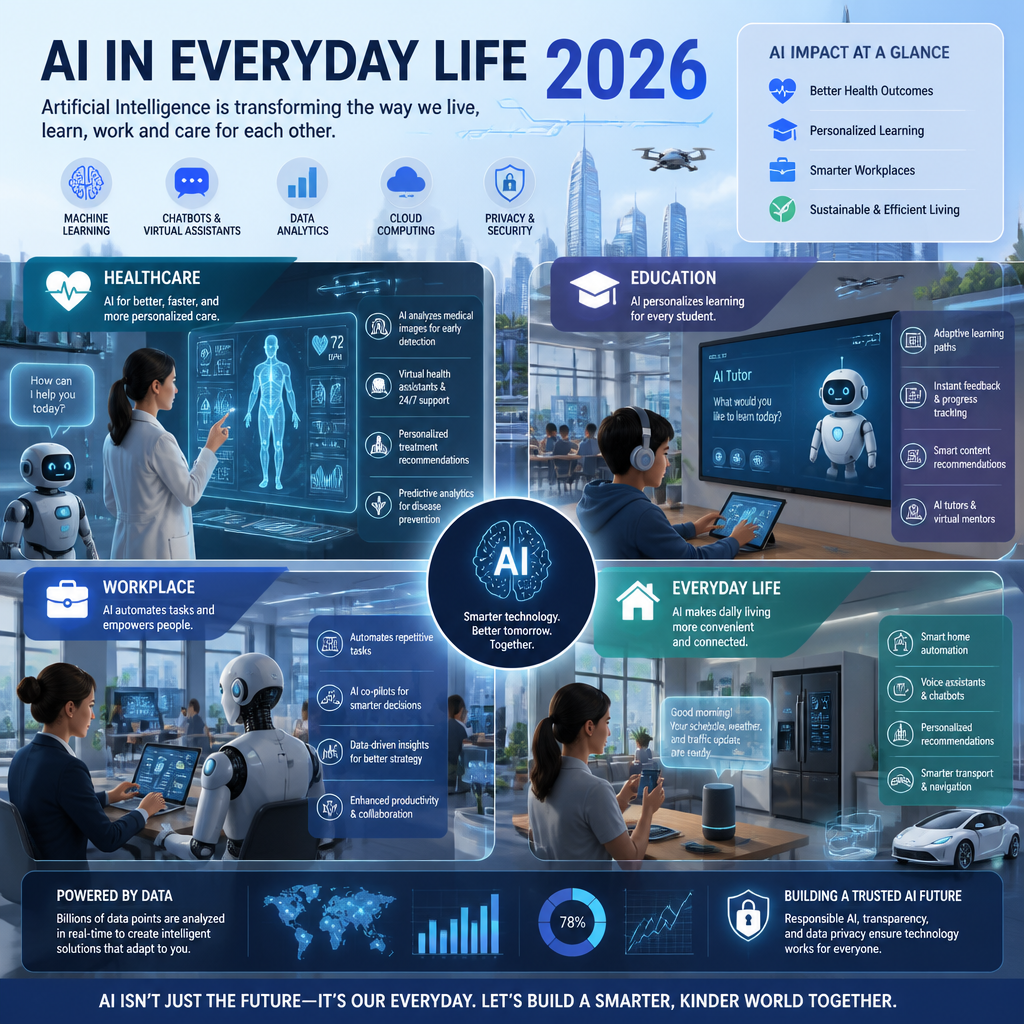
As we approach 2026, it’s crucial to understand the profound impact artificial intelligence (AI) will have on various aspects of our lives. The change won’t come as one big reveal; instead, it’ll come as a steady drip of features that quietly remove friction.
In terms of workplace productivity, 44% of U.S. adults believe AI tools increase their productivity (Ipsos). That number matches what I see in the real world: when a team finds a safe, repeatable AI workflow, the “busy work” shrinks fast.
How AI Works
At its core, AI mimics human intelligence through algorithms that enable machines to perform tasks that typically require human thinking. This includes learning from experiences (machine learning), understanding natural language, and recognizing patterns (National University). But the part people miss is where the value actually comes from: AI doesn’t “think” like a person—it predicts what’s likely next, based on a lot of examples.
So, picture your inbox. In 2026, an AI layer won’t just draft replies; it’ll read the thread, notice you’re being asked for a decision, pull the relevant doc link, and propose a short answer in your tone. Meanwhile, it’ll flag two risks: “This customer is asking for a discount you can’t approve,” and “This date conflicts with your existing timeline.” That sounds fancy, but it’s basically pattern recognition plus a clean interface.
The messy part is reliability. AI works great in the “center” of what it has seen—common tasks, typical phrasing, mainstream situations. But it can get weird on edge cases: unusual legal wording, niche medical history, or your company’s internal acronyms. Because of that, the winning products in 2026 will be the ones that treat AI like a co-pilot with guardrails, not an all-knowing autopilot.
Another under-discussed piece is latency and cost. If an AI feature takes 12 seconds to respond, people stop using it. If it’s instant, it becomes muscle memory. By 2026, a lot of AI will run in smaller, faster models (sometimes on-device) for speed and privacy, while heavy-duty requests will still go to the cloud.
AI as a Helpful Tool
The helpfulness of AI cannot be overstated—if you aim it at the right problems. It’s already making significant strides in sectors like healthcare, where AI-assisted diagnostics are improving patient outcomes. Even outside hospitals, AI is creeping into the “boring” parts: appointment scheduling, symptom checkers that ask better follow-ups, and clinical note drafting.
A stat that lines up with what teams report: 62% of workers across various countries have reported that AI has saved them time at work (Ipsos). The key phrase there is “saved them time,” not “replaced them.” In practice, the biggest wins come from compressing tiny tasks—rewriting a paragraph, summarizing a call, turning bullet points into a slide, extracting action items from a meeting transcript.
Here’s a real-feeling example I’ve seen in multiple orgs. A customer support lead starts using AI to draft first responses. At first, it’s clunky, because the AI doesn’t know policy. Then they feed it the help center and a handful of “gold standard” replies, and suddenly new agents ramp in days instead of weeks. Because of that, escalation volume drops, managers get fewer pings, and customers get answers faster. Nobody’s job disappears overnight, but the workflow changes.
Education will get the same treatment. In 2026, AI-powered tutoring won’t just answer questions; it’ll watch where a student hesitates, then adjust the next explanation. It’ll also give teachers something they rarely get today: a quick map of who’s stuck, on what concept, and since when.
That said, helpful AI also creates new work. Somebody has to verify outputs, handle exceptions, and decide what “good” looks like. If your organization pretends that part is optional, you’ll feel it in mistakes—wrong orders, mixed-up patient notes, or confidently incorrect emails that burn trust.
Making AI Helpful
For AI to be truly helpful, we need to ensure it is designed with users in mind. That sounds obvious, but lots of “AI features” ship because they demo well, not because they reduce real pain.
In professional settings, AI is expected to evolve into collaborative tools that enhance decision-making rather than replace human roles. Practically, that means three things: (1) it has to show its work (where the info came from), (2) it has to be easy to correct, and (3) it must fail gracefully when it doesn’t know.
Organizations can use AI to sift through data rapidly, providing insights that would be painful for humans to gather alone. For example, a sales ops team can ask, “Which deals slipped this quarter because of security review delays?” and get a ranked list, plus common blockers. Then they can actually fix the process instead of guessing.
The adoption curve is already visible: 50% of employed Americans have reported seeing AI tools like ChatGPT in their workplaces (Ipsos). By 2026, the differentiator won’t be “do you have AI?” It’ll be whether your workplace has norms around it.
If you want AI to help instead of harm, I’d start with rules that feel a little boring:
- Decide what data must never go into AI tools (client PII, unreleased financials, patient details). Put it in writing.
- Pick two or three approved tools. Otherwise, you’ll get shadow AI everywhere.
- Require a human owner for every AI-assisted workflow. When something goes sideways—and it will—you need someone accountable.
- Measure outcomes, not hype. Time saved is good, but error rates and rework matter more.
One mistake I’ve watched teams make: they roll out an AI writing tool, then they judge success by “how many people used it.” That’s the wrong metric. Usage goes up even if quality goes down, because it’s novel. The better measurement is: did cycle time drop, did customer satisfaction hold, and did editors spend less time cleaning up?
Understanding Artificial Intelligence
Understanding artificial intelligence involves demystifying what it can and cannot do. Plenty of people swing between extremes—either AI is a looming threat, or it’s a miracle machine. The truth sits in the middle, and it’s much more practical.
In 2026, you’ll get the most out of AI if you treat it like a very fast junior assistant: excellent at first drafts and pattern matching, shaky at judgment, and occasionally overconfident.
What Exactly Is an AI?
Artificial Intelligence refers to systems that can perform tasks that typically require human intelligence. This includes problem-solving, understanding language, and even emotional recognition. But it helps to split “AI” into buckets, because they behave differently.
- Generative AI creates text, images, code, audio. It’s great for drafts, summaries, and transformations (turn this messy note into a clean email).
- Predictive AI scores likelihood (fraud risk, churn risk, demand forecasting). It’s often less flashy, yet it’s where companies quietly make a lot of money.
- Perception AI identifies things in the world (speech-to-text, object detection, medical imaging).
Essentially, AI can look like a human brain on the surface, but it operates through statistical and computational processes rather than biology. That difference matters, because it explains why AI can be eloquent and still wrong.
Also, “emotional recognition” is a loaded claim in the real world. Systems can detect patterns—tone, word choice, facial movement—but that’s not the same as understanding how you feel. If someone sells you AI that “knows” emotions with certainty, be skeptical.
By 2026, a lot of consumer AI will feel personal because it remembers preferences: how you write, what you buy, what you watch, when you commute. That kind of personalization can be genuinely useful. It can also feel creepy, especially when the data trail isn’t obvious.
Human Intelligence vs. AI
While AI is designed to simulate human thought processes, it is fundamentally different from human intelligence. Humans carry context that never appears in the dataset: social nuance, lived experience, ethics, and responsibility.
Humans possess emotional reasoning, social understanding, and ethical considerations that AI cannot replicate. This distinction is crucial when discussing the limitations of AI. For instance, while AI can provide recommendations based on data patterns, it cannot engage in moral reasoning or empathy (National University).
Here’s where this lands in daily life.
If an AI assistant helps a manager write performance feedback, it might produce something “professional-sounding” that’s emotionally tone-deaf. A person has to notice that, soften it, and decide what the employee actually needs to hear. Similarly, if AI suggests a healthcare next step (“follow up in two weeks”), a clinician has to weigh the human reality: the patient’s support system, anxiety, and ability to get back to the clinic.
In 2026, you’ll also see more AI “agents” that can take actions—book travel, file tickets, reorder supplies. That’s powerful, but it increases the blast radius of mistakes. A chatbot hallucinating a sentence is annoying. An agent sending the wrong email to the wrong client is an incident.
So, the practical stance I take is this: let AI generate, propose, and summarize. Keep humans on the hook for decisions, approvals, and anything that touches money, health, or legal exposure.
Performing Tasks with AI
The tasks AI performs can range from simple operations, like scheduling appointments, to complex processes like fraud detection in banking. The key takeaway isn’t just that AI can perform these tasks—it’s how it changes the cost and speed of doing them.
AI systems analyze massive amounts of data at speeds faster than any human could. For example, businesses utilizing AI for marketing analysis can personalize advertisements to cater specifically to individual consumers, boosting conversion rates and customer satisfaction (Kanerika). But personalization has tradeoffs: it can narrow what you see, reinforce habits, and make it harder to “browse” outside your usual bubble.
By 2026, I expect the biggest task-level shifts to show up in five places:
- Writing and rewriting everywhere. Not just marketing—HR policies, internal docs, procurement emails, project updates. People who can clearly instruct an AI (“shorter, friendlier, keep the key details, don’t promise timelines”) will look like better communicators.
- Meetings get compressed. AI will auto-generate agendas, capture decisions, and assign tasks. The win isn’t the transcript; it’s fewer follow-up meetings because the next steps are actually written down.
- Customer support triage. AI will route tickets, detect urgency, and propose replies based on policy. Good teams will keep a human QA loop and track when AI suggestions get edited—those edits become training data.
- Front-line data cleanup. The unglamorous stuff: matching duplicate records, fixing address formats, tagging documents, extracting fields from PDFs. This is where time disappears today, so it’s where AI can give it back.
- Personal life logistics. Meal planning with your dietary constraints, shopping lists that adapt to your budget, travel planning that accounts for layovers you hate. Helpful when it works; frustrating when it doesn’t.
One more mini story, because it’s the kind of thing that’s about to be normal. A friend of mine runs a small professional services firm. They used to spend Sunday nights assembling weekly client updates—status, blockers, next steps. After adding an AI step that summarizes work logs and drafts the email, the owner now spends 20 minutes editing instead of two hours writing. Because of that, they do the update every week, not “when things are on fire.” The client experience improves, and the team gets fewer random check-in calls.
None of this removes the need for human taste. If you don’t know what a good client update looks like, AI won’t save you. It’ll just produce a longer bad update.
In conclusion, as we move toward 2026, AI will play an increasingly critical role in our lives. It will help us be more productive, enhance decision-making, and lead to new opportunities across various sectors.
Still, the expectation shouldn’t be that AI makes everything better by default. The teams and individuals who win will be the ones who set boundaries, learn how to prompt and review, and keep humans responsible for the high-stakes calls. If you want a next step: pick one repetitive task you do weekly, run it through an AI assistant for two weeks, and track time saved and mistakes—then decide if it deserves a permanent place in your workflow.
Leave a Reply