Learn the essentials of blockchain gaming development for 2026. Understand how to build engaging blockchain games and navigate the evolving landscape.
How to Start Developing Blockchain Games in 2026
What is Blockchain Game Development?
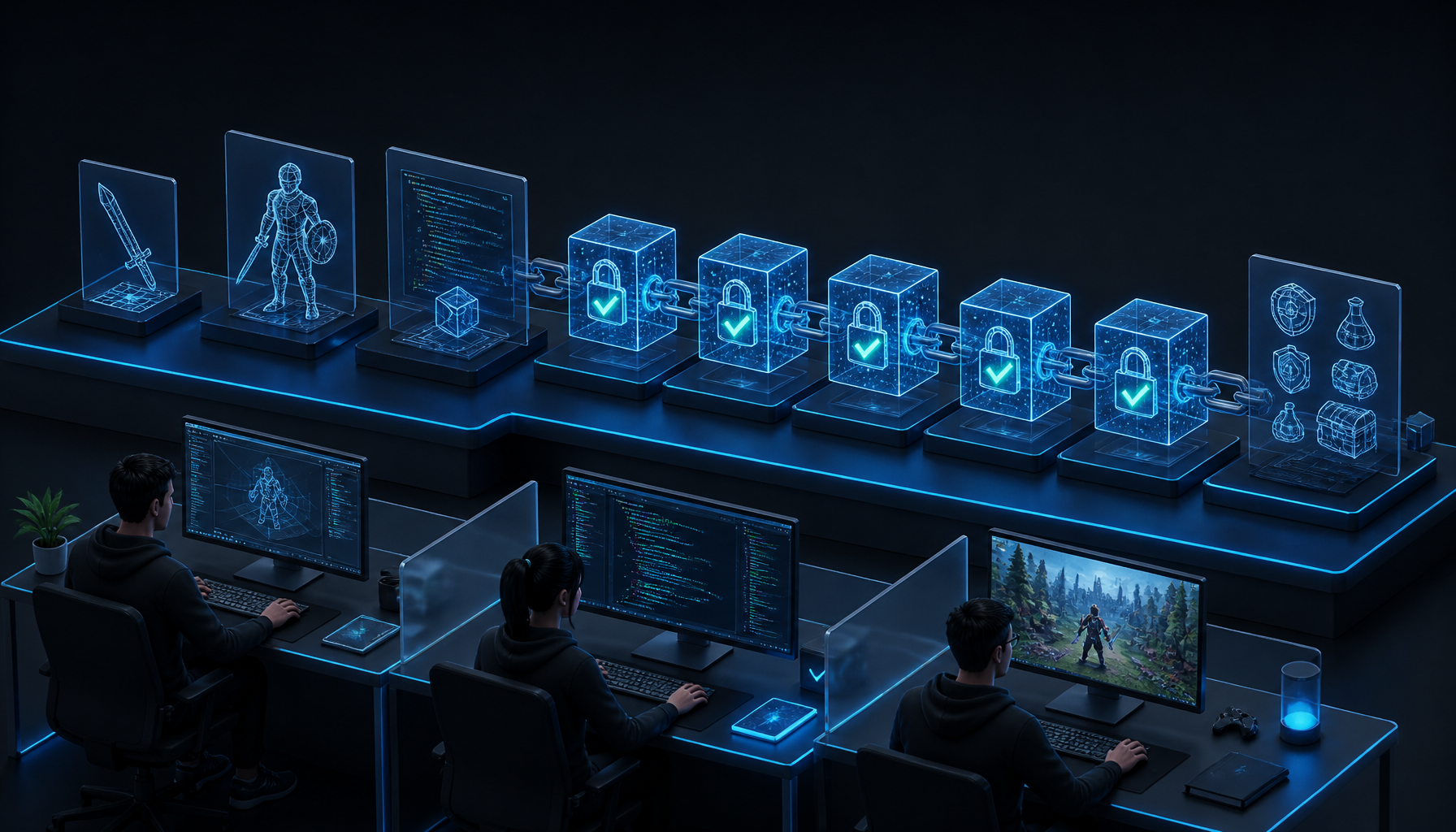
Blockchain game development is building a game where some part of the game state (usually assets, trades, crafting results, tournament payouts, or governance) lives on a blockchain. That on-chain layer lets players actually own items as tokens, verify scarcity, and trade peer-to-peer without you acting as the middleman for every transaction.
The important nuance: not everything belongs on-chain. Moment-to-moment gameplay (movement, combat, physics, matchmaking) stays off-chain because latency and fees will wreck the feel. Instead, you put the “high-trust” moments on-chain—minting a sword, upgrading it, selling it, staking it for an event pass, splitting rewards after a raid.
By 2026, the blockchain gaming market is projected to be worth USD 22.30 billion, reaching USD 398.06 billion by 2033 with a CAGR of 52.0% (Coherent Market Insights). That growth attracts builders, but it also attracts speculators, so your job is to make the game enjoyable even when the market’s boring.
Here’s the “sanity test” I use: if you removed the tokens, would anyone still play for 30 minutes? If the answer is no, you’re building a financial product with a joystick.
Steps to Develop Your Blockchain Game
- Choose the Right Blockchain Platform
Pick the chain based on user experience constraints, not vibes. Fees, finality time, wallet support, and ecosystem tooling will shape your entire game.
Here’s how I’d evaluate Ethereum vs. Polygon vs. BSC in real life:
– If you expect lots of small transactions (crafting, trading, rerolls), you’ll care about predictable fees and fast confirmations.
– If your players are mainstream, you’ll care about how painful wallets and onboarding feel.
– If you want “credible” asset value, you’ll care about liquidity and marketplace support.
Also, decide early whether you’re using L1 directly, an L2, or some hybrid. Changing later is a migration project, not a toggle.
- Define Your Game Concept
Start with the loop, then justify the chain. A few mechanics that actually benefit from blockchain: - Player-made items with provable creators and royalties
- Limited drops where scarcity is verifiable
- Tournament escrow where payouts happen automatically
- Cross-game items (rare, but real if you control multiple titles)
A practical approach: write a one-page “design + economy brief.” Include (a) what’s fun minute-to-minute, (b) what’s tokenized, (c) why the tokenization can’t be done better with a database.
- Build an Engaging User Experience
Wallet prompts are the fastest way to lose normal players, so reduce friction aggressively.
What I’d do in 2026:
– Let players start as a guest, then “claim” ownership later.
– Batch transactions where possible (one signature for a bundle of actions).
– Make failure states human (no “execution reverted” messages—ever).
Community features matter too, but don’t overbuild. A simple guild system with shared goals beats a complicated DAO no one votes in.
- Develop Smart Contracts
Smart contracts aren’t your “feature.” They’re your rules engine for assets and value transfer.
I’d design contracts around these questions:
– What can players mint?
– Who can burn or upgrade items?
– How do you prevent dupes and replay attacks?
– What happens if you need to pause trading during an exploit?
Use battle-tested standards when you can, then customize carefully. If you hire a contractor, insist on tests and a threat model write-up, even if it’s lightweight.
- Test Your Game
Test like you expect people to try to break it—because they will.
A test plan that’s saved teams I’ve worked with:
– Unit test contract math (especially mint limits, fees, royalties).
– Simulate high-volume trading (bots flipping items, not friendly players).
– Run a closed alpha with a wipe, then an open beta with small-value assets.
And yes, test the “boring” stuff: chain congestion, RPC outages, wallet timeouts, and what happens when a transaction sits pending for 3 minutes.
- Launch Your Game
Don’t launch with a giant token sale just because you can. Launch with a fun playable and a clear economy that doesn’t require infinite new players.
Marketing that actually works for early blockchain games tends to be:
– A tight gameplay trailer (not a tokenomics spreadsheet)
– A creator-friendly test environment (streamers love “drops” they can show)
– A real community manager who can handle support and scams
- Monitor and Update
Post-launch, treat your economy like a live service. Track: - Item velocity (how often assets trade)
- Concentration (are whales controlling the market)
- Drop rates vs. churn
Then patch fast. If crafting is printing value, fix it this week, not “next season.”
Common Pitfalls to Avoid in Blockchain Game Development
-
Ignoring User Experience: If your first-time user flow requires three apps, two signatures, and a gas token they’ve never heard of, you’re done. So, design onboarding like you’d design a mobile game tutorial—tight, visual, forgiving.
-
Putting too much on-chain: On-chain combat sounds cool until every action costs money or lags. Store gameplay state off-chain, then commit outcomes on-chain (loot, rankings, ownership changes). That split is how most shippable games survive.
-
Unsustainable Tokenomics: If rewards come mainly from new money entering the system, you built a treadmill. Build sinks (repair costs, crafting inputs, limited events), cap emissions, and avoid “daily APR” bait. Players notice when the math feels like a spreadsheet hustle.
-
Overlooking Regulations: Token sales, gambling-like mechanics, and “guaranteed returns” language can drag you into legal trouble fast. Talk to counsel early if you’re touching real-money value, and don’t market your in-game token like a security.
-
No incident plan: Someone will find an exploit. If you don’t have pause switches, a rollback strategy for off-chain state, and a comms playbook, you’ll lose trust in a weekend.
Understanding Blockchain Gaming Development
If you want to build blockchain games that last, you need to understand the ecosystem you’re shipping into—not just chains, but marketplaces, wallets, studios, and player expectations.
Key Players in Blockchain Game Development
Big studios dipping into blockchain matters because it normalizes the tech, even when their first experiments are clunky.
Notable names and what they signal:
– Ubisoft: Actively exploring blockchain technology for integrating NFTs into their game offerings. Their experiments have pushed the conversation around ownership vs. “cosmetics with receipts.”
– EA: Examining the potential of blockchain to enhance game monetization strategies. That usually means they’re watching how secondary markets change lifetime value.
– Epic Games: Working on integrating blockchain technology into their platform, providing developers with tools to build decentralized games. (source)
– Other blockchain gaming development companies to consider include Antier and RevInfotech.
My take: treat these companies as “signal,” not “validation.” Just because a giant studio tried NFTs doesn’t mean your indie project should copy their approach. Their constraints (brand risk, giant audiences, PR blowback) are different.
Current Trends in Blockchain Gaming
The trendline is moving away from “play-to-earn as a job” and toward “play-and-own” where ownership is a perk, not the whole pitch.
- Player Ownership of Assets: Players want items they can keep, trade, or show off without begging support tickets. NFTs make that legible.
- Decentralized Economies: More games are letting players run markets, set prices, and profit from their time, but that also invites bots and cartel behavior.
- Play-to-Earn Models: Although interest in play-to-earn models has waned since the cryptocurrency boom, refined approaches are emerging that focus on sustainable player engagement and satisfaction. According to a report, more than 90% of Web3 games failed due to poor engagement and unsustainable models (CoinDesk).
A real example I’ve seen (and it’s common): a team launches a “daily quest” that prints tokens. The first month looks amazing—Discord grows, floor prices rise, everyone feels smart. Then players optimize. Bots farm the quests 24/7, inflation spikes, real players feel behind, and the only way to keep payouts attractive is to bring in more buyers. That’s the failure pattern behind a lot of that “90% failed” number.
So here’s a step-by-step way to align with the better trend:
1. Make the core loop fun off-chain (prototype it in Unity/Godot/Unreal first).
2. Pick one on-chain promise (ownership of cosmetics, or crafting provenance, not everything).
3. Design sinks before rewards (repair, merging, entry fees, limited-time forging).
4. Assume adversaries (bots, multi-accounting, wash trading) and build basic detection.
Common mistakes I’d avoid:
– Launching with a token before you have retention data.
– Pricing mints in volatile tokens without guardrails.
– Treating “open economy” as hands-off—economies need moderation.
Conclusion
If you’re starting blockchain gaming development in 2026, the win condition is simple: ship a game people would play even if the tokens were paused for a month. Everything else—NFT drops, marketplaces, secondary royalties—sits on top of that.
Here’s the “last-mile” checklist I use before telling a team to go public:
1. Onboarding works without crypto knowledge (guest mode, clear prompts, no jargon).
2. Contracts are test-covered and you’ve done at least one external review or a serious internal audit pass.
3. Economy has sinks that scale with activity (if players trade more, they also pay more in some form).
4. Exploit response is ready (pause functions, support channels, clear comms templates).
5. Your roadmap isn’t hostage to token price—because it will swing.
One quick persona anecdote: a small studio I advised built a genuinely fun arena battler, then bolted on NFTs for “weapons.” Their first implementation made every loadout change require a transaction. Players hated it—too slow, too many prompts. We moved loadouts off-chain, kept ownership on-chain, and only wrote to the chain when a player sold, upgraded, or fused a weapon. Same “ownership” pitch, dramatically better gameplay feel.
That’s the pattern I’d copy: keep the chain for trust and trade, keep the game for fun.
FAQs
- What is blockchain game development?
Blockchain game development involves creating games that utilize blockchain technology for ownership and transparency. - Why did NFT games fail?
Several NFT games failed due to market saturation, lack of genuine engagement, and regulatory challenges. - Does blockchain gaming have a future?
Yes, there is significant growth potential in blockchain gaming, particularly with evolving technologies. - Who are the big 3 game developers involved in blockchain?
Major developers include Ubisoft, EA, and Epic Games, all exploring blockchain integration.
Leave a Reply